Saturday, September 12, 2026
Home Blog

Sequin Dress Styles for Every Special Occasion

0

Think sequin dresses are only for New Year’s Eve? Think again.
From birthday bashes and rooftop dates to black-tie galas and spring weddings, sequins can work everywhere, if you pick the right cut, length, and color.
This post breaks down must-have sequin dress styles like mini, midi, maxi, bodycon, and long-sleeve, and shows how to shop, style, and layer them so you shine without scratching, shedding, or feeling overdone.
Read on to find the perfect sparkly look for every special occasion.

Shop Sequin Dresses: Top Picks for Every Occasion
wTuJLNarVYiN902Sb7vlsw

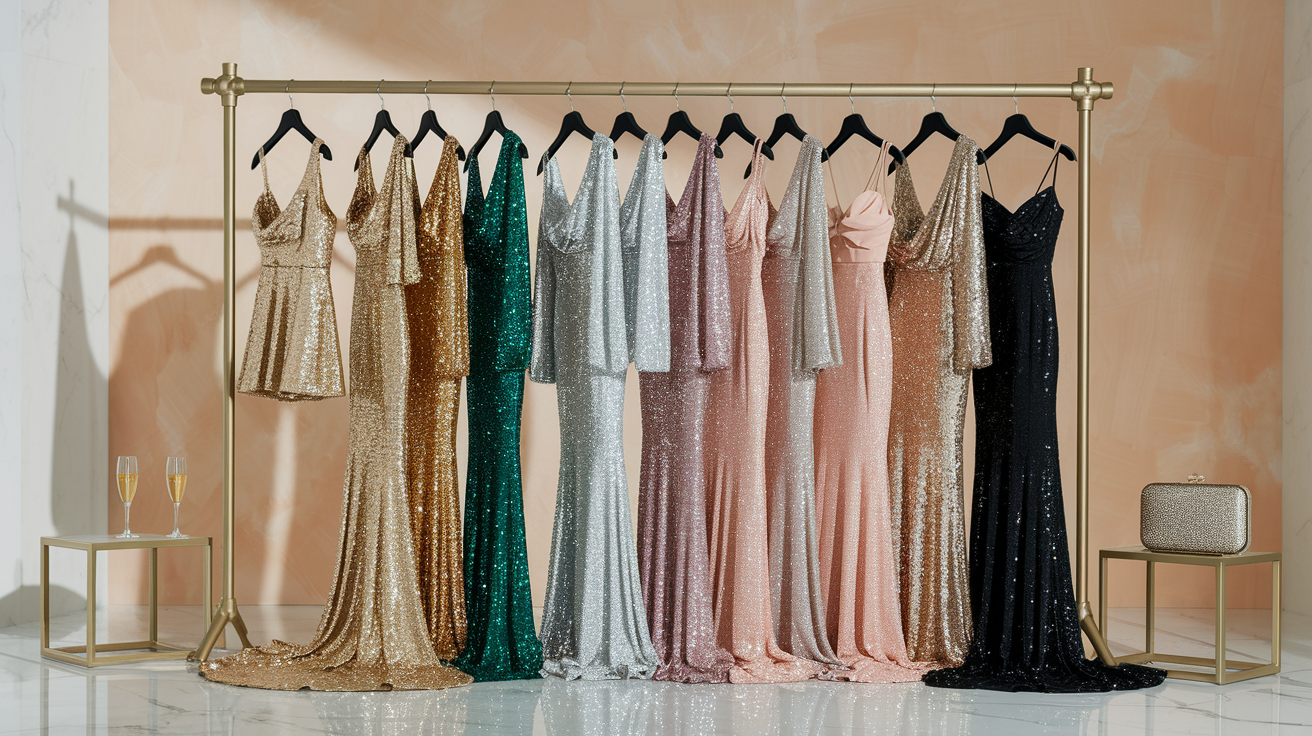
Sequin dresses deliver instant drama for birthday parties, wedding receptions, end-of-year galas, and date nights where showing up matters. You want something that catches light without scratching your skin or shedding sparkle all over the bar. The best ones balance shine with actual wearability, so you can sit through dinner, dance past midnight, and not worry about loose sequins floating into your champagne.

Shopping online now means filtering by price, size, length, and occasion, which gets you from “I need a dress” to checkout in under five minutes. Most people start with silhouette and length, then narrow by color, neckline, and sleeves. A bodycon sequin dress hugs everything and works for clubs or cocktail hour. An A-line cut is more forgiving for dinner parties or family events where you’d rather not feel like a sausage casing. Gold and silver dominate New Year’s Eve. Blush pink, emerald, and champagne feel right for spring weddings. One-shoulder and halter styles add shape, and long sleeves bring coverage without killing the drama, perfect for cooler months or venues that aren’t into bare shoulders.

Most category pages group sequin dresses into buckets that mirror how real shoppers think. Someone planning NYE types “sequin mini dress.” A winter wedding guest searches “long sleeve sequin maxi.” Here are the eight most common categories you’ll find:

  • Mini sequin dresses for parties, clubbing, and thigh-skimming birthday looks
  • Midi sequin dresses hitting knee to mid-calf for cocktail events and office parties
  • Maxi sequin dresses sweeping the floor for galas, black-tie weddings, and red-carpet nights
  • Bodycon sequin dresses in stretch fabrics that hug curves
  • Long-sleeve sequin dresses for fall, winter, or modest dress codes
  • Backless and cut-out sequin dresses with strategic skin-baring details
  • Plus-size sequin dresses from 14 to 26, often with stretch lining and thoughtful seaming
  • Strapless and halter sequin dresses that highlight shoulders and show off jewelry

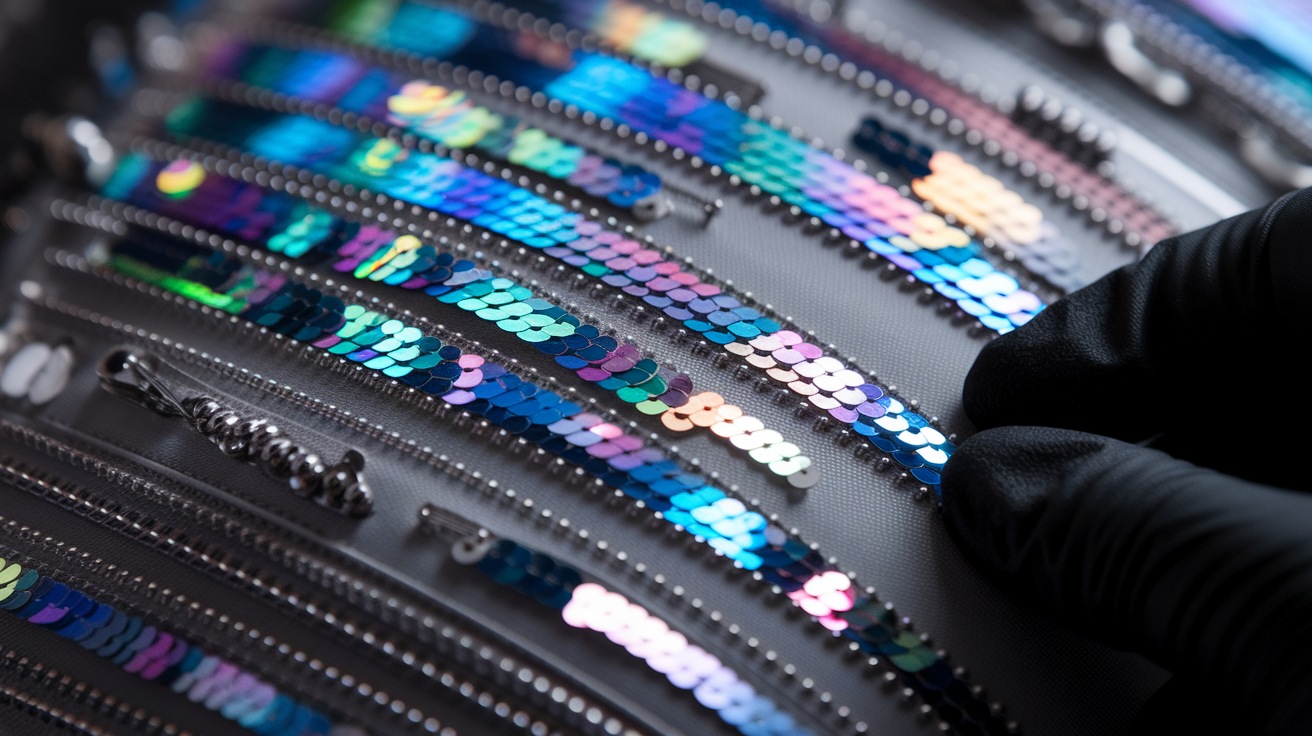
Clear filters, visible stock counts, and zoom-in views on sequin texture close the gap between scrolling and buying.


Find Your Fit: Length, Color, and Silhouette Filters
GXD1VanWV3CpvCo_wwGQ3w

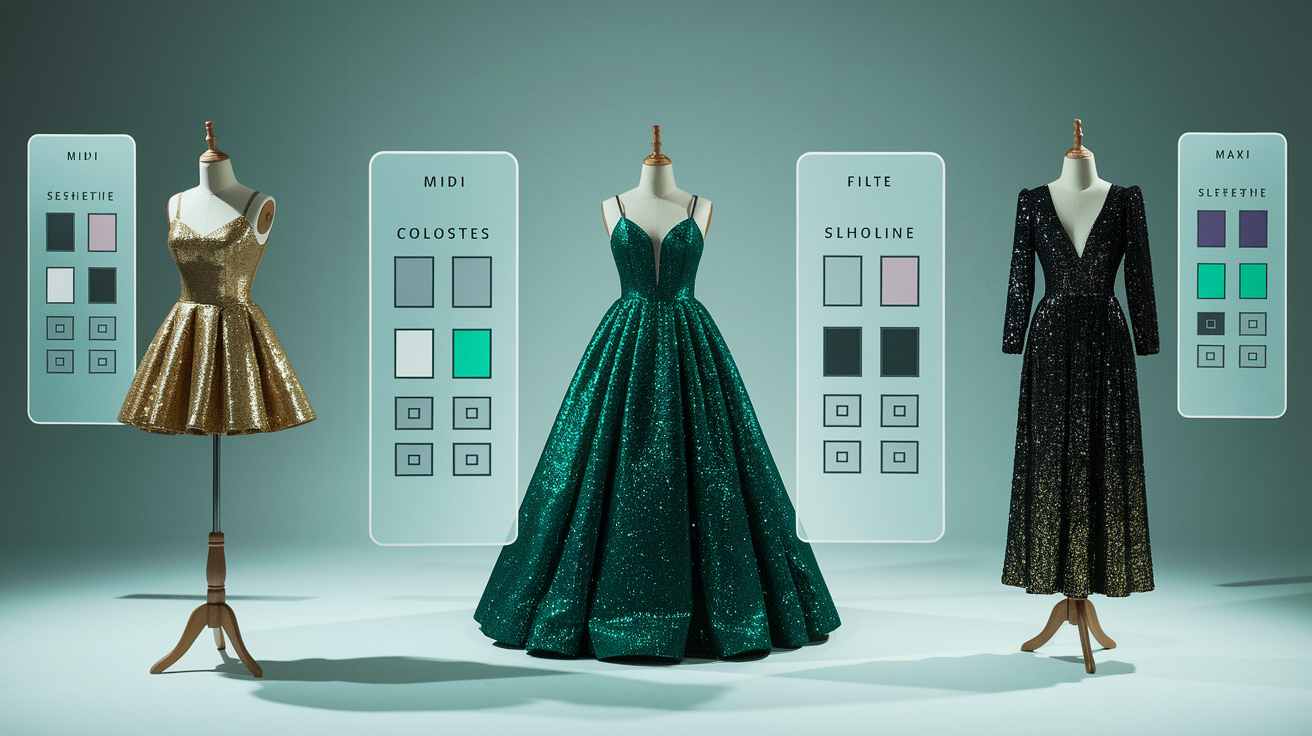
Length dictates formality and comfort, so most shoppers filter by hemline first. A sequin mini dress reads young, fun, party-ready. Good for dancing until 2 a.m. or making an entrance at a rooftop bar. Midi lengths sit between playful and polished, working for daytime weddings, cocktail receptions, and work holiday parties where you want coverage but still want to shine. Maxi sequin dresses bring full glamour. Black-tie galas, military balls, formal award ceremonies.

Silhouette comes next. Bodycon styles show off shape and pair well with high heels and statement earrings. A-line cuts balance sparkle with a universally flattering fit that skims hips and thighs without clinging.

Color changes everything. Gold sequins feel warm, celebratory, holiday-forward. Silver reads sleek and modern. Rose gold and blush suit romantic events like engagement parties and bridal showers. Black sequin dresses offer edge and versatility, working for both not-quite-funerals and New Year’s Eve countdowns. Retailers also filter by neckline (plunge, halter, strapless, high neck) and sleeve style (sleeveless, cap, three-quarter, long), which helps you match a dress to weather, venue dress code, and personal comfort.

Filter Best For
Length (mini, midi, maxi) Adjusting formality level and comfort; minis for parties, maxis for galas, midis for versatile day-to-evening wear
Silhouette (bodycon, A-line, fit-and-flare) Matching your shape and movement needs; bodycon for fitted drama, A-line for forgiving comfort
Color (gold, silver, black, blush, emerald) Coordinating with event theme and season; metallics for holidays, pastels for spring, jewel tones for fall
Neckline (plunge, halter, strapless, high neck) Balancing skin coverage and style; plunge for confident nights, high neck for modest elegance
Sleeve style (sleeveless, long, cap, off-shoulder) Adapting to temperature and venue; long sleeves for winter or conservative settings, sleeveless for heat and dancing

Smart shoppers layer two or three filters at once. Selecting “midi + long sleeve + emerald” narrows a 200-dress category page down to eight strong contenders in seconds. Retailers that show stock counts per filter (like “Gold (12 dresses)”) give you confidence that options exist before you click. The best category pages let you clear all filters with one tap if you want to start over.


Styling a Sequin Dress: Accessories, Shoes, and Layering
dzkHC2FGVCi5OCH3RKt6dQ

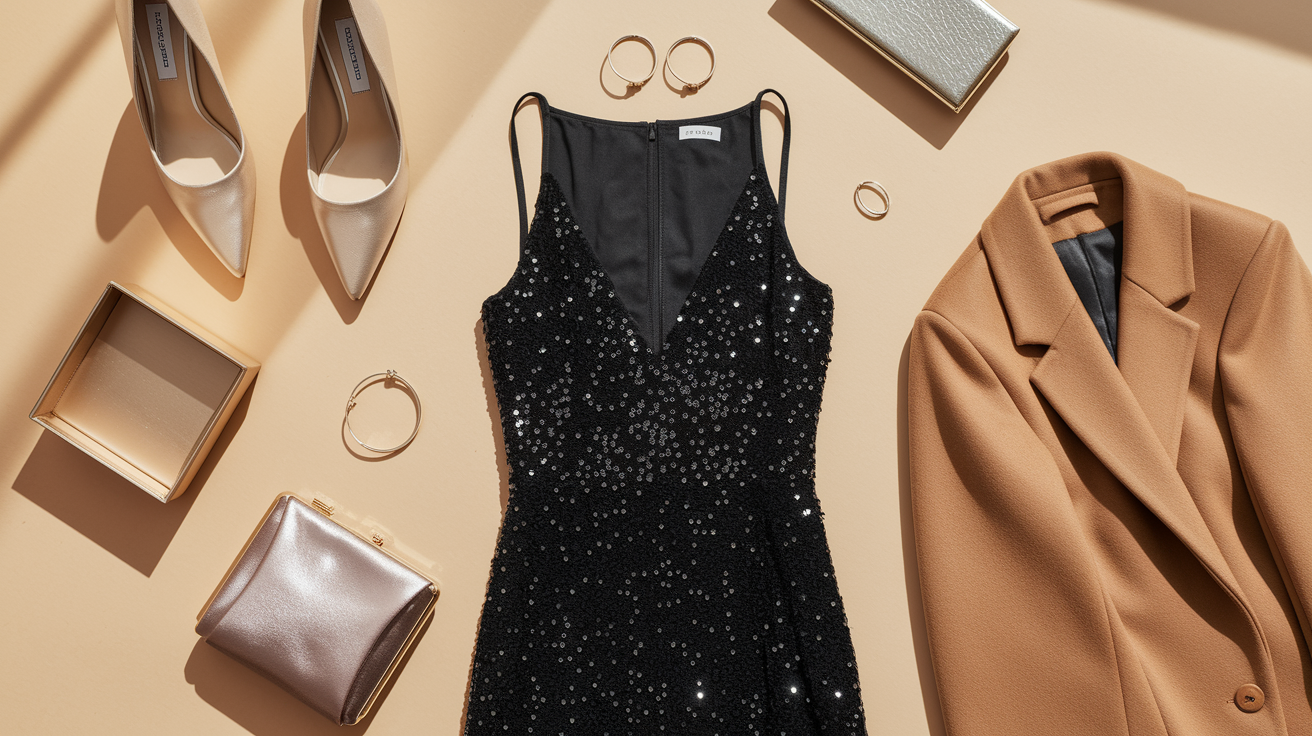
Sequin dresses do the heavy lifting, so your accessories should step back. Neutral heels in nude, black, or metallics that echo the dress color keep the focus where it belongs. Strappy sandals work for warm-weather events. Pointed-toe pumps add polish for cocktail settings. Closed-toe block heels offer stability for all-night dancing. Avoid overly embellished shoes. When your dress is covered in shimmer, your feet don’t need rhinestones too.

Jewelry should be minimal and intentional. If your sequin dress has a high neckline or intricate beading at the bodice, skip the necklace entirely and go for statement earrings. Sleek hoops, geometric studs, or a single drop earring in gold or silver. If the neckline plunges or the dress is strapless, a delicate pendant or thin chain adds a hint of shine without competing. Rings and bracelets can stay understated. One cocktail ring or a slim bangle is enough. Your dress is already the loudest thing in the room.

Layering helps you tone down sequins for daytime or semi-formal settings where full sparkle feels like too much. An oversized blazer in black, camel, or navy transforms a sequin mini into office-party appropriate. A long wool coat or trench softens a sequin midi for brunch or a daytime wedding. Denim jackets work for festival or casual birthday looks, and cropped leather jackets add edge to bodycon sequin styles. Even a chunky knit cardigan can work if the dress silhouette is sleek and the cardigan stays open. Outerwear lets you wear the same sequin dress to three different events with three totally different vibes.

Here are five rules for sequin dresses:

  1. Keep shoes simple. Neutral tones and clean lines prevent style overload and let the dress take center stage.
  2. Go light on jewelry. One statement piece (earrings or a ring) is enough. Skip the necklace if the neckline is busy.
  3. Choose a structured bag. A small box clutch or sleek crossbody in leather or satin balances the texture of sequins.
  4. Layer with intention. Blazers, coats, and jackets can dress sequins down for day or add warmth without hiding the shine.
  5. Mix textures. Pairing shiny sequins with matte accessories (suede shoes, a velvet bag, a wool coat) adds depth and keeps the outfit from feeling one-note.

Best Sequin Dresses for Special Occasions
11FYFZg-VbCVggdS2313wA

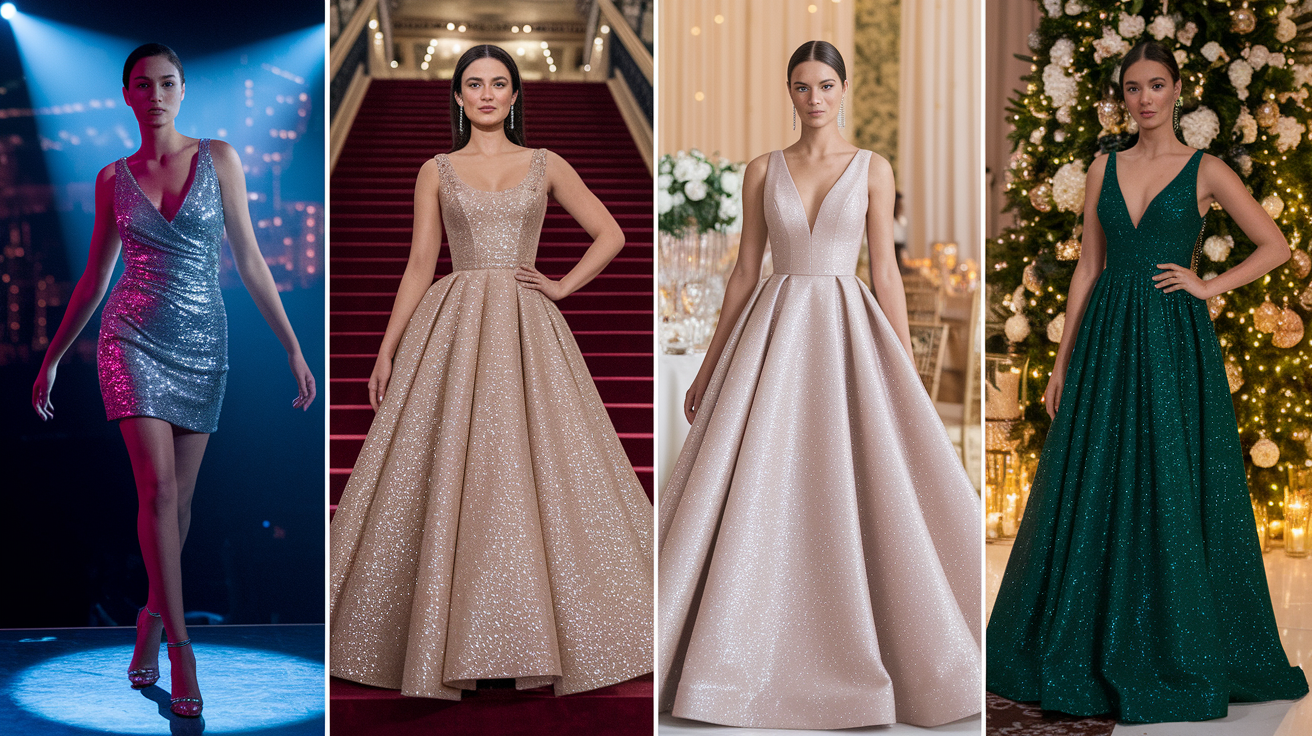
Sequin dresses aren’t one-size-fits-all. The right pick depends entirely on where you’re wearing it. A New Year’s Eve look demands different sparkle than a spring wedding guest dress, and what works for a rooftop cocktail party won’t fly at a black-tie gala.

Parties & Night Out

For birthday dinners, club nights, bachelorette parties, and any event that ends after midnight, reach for a sequin mini dress or a fitted midi with high shine. Gold, silver, hot pink, and all-over glitter finishes work here. This is the time to go loud. Bodycon silhouettes in stretch sequin fabrics let you move on the dance floor, and strapless or spaghetti-strap styles pair perfectly with statement earrings and strappy heels. Look for dresses with full lining so sequins don’t scratch, and bring a small crossbody bag you can dance with hands-free.

Formal Events & Galas

Black-tie weddings, charity galas, award dinners, and military balls call for sequin maxi dresses in elegant cuts. Floor-length gowns with long sleeves, high necklines, or sculptural one-shoulder designs. Stick to classic metallics like champagne, rose gold, navy with silver sequins, or black with tonal beading. A-line and fit-and-flare silhouettes offer movement and photograph beautifully. Fully beaded bodices with flowing skirts balance structure and grace. Pair with closed-toe pumps, a structured clutch, and delicate jewelry. This is not the moment for bold accessories.

Weddings & Receptions

As a wedding guest, your sequin dress should feel celebratory but not louder than the bride. Sequin midi dresses in soft colors work well. Blush, lavender, sage green, or champagne. Avoid all-white or cream sequins unless the bride explicitly says it’s okay, and skip anything too short or too tight for a religious venue. Long-sleeve sequin dresses work for fall and winter weddings, and dresses with subtle sequin accents (a beaded waistband, sequin sleeves with a chiffon skirt) offer sparkle without going full disco ball.

Holiday Celebrations

Christmas parties, New Year’s Eve countdowns, and Hanukkah dinners are peak sequin season. Go all-in with red sequin dresses, emerald green bodycon styles, or head-to-toe gold and silver glitter. Mini and midi lengths dominate here, and you’ll see plenty of cut-out details, backless designs, and plunging necklines. Velvet accessories, metallic heels, and bold red lipstick complete the look. Don’t shy away from sparkle. Holiday events are the one time of year when “too much” doesn’t exist.

Retailers that tag products with event types (party, formal, wedding guest, holiday) make it easy to filter straight to what you need.


Customer Favorites: Reviews and Fit Notes
4LfA9RjZVquhaupp7YTfoQ

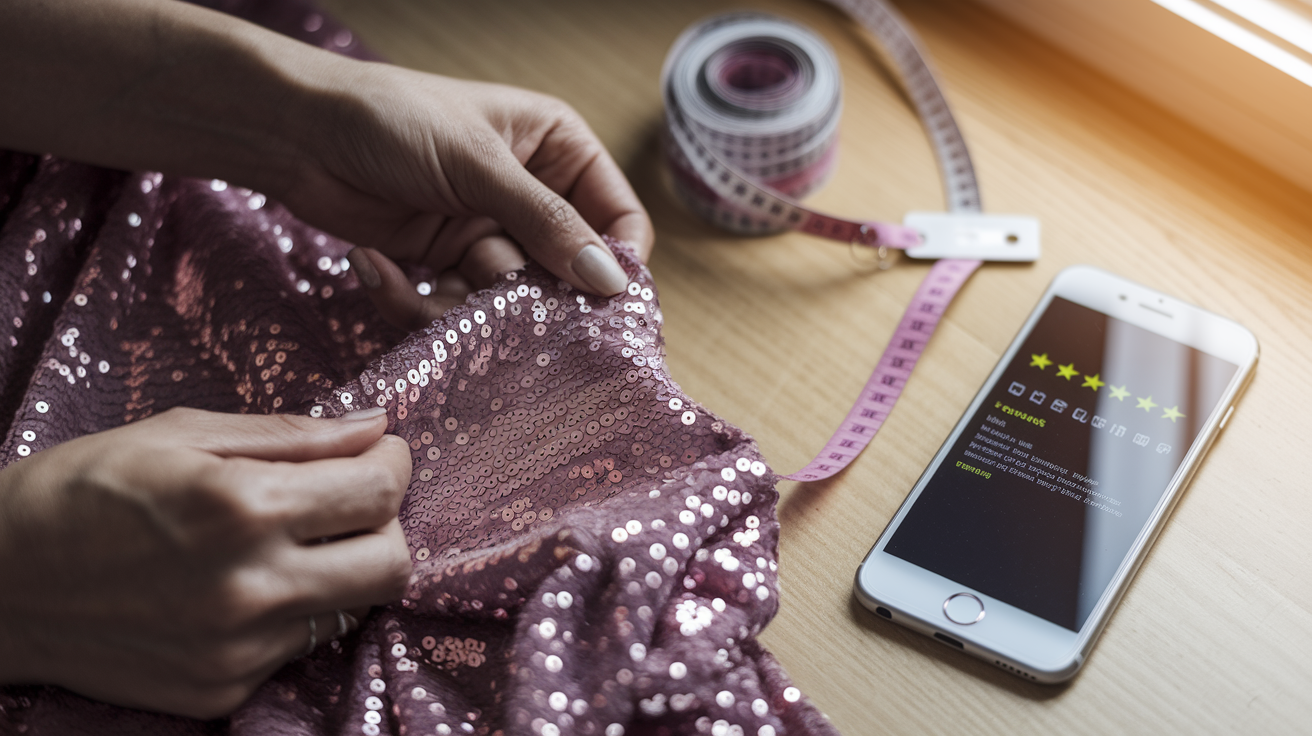
Customer reviews reveal what product photos can’t. How sequin dresses actually fit, move, and hold up after a night of wear. Shoppers consistently praise dresses with four-way stretch lining, which prevents scratching and allows you to sit, dance, and eat without feeling constricted. High ratings also go to styles with secure stitching around sequins, so you’re not leaving a trail of sparkle on the dance floor.

Common complaints center on sizing inconsistencies, especially in bodycon styles where even half a size off can make or break the fit. Shoppers recommend ordering your true size or sizing up if you’re between sizes, particularly in unlined or non-stretch designs. Another frequent note is sequin shedding. Budget-friendly dresses sometimes lose sequins after one wear or a single dry-clean cycle, while higher-quality options use reinforced stitching or heat-sealed sequins that stay put. Reviewers also flag dresses that photograph lighter or darker than they appear in person, so reading reviews with uploaded customer photos helps set accurate expectations.

Here are five themes that appear again and again in sequin dress reviews:

  • Fit accuracy. Does the dress run true to size, or do you need to size up or down? Bodycon styles tend to run snug. A-line cuts offer more flexibility.
  • Comfort and lining. Is the interior lined or scratchy? Stretch lining and soft inner fabrics earn top marks.
  • Stretch level. Does the fabric have give, or is it rigid? Four-way stretch is a deal-maker for all-night wear.
  • Shine quality. Are the sequins densely packed and reflective, or sparse and dull? Close-up customer photos reveal the truth.
  • Shedding concerns. Do sequins fall off during wear, washing, or storage? Reinforced stitching and quality control make the difference.

Care and Maintenance for Sequin Dresses
Uk3s9x8KUxONlOjx4un_bg

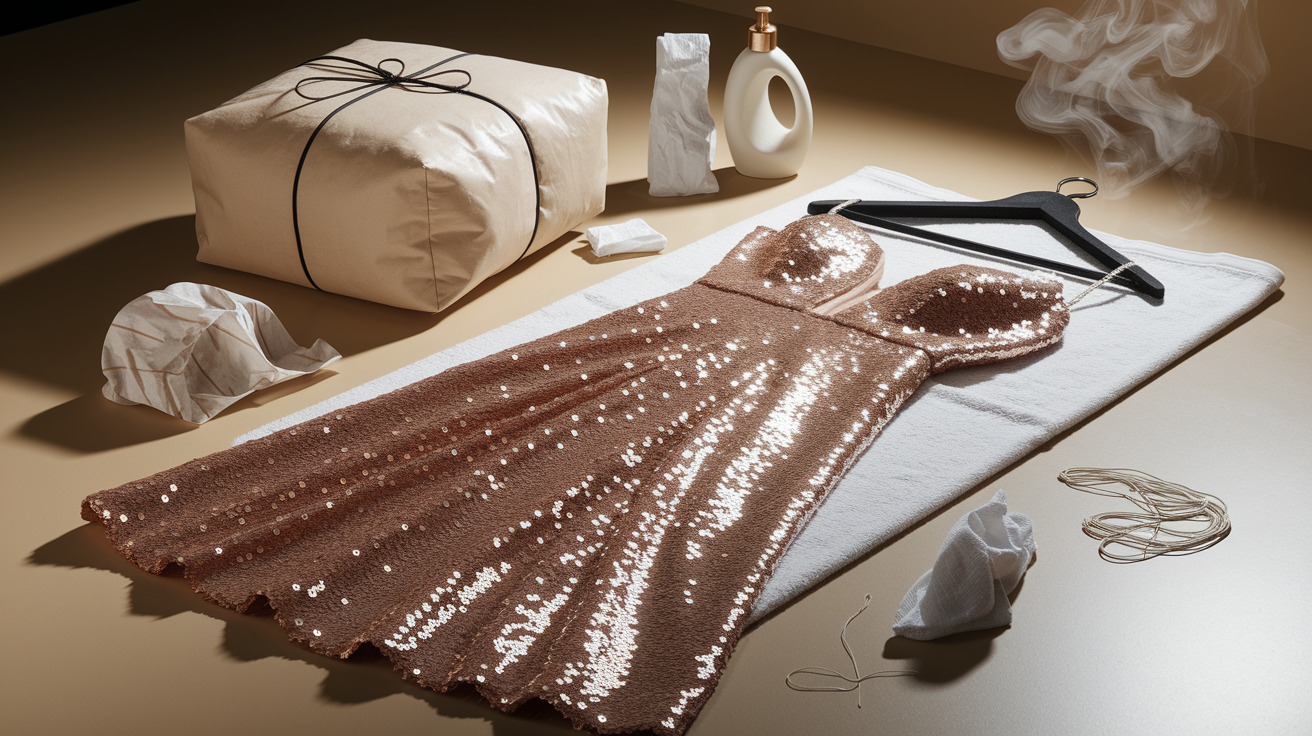
Sequin dresses require more care than cotton tees, but proper handling keeps them looking fresh for years. Most sequin garments should be hand-washed in cold water or dry-cleaned. Machine washing, even on delicate, can loosen sequins, snag threads, and damage the base fabric. If you hand wash, turn the dress inside out, use a gentle detergent, and avoid wringing or twisting the fabric. Submerge, swish gently, rinse with cool water, and lay flat on a towel to air dry. Never hang a wet sequin dress. Water weight can stretch the fabric and pull sequins out of alignment.

Storage matters as much as cleaning. Sequin dresses should be stored flat or on padded hangers in breathable garment bags, away from direct sunlight and humidity. Folding sequin fabric can create permanent creases and bend sequins, so if drawer space is your only option, layer the dress between acid-free tissue paper and avoid stacking heavy items on top. Keep sequin dresses separate from delicate fabrics like silk or chiffon to prevent snagging, and check for loose sequins before each wear. Tightening a thread now prevents a bare patch later.

Follow these six steps to extend the life of your sequin dress:

  1. Spot-clean first. Treat stains immediately with a damp cloth and mild soap. Don’t wait for a full wash cycle.
  2. Turn inside out before washing. Protects sequins from friction and reduces shedding during hand washing.
  3. Air dry flat. Never use a dryer. Heat can melt glue, warp sequins, and shrink lining fabrics.
  4. Store on padded hangers. Prevents shoulder dimples and keeps sequins from bending. Use a breathable garment bag for dust protection.
  5. Avoid direct ironing. If wrinkles appear, steam from the inside or place a pressing cloth between the iron and fabric. Direct heat damages sequins.
  6. Repair loose sequins immediately. Use a needle and thread that matches the base fabric. Secure any wobbly sequins before they fall off completely.

Final Words

Heading to a party and stuck on what to wear? This guide gave a quick shop list of minis, midis, and maxis, showed how to use length and silhouette filters, and walked through shoes, jewelry, reviews, and care.

Simple filters help you find the right fit fast, reviews flag fit and shedding issues, and styling notes keep the shine balanced without overdoing it.

Pick a favorite, follow the care tips, and step out confident in your sequin dress. You’ll sparkle.

FAQ

Q: What lengths do sequin dresses come in and how do I choose?

A: Sequin dresses come in mini, midi, and maxi lengths; pick mini for club nights, midi for semi-formal events, and maxi for formal galas or eveningwear.

Q: Which silhouettes and cuts are most popular for sequin dresses?

A: Popular silhouettes are bodycon for a fitted look, A-line for balanced proportions, one-shoulder, halter, and long-sleeve for extra coverage; choose based on comfort and event formality.

Q: How do I choose a sequin dress color?

A: Choose sequin color based on event and season: metallics like gold and silver for holidays and evening, black for timeless vibes, rose gold or multicolor for playful looks.

Q: How should I style a sequin dress—shoes, accessories, and layering?

A: To style a sequin dress, pair neutral heels, minimal jewelry, and structured outerwear to balance shine. Mix textures, avoid heavy accessories, and keep makeup polished.

Q: Which sequin dress is right for parties, formal events, weddings, and holidays?

A: For parties, choose mini or bodycon; for formal events and galas, opt for maxi or long-sleeve gowns; for weddings pick tasteful midi or A-line in subtle metallics; holidays welcome bold metallics and multicolor.

Q: How do I pick the right size and fit when buying a sequin dress online?

A: To pick size, use measurements and size charts, check stretch and lining notes, read fit reviews, size up if unsure, and look for plus-size lines or supportive seaming for comfort.

Q: What do customer reviews usually say about sequin dresses?

A: Customer reviews often praise sparkle and fit, and flag concerns about sequin shedding, lining comfort, and limited stretch; use reviews to check true-to-size notes and fabric feel.

Q: How do I clean and maintain a sequin dress?

A: Sequin dresses usually need hand washing or dry cleaning; spot clean stains, avoid machine cycles, lay flat to dry, and use gentle detergent for hand wash.

Q: How should I store a sequin dress to prevent damage and shedding?

A: Store sequin dresses flat or on a padded hanger in a garment bag, avoid crushing sequins, keep away from heat and humidity, and cover with breathable fabric to prevent snags.
Sydney Sweeney Dress Moments: Designer Looks & Where to Buy

0

Is Sydney Sweeney staging viral moments or just showing exactly how to own a red carpet?
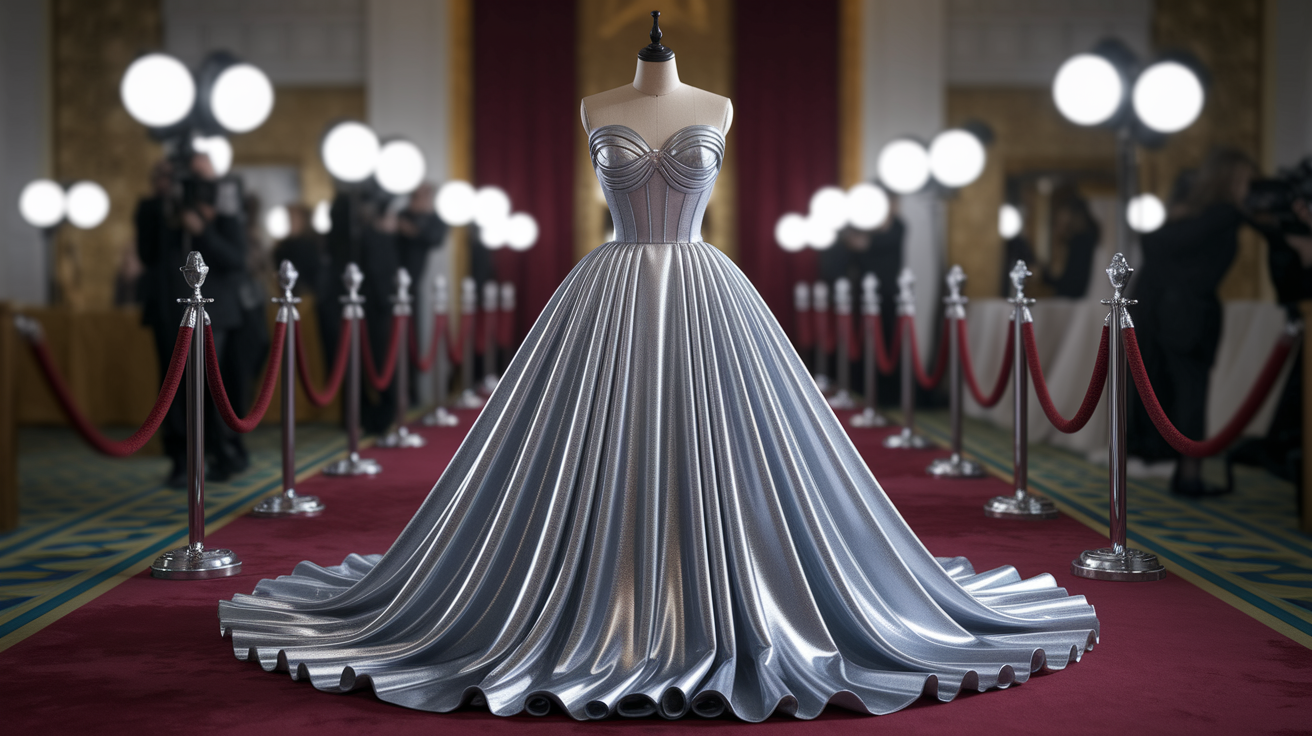
Her October 2025 sheer silver gown at Variety became the most talked about dress of the year, forcing press to blur photos and everyone to start hunting designers.
From chainmail naked dresses to old-Hollywood corsets, her looks spark instant “where can I buy this” searches.
This guide rounds up her biggest dress moments, names the designers, breaks down the must-see details, and points to where you can buy or recreate each look.

The Most Iconic Sydney Sweeney Dress Moments (Complete Visual & Shopping Overview)

4xb9JN1kUTyocnrrWb2WRg

Sydney Sweeney’s become one of the most searched red carpet names of the 2020s. Her October 2025 sheer silver gown at Variety’s Power of Women event got crowned “the most talked about dress of 2025.” The floor length metallic piece was so revealing that press photos needed trophy emoji censorship, proving she’s a risk taker who knows exactly how to own a news cycle. From chainmail naked dresses to period inspired corsetry, her wardrobe sparks conversation, comparison, and immediate “where can I buy this” searches across fashion forums and social feeds.

Her most viral looks cover a surprisingly wide range. Sheer fabrics layered over minimal undergarments, vintage 1950s silhouettes that get Marilyn Monroe comparisons, tightly corseted bodices paired with dramatic trains, and embellished little black dresses that reference iconic fashion moments like Elizabeth Hurley’s safety pin gown. Across eight heavily documented appearances between 2024 and 2025, you’ll spot recurring themes: sculptural corsetry, strategic cutouts, metallic finishes, high thigh slits, and an unflinching commitment to dressing for the photograph.

Each dress tied to a specific event that amplified its impact. The sheer silver moment at the Beverly Hills Hotel for Variety. A plunging scarlet gown worn days after Valentine’s Day 2024. A ribbed cream corset at a Toronto screening of her boxing biopic Christy. A classical corseted red dress with Bridgerton era elegance. A seductive Vanity Fair Oscars Party look described as Bond audition material. The diamante button LBD at another Oscars party. A bridal white 1950s gown at The Housemaid LA premiere. And a futuristic metallic corset with sculpted nipple detailing at a GQ red carpet event. Getty Images catalogued every angle, and fans immediately started hunting for designer credits and shopping links that were rarely provided in original coverage.

Sydney Sweeney’s Sheer Silver Dress: Full Breakdown of the 2025 Viral Look

ZbyFJiyCWQaSQTVBkZBm3Q

The floor length sheer silver gown worn in October 2025 was built from draped metallic fabric engineered to “cover in the right places” while staying fully transparent everywhere else. The silhouette relied on strategic gathering at the bust and hips, creating sculptural volume that caught light from every camera angle while leaving little to the imagination. The shine was mirror like, reflecting flash photography in a way that made censorship inevitable. Press outlets covered key areas with trophy emojis during the week she was generating Oscar nomination buzz, turning a red carpet appearance into a viral phenomenon that went way beyond fashion coverage.

The dress went viral not because it was sheer. Sheer gowns show up on red carpets weekly. But because the timing, fit, and Sweeney’s confidence created a perfect storm of media attention. Comparisons to Old Hollywood bombshells flooded social media within hours, while fashion critics debated whether the look was empowering or engineered purely for shock value. The gown became shorthand for her entire aesthetic philosophy: calculated risk taking, an understanding of her own image, and a willingness to wear pieces that generate as much debate as admiration. No designer credit was published in initial coverage, leaving fashion sleuths scrambling to identify the creator behind the year’s most discussed dress.

Deep Dive Into the Chainmail Naked Dress by Christian Cowan (Spring/Summer 2026)

8cp1iQblXaa3ECVofVPL7Q

Dress Construction

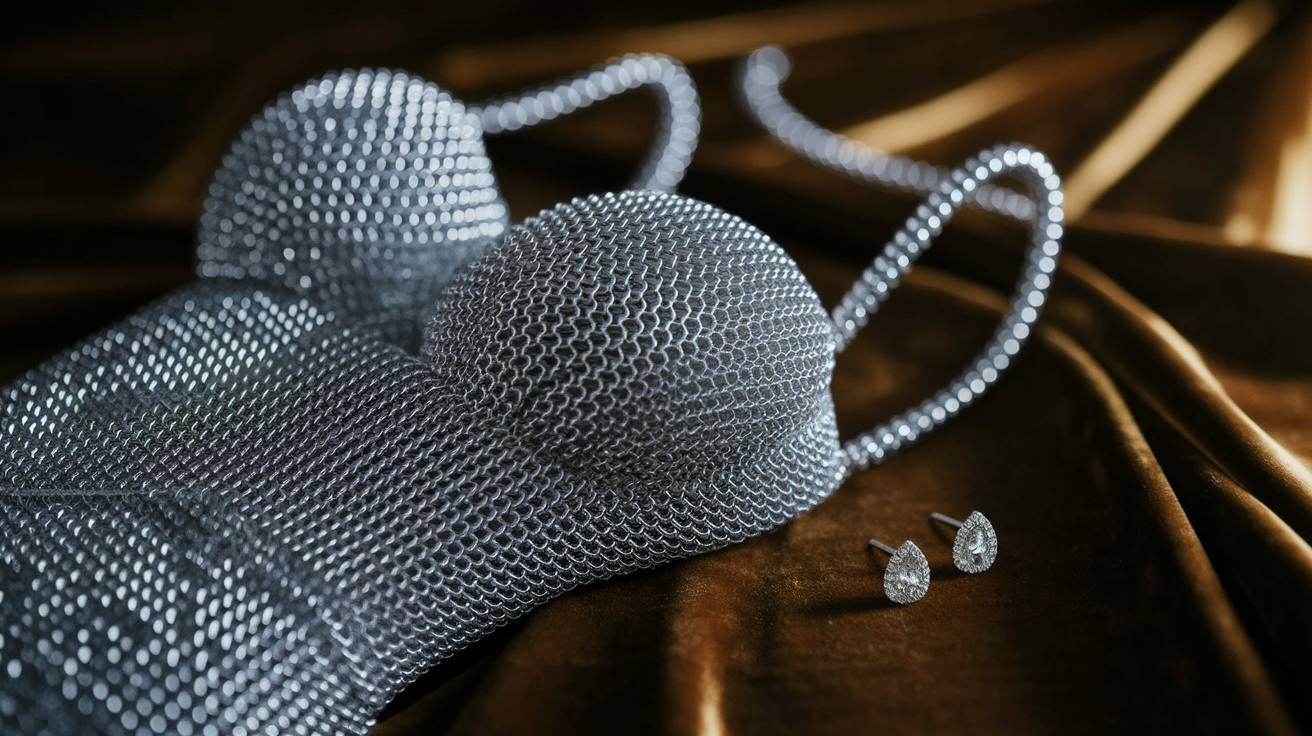
Christian Cowan’s Spring/Summer 2026 ready to wear chainmail dress featured a wide scoop neckline that sat low across the collarbone, creating an uninterrupted horizontal line that emphasized shoulder width. The metallic mesh material was fully see through, constructed from individual interlocking rings that moved with the body while keeping structure through a sculptural, ruched bodice. Fabric appeared twisted around a cinched waist, creating texture and visual interest in the torso region where sheer gowns often flatten. Flowy mid length sleeves added an unexpected softness to an otherwise hard edged material, and the back featured a functional lace up closure that ran the full length of the spine, turning the exit as important as the entrance.

Styling Choices

Sweeney wore the chainmail gown over nude panties with no additional undergarments. A styling decision that required precise fit and confidence in the garment’s structural integrity. Romantic diamond drop earrings and multiple rings from Effy Jewelry provided sparkle without competing with the dress’s metallic finish. Her honey blonde bob was styled into a glamorous wavy blowout that framed her face, while black cat eye liner sharpened the look and prevented it from reading too soft. Bronzed cheeks and a bold brown lip added warmth to a look that could’ve skewed cold in the wrong hands, balancing the futuristic chainmail with classic Hollywood beauty references.

Context & Impact

The dress debuted at Variety’s Power of Women event at the Beverly Hills Hotel in Los Angeles, an industry insider occasion that guaranteed coverage among the exact demographic most likely to dissect fashion choices. One day earlier, Sweeney had been photographed at Dodger Stadium for the LA Dodgers vs. Toronto Blue Jays game wearing a white tank, cutoff denim short shorts, cowboy boots, team merchandise, a diamond tennis necklace, oversize black shades, and her blonde bob styled into tight curls. The whiplash contrast between baseball game casual and red carpet chainmail demonstrated her range and her team’s understanding of how to build narrative through wardrobe. Approachable one day, untouchable the next.

Sydney Sweeney’s Venice Illusion Gown: Embroidery, Sheerness & Glam Details

ojmCS8ttXo2aGp-n2k41Eg

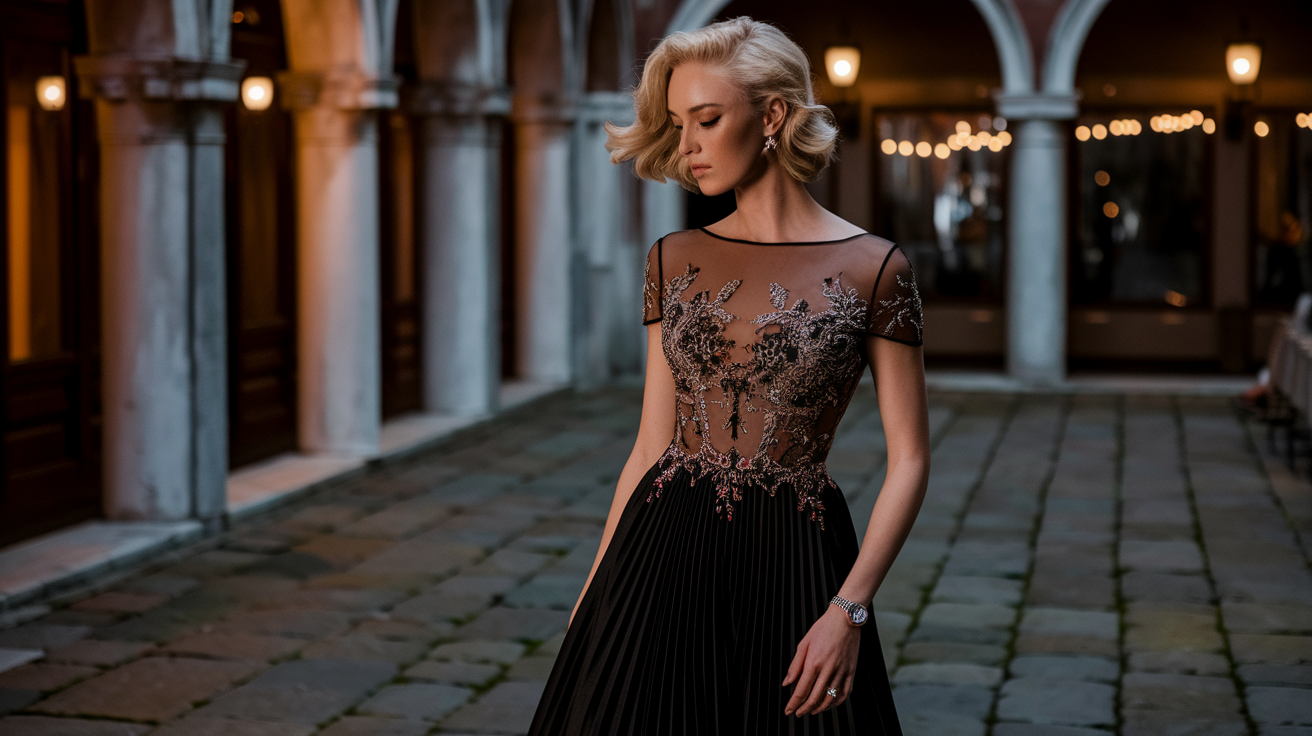
At the 81st Venice International Film Festival in 2024, Sweeney attended an Armani Beauty hosted dinner at the Venetian Arsenal wearing a black gown built around optical illusion. The dress featured an off the shoulder neckline and skin baring bodice covered in floral and crystal embroidery, with a sheer delicate panel across the chest that created the impression of bare skin beneath intricate beadwork. The pleated skirt added volume and movement, trailing into a dramatic mini train that required careful navigation of the historic venue’s cobblestones. Vivid drapings on the hip introduced asymmetry and prevented the silhouette from reading too formal or stiff, a styling decision that kept the look youthful despite its technical complexity.

Accessories were kept minimal and high impact. Multiple De Beers rings and a diamond watch that caught candlelight without overwhelming the embroidery. Stylist Molly Dickson, who’s shaped many of Sweeney’s most discussed moments, understood that a gown this detailed required restraint everywhere else. No necklace, no bracelet stack, no additional sparkle competing for attention. The result was a look that photographed as cohesive and intentional rather than over styled.

Makeup was executed entirely with Armani Beauty products, a natural partnership given the event’s host. Her golden blonde hair was worn side parted and down in soft waves, while her face featured Power Fabric foundation and concealer for a flawless base, Lip Power in shade 109 for a glossy pink lip, Luminous Silk Glow Blush in shade 51 for coral colored warmth, and Prisma Glass in shade 01 for subtle highlight. She later captioned the look on social media: “A glowy evening in Venice wearing my @armanibeauty faves.” The specific product callouts turned the post into shoppable content, allowing fans to recreate the exact makeup even if the gown remained out of reach.

Inside Her Most Talked‑About Vintage & Corset Dress Moments

PRYfeazbXH6_XncDI5Dgng

Sydney Sweeney’s thing for corsetry and vintage inspired silhouettes has produced some of her most memorable fashion moments, often drawing direct comparisons to mid century icons. Her team’s confirmed they “brainstorm a moodboard for each of these looks,” explaining the cohesive aesthetic thread that runs through otherwise different events. The result is a wardrobe that feels curated, with clear references to specific eras and garment construction techniques that modern fast fashion has largely ditched.

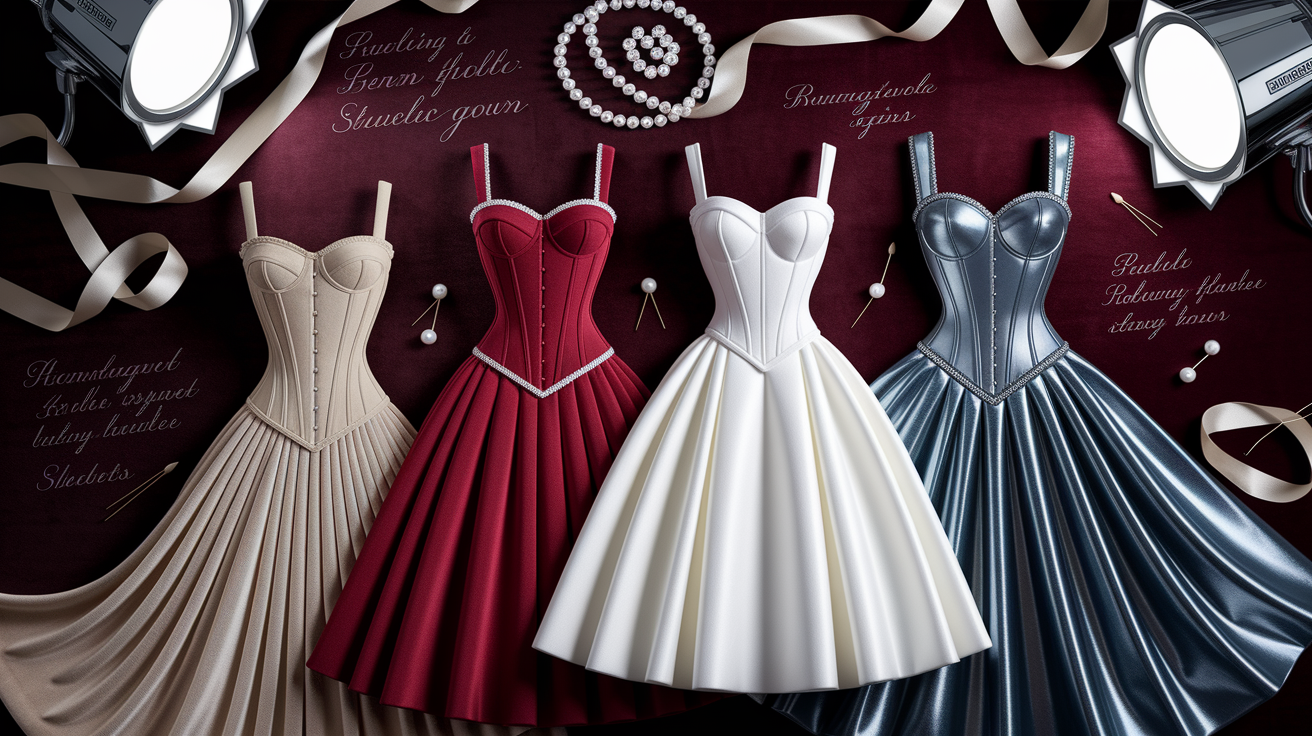
Toronto screening ribbed cream corset look – Worn to a special screening of her boxing biopic Christy, this tight corseted piece featured a soft velvet trail that added Old Hollywood elegance to an athletic film premiere.

Bridgerton style red corseted dress – A classical period inspired LRD with breath taking corset structure that leaned into the Regency era aesthetic popularized by costume dramas, proving her range extends beyond contemporary glamour.

Marilyn Monroe inspired 1950s white gown – Debuted at the LA premiere of The Housemaid, this bridal white look led fans to call her a “modern day Marilyn Monroe,” with a silhouette that referenced the starlet’s most iconic photo call moments.

Metallic GQ corset (sci fi aesthetic) – A rock chic styling moment with winged liner, black nails, and sculpted nipples visible through the corset, described as “out of this world” and leaning into futuristic rather than vintage references.

The Oscars Party Dresses: Thigh Splits, Diamante Buttons & High Drama Styling

NHeveapLX5iZyQnx98V-gQ

The Oscars party LBD reworked with diamante buttons represented a direct homage to Elizabeth Hurley’s iconic safety pin Versace moment, updated for a new generation. Diamante buttons were placed tactically along a thigh split, creating both structural interest and built in controversy. Each step revealed leg while the hardware glinted under camera flash. The look required confidence and careful movement, turning walking into performance and making sure every photograph captured intentional glamour rather than accidental exposure. It was a masterclass in referencing fashion history without copying it, borrowing the spirit of Hurley’s risk taking while keeping a distinct silhouette.

An earlier Oscars party appearance leaned into high end seduction, with coverage framing the look as Bond girl audition material. Sweeney later addressed the constant Bond girl speculation in an interview, saying, “Depends on the script. I think I’d have more fun as James Bond.” The quote reframed the entire styling conversation. This wasn’t a woman auditioning to be arm candy, but someone using red carpet moments to demonstrate leading role range. The dress became secondary to the message, though its impact was undeniable in generating the exact type of media attention that keeps actors in consideration for major franchise roles.

How to Copy a Sydney Sweeney Dress Look (Affordable to Luxury)

OZMojOPxVkScAky-MEKr7w

Recreating a Sydney Sweeney red carpet moment requires understanding the foundational elements. Silhouette, sheer vs. opaque balance, waist definition, and strategic embellishment. Then adapting them to your budget and body type. Start by identifying which of her recurring themes resonates most: corset structure, vintage 1950s curves, sheer overlay with strategic coverage, or metallic high shine finishes. Match the silhouette to your body shape rather than forcing an exact replica. If she’s wearing a plunging neckline on a straight frame, a sweetheart neckline on a curvier frame gets the same visual impact without the same fit challenges.

How to recreate her look:

Choose nude seamless undergarments or go braless if the dress has built in structure. Visible bra lines destroy the illusion sheer gowns rely on.

Invest in one statement jewelry piece (drop earrings or rings) rather than layering multiple accessories that compete for attention.

Pair metallic or sheer gowns with simple, classic shoes. Strappy sandals or pointed toe pumps in nude or black keep the focus on the dress.

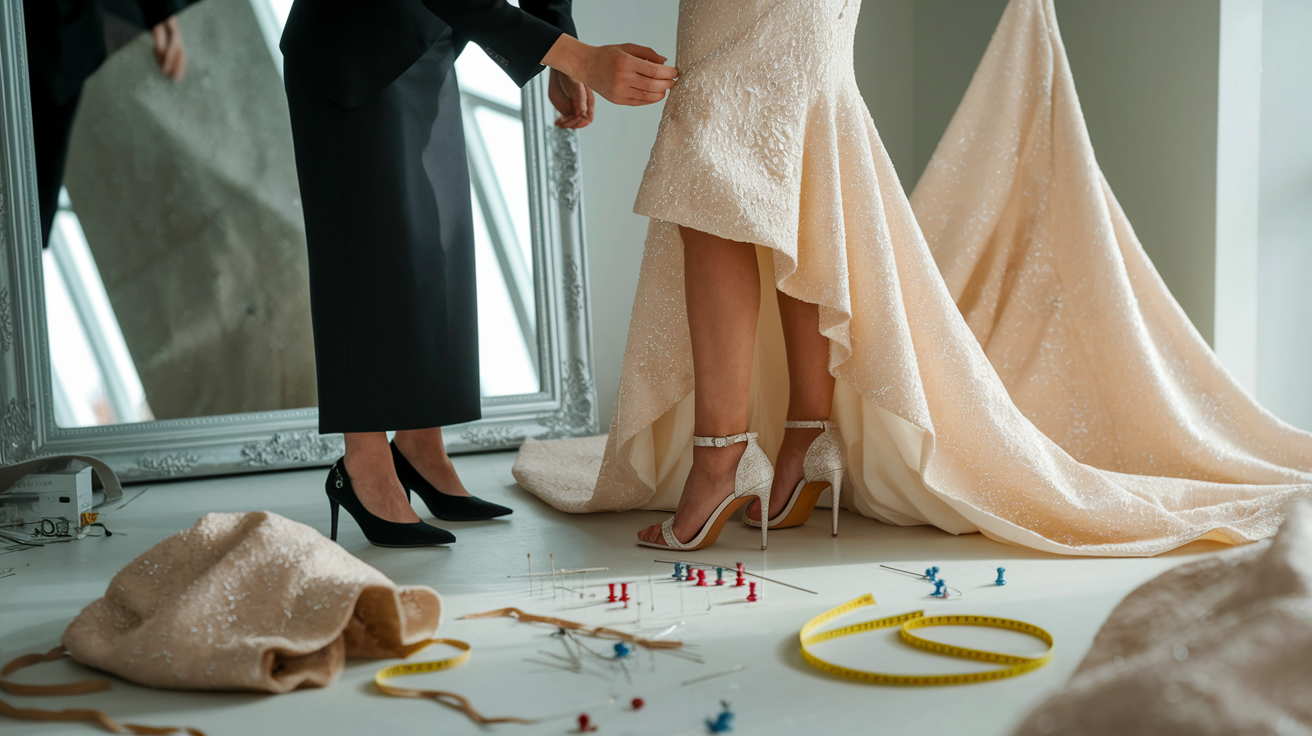
Book a tailor for hemming and waist adjustments. Off the rack gowns rarely fit like custom couture, but $40 in alterations closes 80% of the gap.

Study her makeup: bronzed skin, defined eyes, and bold lips appear consistently, creating a signature beauty look that ties different fashion moments together.

Style Estimated Price
Couture sheer gown (designer level) $3,000–$15,000+
High street corset dress (structured bodice) $200–$800
Embellished LBD with thigh split $300–$2,000
Metallic chainmail or mesh gown $150–$2,500

Body shape styling matters more than exact dress duplication. If you’re petite, a floor length train will overwhelm your frame, so opt for a midi version of the same silhouette. If you’re tall, make sure the bodice has enough length to sit properly at your natural waist rather than riding up. Alterations for perfect fit are non negotiable when working with bodycon or corset styles. What looks effortless on a red carpet required multiple fittings and custom adjustments behind the scenes.

Where to Buy Similar Sydney Sweeney Dresses Online

deX2P4JuVtq9wEn58mIN7w

Designer level pieces require reverse image searches and careful authentication, especially when original coverage fails to credit the designer. Search terms like “chainmail evening gown,” “sheer draped metallic dress,” or “corseted LBD with diamante detail” will surface both exact matches and inspired alternatives. When investing in a high ticket item, verify authenticity through platform guarantees (The RealReal, Vestiaire Collective) or request proof of purchase and original tags from private sellers. Christian Cowan pieces, for example, often feature signature construction details in the lining and hardware that counterfeiters skip.

High street dupes from brands like ASOS, Zara, and Revolve typically surface within two weeks of a major red carpet moment, interpreting the silhouette and vibe at accessible price points. Quality will vary. Sheer fabrics may read cheap rather than luxurious, and corset boning may lack the structure needed to smooth the torso. Read reviews for fit feedback, particularly around bust support and whether the dress requires additional undergarments. Expect these pieces to photograph well but require careful styling to avoid looking costume like in person.

Rental services like Rent the Runway and Nuuly offer access to designer gowns at a fraction of retail, ideal for one time event wear that mimics Sweeney’s high impact looks. Resale market prices for her exact designers fluctuate based on media coverage. A Christian Cowan gown may spike in search and price immediately after she wears one, then settle back down within a month. Secondhand shopping tips: set alerts for specific designers, know your measurements in multiple size systems, and factor in tailoring costs when budgeting. A $400 pre owned gown plus $60 in alterations still delivers designer quality at a fraction of the $3,000+ retail price.

Final Words

On the red carpet, the sheer silver gown from Variety Power of Women still stole the show, and it’s just one of eight viral moments we walked through.

From chainmail mid-lengths and corseted creams to Marilyn-style white gowns, Venice illusion embroidery and LBDs with diamante buttons, we broke down silhouettes, styling, and why each look mattered.

You got shopping tips, alteration notes and dupe-rental options to copy the vibe. If you’re hunting a sydney sweeney dress inspo, this gallery is your shortcut to bold, wearable red carpet energy.

FAQ

Q: Why did Sydney Sweeney wear that dress?

A: Sydney Sweeney wore that sheer silver dress to the October 2025 Variety Power of Women event; the floor-length, draped gown revealed while covering key areas, made a bold fashion statement and quickly went viral.

Q: Who wore the most revealing dress at the Oscars?

A: The most revealing dress at the Oscars party was one of Sydney Sweeney’s looks — a thigh-slit black LBD with diamante buttons — noted for its high slit and Bond-girl, Elizabeth Hurley–referencing vibe.

Q: Are Sydney Sweeney’s breasts all natural?

A: Sydney Sweeney’s breasts are not publicly confirmed as surgically altered; she hasn’t commented on any procedures, so whether they’re natural remains unconfirmed.

Most Controversial Red Carpet Dresses That Ignited Global Debates

0

What does it take for a dress to spark a global debate?
From Gaga’s meat dress to J.Lo’s jungle-print plunge, some red carpet looks did more than shock, and they sparked real conversations about body, power, faith, gender, and ethics.
This piece breaks down the most controversial red carpet dresses and why each one became a stand-in for a bigger fight.
We’ll show who wore them, what they were trying to say, and how a single outfit can start an argument that won’t go away.

The Most Iconic Controversial Red Carpet Dresses at a Glance

K44MKKhhVh6tgbO-PVty9Q

Lady Gaga showed up to the 2010 MTV Video Music Awards in a dress made of raw beef. Franc Fernandez designed it. Rihanna wore 216,000 Swarovski crystals and not much else to the 2014 CFDA Fashion Awards in an Adam Selman gown that exposed basically everything. Björk floated into the 2001 Oscars wearing a white swan dress by Marjan Pejoski. Jennifer Lopez’s jungle-print Versace gown at the 2000 Grammy Awards had a neckline that went past her navel, and people say that moment’s why Google Images exists. On January 7, 2018, hundreds of stars wore all black to the 75th Golden Globes for #TimesUp. Billy Porter got carried in on a litter at the 2019 Met Gala wearing an Egyptian Sun God tuxedo-gown thing that basically redefined what masculinity could look like on the red carpet.

K44MKKhhVh6tgbO-PVty9Q

These controversial red carpet dresses all did the same thing. They stopped the scroll, dominated headlines for days, forced conversations about stuff people would rather ignore. The dresses become stand-ins for bigger arguments about who gets to show skin, which symbols are off-limits, whether fashion counts as activism or just art. One garment can get celebrated as bold self-expression and trashed as tasteless spectacle at the exact same time. The difference between a standing ovation and total outrage? Timing, identity, and whether people are ready to sit with their own discomfort.

Controversial red carpet dresses consistently blow up when they cross invisible lines. The stuff that turns a gown into a flashpoint:

Nudity and sheer fabric that messes with broadcast standards and kicks off body-autonomy versus objectification fights.

Political messaging through coordinated looks, slogans, or symbolic accessories that turn celebrity appearance into protest.

Religious iconography worn provocatively, which raises questions about artistic tribute versus straight-up sacrilege.

Gender-defying silhouettes that disrupt formal dress codes and expand what masculinity, femininity, or non-binary presentation can look like.

Animal ethics and sustainability when real fur, leather, or literal meat shows up, and advocacy groups lose it.

Historic preservation concerns when fragile archival pieces get worn for publicity, pitting spectacle against conservation.

Pros & Cons of Highly Controversial Red Carpet Fashion Moments

K44MKKhhVh6tgbO-PVty9Q-1

Angelina Jolie’s right leg became the internet’s most-memed body part after she kept posing at the 2012 Oscars with her Versace gown’s slit showing her thigh. Anne Hathaway’s 2013 Prada dress made “nipple darts” trend worldwide because the seaming looked like it was accentuating her chest. Billy Porter’s 2019 Met Gala look got praised for queer visibility and criticized by people saying he was mocking formal wear. Every risky outfit delivers career-boosting attention and potential reputation damage, with PR teams scrambling to control the story within hours.

K44MKKhhVh6tgbO-PVty9Q-1

Bold celebrity gowns that sparked debate generate insane visibility and can cement a star’s place in pop culture forever. But they also need serious damage control and expose the wearer to coordinated attacks. You’re weighing instant virality against long-term brand stuff, and not every controversial moment ages well.

Pros:

Instant global coverage across print, broadcast, social.

Meme longevity that keeps the look circulating for years.

Gets you repositioned as a cultural icon or risk-taker instead of a safe choice.

Can actually spark real conversation about body autonomy, gender, ethics.

Cons:

You risk backlash from advocacy groups, religious organizations, conservative audiences.

The look might overshadow your actual achievements or the event itself.

Coordinated criticism that can spiral into personal attacks or full harassment.

Museum or archive regret if your stunt damages irreplaceable stuff or undermines preservation standards.

What Defines an Iconic Shock Dress in Red Carpet History

2d1higMKX7CdIqTtKAQ2oA

Björk’s 2001 swan dress became shorthand for “too weird for the Oscars.” Tabloids mocked it relentlessly, but the Marjan Pejoski design is now cited in museum retrospectives as performance art. Cher’s 1986 Oscars ensemble pushed boundaries on what Hollywood considered acceptable formal wear and still gets referenced for gender-bending red-carpet style. Lizzy Gardiner walked the 1995 Oscars in a dress made entirely of American Express gold cards, a tongue-in-cheek statement about being “broke” that doubled as anti-consumerist commentary. Not every head-turning gown survives the decade. A select few transcend initial ridicule to become permanent entries in fashion lexicon.

An iconic shock dress needs more than fleeting outrage. It has to carry narrative weight, designer intention, cultural disruption that outlasts the news cycle. The look has to be defensible as art, activism, or identity statement rather than pure publicity stunt. It needs enough archival interest that museums, critics, historians revisit it years later. The real test? Whether the dress becomes cultural shorthand. Whether saying “the swan dress” or “the meat dress” instantly conjures the image and the controversy without needing further explanation.

Key attributes that elevate a controversial gown into lasting icon status:

Narrative significance. The look tells a story about identity, politics, or cultural moment that goes beyond fabric and fit.

Designer intent and craftsmanship. Hours of handwork, innovative materials, collaboration that signals this was deliberate art, not accident.

Disruption of formal codes. The garment violated unspoken rules about modesty, gender, reverence, appropriate materials in a way that forced institutions to react.

Cultural longevity. Continued citation in retrospectives, memes, museum exhibits, fashion-school curricula decades after the initial appearance.

What Drives Media Obsession With Scandalous Red Carpet Gowns

2d1higMKX7CdIqTtKAQ2oA-1

Angelina Jolie’s 2012 leg pose spawned thousands of Photoshop parodies within 48 hours. People inserted her limb into everything from Renaissance paintings to disaster-movie posters. Doja Cat responded to red-carpet interviewers at the 2023 Met Gala by meowing instead of speaking, a performance that extended her cat-prosthetic look into viral audio clips. Zendaya executed a planned dual-look moment at the 2024 Met Gala, walking in one Maison Margiela gown then reappearing minutes later in archival Givenchy with altered makeup. It redefined what “carpet arrival” could mean. Jennifer Lopez’s 2000 Versace jungle-print dress generated such intense search traffic that Google has repeatedly said the moment helped launch Google Images in July 2001. These looks work because they supply endless content for news cycles, meme factories, social algorithms hungry for shareable spectacle.

The media ecosystem transforms a single red-carpet appearance into a multi-day event through coordinated amplification. Traditional outlets publish instant hot-takes and quote celebrity stylists. Social platforms generate reaction GIFs, side-by-side comparisons, hashtag campaigns. Advocacy groups issue press releases either condemning or praising the choice. The celebrity’s PR team feeds follow-up interviews and behind-the-scenes footage to extend the conversation. The result? A self-sustaining loop where each new angle justifies another round of coverage.

Media obsession with scandalous celebrity gowns that sparked debate gets driven by:

Visual shock value that translates instantly to thumbnail images and shareable stills, no context needed.

Moral-panic framing that lets outlets publish the same provocative image repeatedly under the guise of critique or analysis.

Meme potential offering endless remixing opportunities that keep the look circulating across platforms long after the event ends.

Staged reveal mechanics like outfit changes, props, performance elements that provide multiple content beats from a single appearance.

Algorithmic amplification where high engagement signals social platforms to push the content further, creating exponential reach within hours.

How to Analyze the Most Controversial Red Carpet Dresses and the Cultural Conversations They Sparked

ccv6l4aTXT6-q_PUreDWRA

How to do a Context Check

Verify the event name, exact date, designer credits, stated theme before evaluating why a look sparked controversy. Jennifer Lopez wore her Versace jungle dress to the Grammy Awards on February 23, 2000. Context matters because award-show formality expectations differ sharply from, say, the Camp-themed 2019 Met Gala where theatricality was explicitly invited. Björk’s swan dress appeared at the 73rd Academy Awards on March 25, 2001, an era when Oscars red-carpet norms were way more conservative than today. Billy Porter’s gender-defying ensemble debuted at the May 6, 2019 Met Gala under the “Camp: Notes on Fashion” theme, which provided institutional permission for boundary-pushing looks.

Step one: Record the full event name, day/month/year, any official theme or dress code announced by organizers.

Step two: Identify the designer, maker, or provenance. Whether it’s a living couturier, archival loan, or DIY statement piece like Lizzy Gardiner’s 1995 AmEx-card dress.

Step three: Note the celebrity’s career stage and public persona at that moment, since a provocative choice reads differently for an emerging artist versus an established icon.

How to Identify the Triggering Element

Isolate the specific design feature or symbolic reference that crossed a cultural line and generated backlash or debate. Rihanna’s 2014 CFDA gown used 216,000 Swarovski crystals on sheer fabric that left her nearly nude, triggering arguments about empowerment versus objectification. Lady Gaga’s 2010 meat dress employed raw beef as the primary material, sparking immediate condemnation from PETA and forcing a conversation about shock tactics in art. Nicki Minaj’s 2012 Grammy Awards ensemble included a red silk gown and nun-like headdress paired with a companion dressed as “the Pope,” raising questions about religious sensitivity and whether Catholic iconography was being mocked or honored.

Step one: Examine fabric choice, silhouette, level of exposure. Identify whether the controversy centers on nudity, transparency, body parts traditionally covered at formal events.

Step two: Look for religious symbols, political slogans, activist messaging embedded in the design, such as Cara Delevingne’s 2021 “Peg the patriarchy?” Dior top.

Step three: Assess whether the look challenged gender norms, formal dress codes, ethical standards around materials like fur, leather, fragile historic garments.

How to Track Public Reaction

Map the immediate response across traditional media, social platforms, institutional statements to understand how quickly controversy escalated. Anne Hathaway’s 2013 Prada dress made “nipple darts” trend globally within hours as Twitter users debated seaming and wardrobe intent. The January 7, 2018 Golden Globes blackout generated synchronized press coverage because hundreds of attendees coordinated their all-black looks in advance, turning individual fashion choices into a collective political statement. Kim Kardashian’s brief May 2, 2022 appearance in Marilyn Monroe’s original 1962 “Happy Birthday, Mr. President” dress prompted conservation professionals to issue public warnings about damage to historic textiles within 24 hours.

Step one: Collect headlines, social-media trending topics, hashtag counts from the first 48 hours to gauge initial virality and sentiment.

Step two: Document responses from advocacy groups, religious organizations, designers, museum professionals who weighed in with official statements.

Step three: Track meme cycles, parody accounts, user-generated content to see whether the look became a joke, a rallying symbol, or both at once.

How to Examine Cultural Impact

Trace the long-term conversations the look ignited about body autonomy, gender expression, religious sensitivity, ethics, institutional access. Rihanna’s 2018 Maison Margiela papal-inspired look for the “Heavenly Bodies” Met Gala theme forced ongoing debate about whether high fashion can respectfully engage with Catholic imagery or whether any such use is appropriation and offense. Billy Porter’s 2019 gender-expansive ensemble became a touchstone in discussions about queer visibility, red-carpet inclusivity, whether formal menswear must remain rigidly gendered. Lady Gaga’s 2010 meat dress was preserved in modified form for museum display, raising questions about how ephemeral shock becomes archival artifact and what that says about art versus spectacle.

Step one: Identify the primary cultural debate triggered. Whether it centers on sexuality, politics, religion, gender, animal rights, preservation ethics.

Step two: Note any institutional responses, such as museum acquisitions, policy changes at award shows, shifts in designer practices following backlash.

Step three: Assess whether the look influenced future red-carpet behavior, inspired copycat moments, became a case study in fashion-school curricula and cultural criticism.

How to Compare Historic vs. Modern Controversies

Analyze how evolving media ecosystems, social norms, celebrity platforms have changed what qualifies as controversial from the 1980s through the 2020s. Cher’s 1986 Oscars outfit was boundary-pushing for its time but would barely register as unusual at a contemporary Met Gala. Elizabeth Hurley’s 1994 Versace safety-pin dress at the “Four Weddings and a Funeral” premiere generated tabloid frenzy in an era before social media, meaning the controversy unfolded over days via print coverage rather than minutes via Twitter. By contrast, Tyla’s 2024 Balmain “sand” gown, reportedly so fragile she had to be carried up stairs, went viral globally within an hour of her arrival. Shows how modern amplification compresses reaction timelines and magnifies reach.

Step one: Compare the media channels available at the time of the look. Pre-internet tabloids versus real-time social platforms, and how those shaped controversy velocity.

Step two: Evaluate shifting cultural norms around nudity, gender, religion, activism to understand why a 1990s shock moment might seem tame today or vice versa.

Step three: Track whether controversies now prompt faster institutional responses, more sophisticated PR counter-narratives, greater celebrity control over the story via owned social accounts.

Comparison Between Major Red Carpet Controversy Types

OsAzbD_QUKG2yWUuVbYMqw

Lizzy Gardiner’s 1995 American Express gold-card dress explicitly critiqued consumerism and industry economics by turning credit cards into couture, a statement that doubled as performance art. Rihanna’s 2014 CFDA sheer gown constructed from 216,000 crystals centered the debate entirely on body exposure, agency, whether near-nudity is empowerment or exploitation. Billy Porter’s 2019 Met Gala tuxedo-gown hybrid disrupted rigid gender binaries in formal wear and sparked conversations about queer visibility, masculinity, the politics of presentation. Each controversy type generates distinct arguments, media frames, lasting legacies, even when the looks share a red carpet and similar shock value.

Different controversial looks trigger different cultural fault lines. A garment that challenges modesty norms will ignite body-autonomy debates and generate responses from religious or conservative groups. A politically charged ensemble like the 2018 Golden Globes blackout shifts the conversation to workplace harassment, solidarity, whether coordinated fashion is effective activism. A look that uses provocative materials (Gaga’s meat, real fur, fragile museum pieces) draws ethical and preservation critiques rather than moral panic about skin. Understanding the type of controversy helps decode which audiences will react, how media will frame the story, whether the moment will be remembered as brave, tasteless, or both.

Look Type Example Cultural Debate Lasting Impact
Consumerism critique Lizzy Gardiner’s 1995 AmEx-card dress Fashion as anti-capitalist statement; who gets to mock wealth on industry’s biggest stage Cited as early example of meta-commentary in red-carpet dressing; inspired later activist fashion
Nudity and body autonomy Rihanna’s 2014 CFDA sheer gown (216,000 crystals) Empowerment vs. objectification; decency standards; body positivity and agency Reinforced celebrity control over image; normalized sheer/naked dressing at award shows
Gender disruption Billy Porter’s 2019 Met Gala tuxedo-gown Masculinity norms; queer and trans visibility; formal dress-code policing Expanded red-carpet gender expression; became case study in performative activism and identity
Religious iconography Nicki Minaj’s 2012 Grammy nun/Pope ensemble Sacrilege vs. artistic homage; who has authority to use sacred symbols in secular settings Ongoing sensitivity debates around Catholic imagery in fashion; influenced Met Gala “Heavenly Bodies” theme responses
Historic preservation vs. spectacle Kim Kardashian in Marilyn Monroe’s 1962 dress (May 2, 2022) Ethics of wearing fragile archival garments; museum loan policies; celebrity access to cultural artifacts Prompted conservation professionals to issue public warnings; museums reconsidered loan practices for live wear

How to Use These Controversial Fashion Moments to Understand Cultural Shifts

dm5TYDQBUmWA2kv7ZjTJOA

Lady Gaga’s 2010 meat dress was preserved in modified form and displayed in museums, transforming a one-night shock tactic into a permanent artifact that institutions now use to teach students about art, spectacle, the line between the two. The coordinated January 7, 2018 Golden Globes blackout showed that red-carpet fashion could function as synchronized protest, totally changing how PR teams and activists plan visibility campaigns around award shows. Jennifer Lopez’s February 23, 2000 Versace jungle dress generated such intense search demand that Google has repeatedly said the moment drove the launch of Google Images in July 2001. Shows how a single garment can reshape technology infrastructure. These controversial red carpet dresses offer a timeline of evolving norms around gender, sexuality, religion, ethics, institutional power. Each look functioning as a data point in larger cultural negotiations about who gets to be seen, how, on whose terms.

When a dress ignites debate, it reveals the invisible boundaries a society is actively policing at that moment. The outrage or celebration tells you which taboos are weakening and which remain fiercely defended. A look that would’ve ended a career in 1995 might barely register today, while a garment that feels celebratory now could face harsher backlash in a more conservative future climate. Tracking these shifts over decades shows how fashion operates as both mirror and engine of cultural change. It reflects current anxieties and accelerates the conversations that eventually move norms.

You can interpret present and future red-carpet controversies as cultural signals by:

Mapping which topics generate the fiercest backlash in real time. Whether nudity, religion, gender, ethics, to identify the boundaries a culture is actively renegotiating.

Tracking institutional responses from museums, award shows, advocacy groups to see when a controversy prompts policy change versus when it’s dismissed as fleeting outrage.

Comparing meme cycles and media longevity to distinguish between looks that become lasting icons versus those that fade once the initial shock wears off.

Analyzing who gets punished versus celebrated for identical choices, revealing double standards around race, gender, body type, celebrity tier.

Watching for preservation moments when ephemeral spectacle is archived, signaling that institutions now view the controversy as historically significant rather than tasteless stunt.

Final Words

We opened with iconic shock looks, Björk’s swan, Gaga’s meat dress, Rihanna’s crystal sheer, J.Lo’s Versace and Billy Porter’s Met Gala moment, and why they blew up into cultural flashpoints.

We then showed how media, critics, and social feeds escalated debates, weighed pros and cons, and laid out what makes a look “iconic shock.”

Use the guide’s context checks, trigger-spotting steps, and timeline tools to judge future moments; studying the most controversial red carpet dresses and the cultural conversations they sparked helps you spot bigger cultural shifts. Fashion keeps pushing, and that’s kind of exciting.

FAQ

Q: What was the most inappropriate dress on the red carpet?

A: The most inappropriate dress on the red carpet is subjective, but widely cited examples include Lady Gaga’s 2010 meat dress and Björk’s 2001 swan dress, both sparking major backlash and debate.

Q: What is the 3 3 3 rule in fashion?

A: The 3 3 3 rule in fashion means limiting an outfit to no more than three colors, three patterns, or three accessories to keep looks balanced and camera-ready.

Q: Who created the worst dressed list?

A: The worst dressed list was created by American critic Richard “Mr. Blackwell” Blackwell, who published his annual “Ten Worst Dressed” lists from the 1960s and became known for them.

Q: What makes a woman look wealthy?

A: A woman looks wealthy through polished tailoring, quality fabrics, minimal but luxe accessories, a neutral palette, good grooming, and understated branding, all signals of investment and taste, not flashy logos.

Harvey Weinstein Scandal Timeline: Key Events That Sparked the #MeToo Movement

0

What happens when one of Hollywood’s most powerful men is finally exposed?
Everything blew apart on October 5, 2017, when a New York Times investigation named 13 women and detailed decades of alleged harassment.
Five days later, a New Yorker report added more accusers, including claims of rape, and within days Weinstein was fired, expelled from the Academy, and widely condemned.
This timeline walks the key moments, from the first exposés to criminal trials, corporate collapse, and the viral #MeToo wave, so you can see how reporting, survivor testimony, and public outrage changed how workplaces respond to sexual misconduct.

Comprehensive Breakdown of the Harvey Weinstein Scandal Timeline

gQDPmzVbUmC7bpA1pwDjGw

Everything blew apart on October 5, 2017. That’s when a major investigation named 13 alleged victims and laid out decades of alleged sexual harassment and assault. Five days later, on October 10, another report dropped with dozens more women, several alleging rape. Within days, Weinstein got fired from his own company, kicked out of the Academy, and turned into the face of a global reckoning. But the scandal didn’t end with headlines. It sparked criminal prosecutions, corporate bankruptcy, and a viral movement that changed how workplaces handle sexual misconduct.

By late October 2017, more than 80 women had gone public with accusations across media reports and legal filings. That single month set up years of legal battles. On May 25, 2018, Weinstein turned himself in to New York police and got charged with multiple felony sex crimes. The first criminal trial started in January 2020. On February 24, 2020, a Manhattan jury convicted him on two counts: third-degree rape and a first-degree criminal sexual act. Eleven days later, March 11, 2020, he got sentenced to 23 years in prison.

The legal fallout didn’t stop in New York. In December 2022, a Los Angeles jury convicted Weinstein on three separate felony counts for sexual assaults in California. On July 11, 2023, he received another 16 years in California state prison. Meanwhile, his production company filed for Chapter 11 bankruptcy on March 19, 2018, and its assets got sold off later that year. The timeline of the Harvey Weinstein scandal explained shows how investigative journalism, survivor testimony, and public outrage combined to take down one of Hollywood’s most powerful figures.

Timeline of the Harvey Weinstein Scandal Explained – Key Dates:

  • October 5, 2017: First major investigation published, naming 13 alleged victims and detailing decades of alleged misconduct
  • October 8, 2017: Weinstein fired from The Weinstein Company
  • October 10, 2017: Follow-up report expanded allegations; Weinstein’s wife announced she was leaving him
  • October 14, 2017: Academy of Motion Picture Arts and Sciences expelled Weinstein
  • October 15, 2017: #MeToo hashtag went viral with millions of posts globally
  • March 19, 2018: The Weinstein Company filed for Chapter 11 bankruptcy
  • May 25, 2018: Weinstein arrested in New York, released on bail
  • February 24, 2020: Convicted in New York on two criminal counts
  • March 11, 2020: Sentenced to 23 years in New York state prison
  • December 2022: Convicted in Los Angeles on three felony counts; sentenced to 16 years on July 11, 2023

Early Rumors and Pre-2017 Allegations Leading Into the Weinstein Scandal

j6_TZNlWUG-j_xBX9IWhnw

Long before 2017, whispers about Harvey Weinstein circulated through Hollywood. Allegations history before 2017 stretched back to the 1990s, when Weinstein co-founded Miramax and later launched The Weinstein Company. Multiple women reportedly settled complaints privately, signing nondisclosure agreements that kept their stories buried. Those NDAs became a weapon to maintain silence, letting alleged misconduct continue for decades without consequences.

The power imbalance in casting and careers was central to how the alleged abuse went on. Weinstein controlled access to career-making roles, Oscar campaigns, and industry prestige. Aspiring actors and assistants who raised concerns risked professional exile. Industry insiders later admitted that rumors were common knowledge in certain circles. But the combination of legal settlements, fear of retaliation, and cultural norms around “difficult” powerful men kept most allegations private.

By the time the 2017 reports surfaced, investigators had uncovered a long trail of private settlements, intimidation tactics, and institutional enabling. The allegations spanned from the 1990s through the 2010s, involving film industry actors, assistants, and other professionals. The pre-2017 period set the stage for the explosive revelations that followed, showing how systemic silence can protect misconduct for years.

Patterns in Pre-2017 Allegations:

  • Private financial settlements with accusers dating back to the 1990s
  • Nondisclosure agreements that legally prevented women from speaking publicly
  • Industry-wide reluctance to challenge a powerful producer with Oscar influence
  • Reports of intimidation and career retaliation against those who resisted or complained
  • Institutional complicity at companies and organizations that received complaints but took limited action

The Explosive October 2017 Reports That Triggered the Scandal

MmSsUcbgWwOXyjDpyMcH_w

The timeline of media coverage started with two landmark pieces of investigative journalism that changed everything. On October 5, 2017, the first report detailed allegations from multiple women, describing decades of alleged sexual harassment and assault. The Oct 2017 New York Times investigation, led by reporters Jodi Kantor and Megan Twohey, named 13 victims and revealed a pattern of private settlements and NDAs. Weinstein issued a public apology, announced he was taking a leave of absence, and said he was entering therapy. He also denied many of the allegations.

Five days later, on October 10, 2017, a second investigation by Ronan Farrow in The New Yorker added 13 more women to the public record. Three alleged rape. The Ronan Farrow New Yorker report used on-the-record interviews, corroborating witnesses, and documented settlement agreements to build a detailed case. Combined, the two reports identified more than 80 accusers over time, transforming isolated rumors into a documented pattern of alleged predatory behavior.

The impact was immediate. Within hours of the first report, Weinstein’s career started collapsing. The Oct 2017 New York Times investigation and the follow-up from The New Yorker didn’t just expose one man. They demonstrated how investigative reporting could break through decades of institutional silence. Both outlets faced legal threats and pressure, but their rigorous sourcing and fact-checking held up.

The New York Times Report

Jodi Kantor and Megan Twohey spent months persuading women to go on the record, navigating NDAs and legal threats. Their October 5 report outlined a three-decade pattern of alleged misconduct, supported by employment records, settlement documents, and multiple corroborating sources. The piece detailed how Weinstein allegedly invited women to business meetings in hotel rooms, appeared in bathrobes or naked, and used his power to coerce physical contact. The investigative journalism techniques included verifying settlements, cross-referencing timelines, and obtaining internal company communications that showed awareness of complaints.

The New Yorker Investigation

Ronan Farrow’s October 10 piece expanded the allegations to include rape. He interviewed 13 women, several of whom described incidents in hotel rooms during film festivals or business trips. Farrow also obtained audio recordings of Weinstein admitting to groping a woman, which had been captured during a police investigation years earlier but hadn’t led to charges. The combination of audio evidence, on-the-record testimonies, and documented settlements made the report nearly impossible to dismiss.

Date Outlet Key Revelations
October 5, 2017 The New York Times 13 alleged victims named; decades of settlements and NDAs detailed; allegations of harassment and coercion
October 10, 2017 The New Yorker 13 additional women spoke; three alleged rape; audio recording of Weinstein admitting to groping
Late October 2017 Multiple Outlets Total public accusers exceeded 80; international accusers came forward; industry-wide reckoning began

Immediate Fallout After the Initial Allegations

5Twqo4PCW9qaud8bxcZFqQ

The initial public allegations triggered a corporate and cultural collapse that happened in days. On October 6, 2017, Weinstein took an indefinite leave from The Weinstein Company. Two days later, on October 8, the company’s board fired him. His wife, designer Georgina Chapman, announced on October 10 that she was leaving him. By October 14, the Academy of Motion Picture Arts and Sciences had expelled Weinstein from membership, an extraordinarily rare move that signaled the industry’s attempt to distance itself.

Public relations timeline showed a rapid unraveling. Major studios and distributors cut ties, canceled projects, and issued statements condemning Weinstein’s alleged behavior. Actors and directors who’d worked with him for decades spoke out, many expressing shock, regret, or admissions that they’d heard rumors but failed to act. The board actions and firing at The Weinstein Company came after years of alleged internal complaints, raising questions about how much executives and board members had known.

Reactions from actors and directors ranged from condemnation to apology. Some stars donated fees from Weinstein-produced films to anti-harassment organizations. Others faced criticism for staying silent for years. The speed and scale of the fallout reflected the sheer number of accusers and the credibility of the investigative reporting. Within two weeks, Weinstein had lost his company, his industry honors, his marriage, and his public standing.

Company Response

The Weinstein Company’s internal company response was immediate but messy. The board initially announced an investigation, but within days, Weinstein was out. Co-founder and brother Bob Weinstein tried to distance himself and the company from Harvey’s actions. But the damage was done. Sponsors pulled funding, distributors canceled deals, and the company’s financial position became untenable. By early 2018, the company was exploring bankruptcy options.

Public Reactions

Hollywood’s public reactions came in waves. High-profile actors issued statements expressing support for survivors and condemning Weinstein’s alleged actions. Directors and producers who’d worked with him for years faced tough questions about what they knew and when. Some industry figures admitted they’d heard rumors but failed to speak up. Others claimed total ignorance. The cultural moment forced a broader conversation about complicity, silence, and the structures that protect powerful men.

Major Immediate Reactions:

  • Weinstein fired from The Weinstein Company on October 8, 2017
  • Academy of Motion Picture Arts and Sciences expelled Weinstein on October 14, 2017
  • Georgina Chapman announced separation from Weinstein on October 10, 2017
  • Major studios and distributors severed ties and canceled projects
  • Actors donated fees from Weinstein films to anti-harassment charities
  • Industry organizations revoked honors and memberships within days

Rise of #MeToo and Social Movement Expansion After Weinstein

DhQZIETGWQKnrXpoeUxLCQ

The impact on #MeToo movement was seismic. On October 15, 2017, actor Alyssa Milano posted a message encouraging women who’d been sexually harassed or assaulted to reply with “Me Too.” The phrase, originally coined by activist Tarana Burke in 2006 to support survivors of sexual violence, went viral within hours. Millions of social media posts flooded platforms worldwide, creating a public record of widespread harassment and assault across industries.

The social media reaction transformed the Weinstein scandal from a Hollywood story into a global cultural moment. Women in tech, finance, journalism, politics, and academia shared their own experiences, using the hashtag to show how pervasive sexual misconduct was. The MeToo origins and growth trace back to Burke’s grassroots work with marginalized communities, but the October 2017 surge brought the movement into mainstream consciousness. The Weinstein timeline of cultural fallout accelerated as more high-profile men in media, politics, and business faced public allegations and lost their jobs.

Key Movement Milestones:

  • October 15, 2017: #MeToo hashtag went viral, generating millions of posts within 48 hours
  • January 1, 2018: Time’s Up campaign launched to fight workplace sexual harassment and fund legal defenses for victims
  • Late 2017–2018: Dozens of high-profile men across industries faced allegations, resignations, and firings
  • 2018 onward: Legislative reforms, corporate policy changes, and global awareness campaigns expanded rapidly

Criminal Investigations and Early Legal Actions in 2017–2018

JPcc1IfgUa2W9E_S2R6-IA

Late 2017 and early 2018 saw a wave of police investigations timeline activity as law enforcement in multiple jurisdictions opened inquiries. The Manhattan District Attorney’s office began building a criminal case, interviewing witnesses and reviewing evidence. Other cities, including Los Angeles and London, announced investigations as well. By spring 2018, the timeline of criminal charges filed was taking shape, with prosecutors preparing to bring felony counts.

On May 25, 2018, Weinstein surrendered to New York police and got arrested on charges related to alleged assaults in 2004 and 2013. He was released on bail after posting a bond and agreeing to wear an ankle monitor. On June 5, 2018, he pleaded not guilty to the initial charges. Four days later, on June 9, prosecutors added a third charge related to an alleged 2006 assault. A grand jury indictment followed, and the case moved toward trial.

Civil lawsuits and settlements post-2017 unfolded in parallel. Dozens of women filed civil claims seeking damages for harassment, assault, and emotional harm. The legal landscape was complex, with some claims barred by statutes of limitations and others proceeding in state and federal courts. The Weinstein Company faced mounting legal fees. By early 2018, it was clear the company couldn’t survive the financial and reputational damage.

Criminal Inquiries

The Manhattan district attorney case was the most prominent, but police in Los Angeles, London, and other cities also opened investigations. Prosecutors faced challenges: some alleged incidents occurred decades earlier, and statutes of limitations barred some charges. Investigators worked to identify corroborating witnesses, gather physical evidence, and build cases that could survive legal scrutiny. The timeline of criminal investigations by jurisdiction showed coordination between cities as prosecutors shared information and evidence.

Civil Suits

Civil lawsuits piled up in 2017 and 2018, with accusers seeking financial damages and public accountability. Some claims were settled confidentially. Others remained public. The civil process allowed accusers to pursue justice even when criminal statutes of limitations had expired. Weinstein’s legal team fought on multiple fronts, defending against both criminal prosecution and civil liability.

Date Legal Action Jurisdiction
Late 2017 Police investigations opened; interviews and evidence collection began New York, Los Angeles, London
May 25, 2018 Weinstein arrested in New York; charged with rape and criminal sexual act; released on bail New York
June 2018 Grand jury returned indictment; additional charges added; not-guilty pleas entered New York
2017–2018 Dozens of civil lawsuits filed; settlements negotiated; bankruptcy loomed for The Weinstein Company Multiple U.S. jurisdictions

Inside the 2019–2020 New York Trial, Verdict, and Sentencing

8bjt5ufnUj-vyX6JnvaSEQ

The 2020 criminal trial New York kicked off on January 6, 2020, after months of pre-trial motions, attorney changes, and legal maneuvering. Jury selection took several days, with both sides scrutinizing potential jurors for bias or preconceived notions about the case. The trial focused on allegations from two women: Mimi Haleyi, a former production assistant who alleged Weinstein forcibly performed oral sex on her in 2006, and Jessica Mann, who alleged Weinstein raped her in 2013.

Prosecutors presented testimony from both women, along with corroborating witnesses and expert testimony about trauma and victim behavior. The defense argued the encounters were consensual and pointed to emails and communications that they claimed showed ongoing consensual relationships. On February 18, 2020, the jury entered deliberations. Six days later, on February 24, the conviction and sentencing timeline reached a pivotal moment: the jury found Weinstein guilty on two counts, a criminal sexual act in the first degree (related to Haleyi) and rape in the third degree (related to Mann). He was acquitted of the most serious charge, predatory sexual assault, which required proof of multiple victims over time.

On March 11, 2020, a judge sentenced Weinstein to 23 years in prison. The prison sentence details reflected the severity of the convictions and the judge’s conclusion that Weinstein had shown no remorse. Immediately after the verdict, Weinstein was taken into custody and transferred to Rikers Island before being moved to a state correctional facility. The trial was widely viewed as a landmark for the #MeToo movement, proving that even powerful men could face criminal accountability.

Charges and Testimony

The charges centered on two incidents: the 2006 alleged assault of Mimi Haleyi and the 2013 alleged rape of Jessica Mann. Prosecutors also called additional witnesses whose allegations weren’t part of the criminal charges but were allowed to establish a pattern of behavior. The witnesses and corroboration timeline showed a consistent modus operandi: hotel-room meetings, promises of career advancement, and alleged coercion. Defense attorneys cross-examined accusers aggressively, focusing on post-incident communications and questioning why women maintained contact with Weinstein after alleged assaults.

Verdict and Sentencing

The jury deliberated for five days before reaching a verdict. The conviction on two counts carried a combined maximum sentence of up to 29 years, but the judge imposed 23 years. The sentencing hearing included victim-impact statements, with several women describing the long-term harm of Weinstein’s alleged actions. Weinstein’s legal team argued for leniency, citing his age and health, but the judge rejected those arguments, emphasizing the gravity of the crimes and the need for accountability.

Key Trial and Sentencing Points:

  • Trial began January 6, 2020, after months of pre-trial motions and attorney changes
  • Central accusers: Mimi Haleyi (2006 incident) and Jessica Mann (2013 incident)
  • Additional “prior bad acts” witnesses testified to establish a pattern of behavior
  • Jury deliberated from February 18 to February 24, 2020
  • Convicted on two counts: criminal sexual act in the first degree and rape in the third degree
  • Acquitted of predatory sexual assault, the most serious charge
  • Sentenced March 11, 2020, to 23 years in New York state prison
  • Taken into custody immediately after the verdict; transferred to Rikers Island and later to a state correctional facility

Additional California Charges, Conviction, and Sentencing

loApDztoUIOdg82u62LlUQ

While Weinstein was serving his New York sentence, prosecutors in Los Angeles moved forward with their own case. In mid-2021, Weinstein was extradited to California to face charges related to alleged sexual assaults in Los Angeles. The timeline of criminal investigations by jurisdiction showed coordination between New York and California authorities to manage custody and legal proceedings.

In December 2022, a Los Angeles jury convicted Weinstein on three felony counts related to alleged sexual assaults that occurred in California. The conviction added to the legal consequences he was already facing in New York. On July 11, 2023, a California judge sentenced Weinstein to 16 years in state prison on the California convictions. The sentencing hearings chronology demonstrated that Weinstein faced accountability in multiple jurisdictions, with sentences running consecutively or concurrently depending on how authorities coordinated enforcement.

California Case Summary:

  • Mid-2021: Weinstein extradited from New York to Los Angeles to face separate criminal charges
  • December 2022: Convicted in Los Angeles on three felony counts related to alleged sexual assaults in California
  • July 11, 2023: Sentenced to 16 years in California state prison, in addition to the 23-year New York sentence

Appeals, Ongoing Cases, and Weinstein’s Current Legal Status

LAxszd7-UOOK11ISeN8jHQ

Weinstein’s legal team filed appeals and legal challenges immediately after the New York conviction, arguing that the trial judge allowed prejudicial testimony and that the jury was biased. The timeline of appeals and legal filings has continued into the 2020s, with motions, briefs, and court hearings in both New York and California. Appeals courts have reviewed claims of procedural errors, jury misconduct, and evidentiary rulings.

The criminal vs civil process explained shows that Weinstein faced two separate tracks of accountability. Criminal convictions in New York and California resulted in prison sentences, while civil settlements continued in parallel. In December 2019, Weinstein and his bankrupt studio reached a tentative $25 million civil settlement with dozens of women, though some accusers rejected the terms and continued litigation. The settlement didn’t require Weinstein to admit wrongdoing, and it was funded largely by insurance policies rather than Weinstein’s personal assets.

As of the latest updates, Weinstein remains in custody, serving time in state prison while his legal team continues to pursue appeals. Custody transfers between states have been managed by correctional authorities, and simultaneous civil settlements have resulted in confidential agreements with some accusers. The ongoing legal status reflects a complex web of criminal accountability, civil liability, and appellate review.

Active Appeals and Legal Actions:

  • New York conviction appealed on grounds of prejudicial testimony and jury bias; appellate courts reviewing claims
  • California conviction also under appeal, with defense attorneys arguing procedural errors
  • Civil settlements reached with some accusers, while others continue litigation
  • Custody managed by state correctional authorities, with coordination between New York and California

Cultural, Industrial, and Policy Impact of the Weinstein Timeline

IA20TGK0W9amVlfgZJAvtA

The corporate culture reforms in Hollywood that followed the Weinstein scandal were sweeping. Major studios, production companies, and talent agencies adopted new harassment reporting policies, mandatory training programs, and third-party investigation protocols. The industry-wide policy changes included stricter enforcement of codes of conduct, limits on one-on-one meetings in hotel rooms, and transparent processes for handling complaints.

The nondisclosure agreement ethics debate became a central issue. Critics argued that NDAs allowed serial abusers to silence victims and continue harmful behavior. Some states and countries passed laws limiting the use of NDAs in sexual harassment and assault cases, and several companies voluntarily committed to ending the practice. The toxic workplace allegations extended beyond Weinstein to dozens of other high-profile men in entertainment, media, and business, leading to widespread resignations and firings.

Hollywood power dynamics shifted as the scandal exposed how unchecked influence and fear of retaliation enabled abuse. Time’s Up, launched in January 2018, created a legal defense fund and advocacy platform for survivors. The campaign raised millions of dollars and supported legislative reforms aimed at strengthening protections for workers. The cultural impact of the Weinstein timeline reached far beyond Hollywood, influencing global conversations about consent, accountability, and institutional responsibility.

Industry observers noted that the scandal accelerated changes that had been resisted for years. Talent agencies created safe-reporting channels, unions negotiated stronger protections, and studios hired compliance officers to oversee workplace conduct. The long-term consequences included a more transparent industry, though critics argued that progress remained uneven and that powerful individuals still faced insufficient accountability.

Industry Change Description
Harassment Reporting Policies Studios and agencies adopted third-party hotlines, transparent investigation protocols, and mandatory training programs
NDA Restrictions Legislative and corporate limits on nondisclosure agreements in harassment cases; some companies voluntarily ended the practice
Time’s Up Campaign Legal defense fund and advocacy platform launched January 1, 2018; raised millions to support survivors and legislative reform
High-Profile Accountability Dozens of men across industries resigned, were fired, or faced legal consequences following public allegations
Power Dynamics Shift Increased transparency, compliance officers, union-negotiated protections, and cultural awareness about consent and retaliation

Key Accusers, Testimonies, and Public Statements Connected to the Timeline

The list of accusers and allegations included more than 80 women who publicly spoke about Weinstein’s alleged misconduct. Well-known accusers included actors Rose McGowan, Ashley Judd, Gwyneth Paltrow, Mira Sorvino, and Asia Argento, each of whom described incidents ranging from harassment to assault. Their public statements from accusers helped break the wall of silence and encouraged others to come forward.

In the criminal trials, the most prominent accusers statements came from Mimi Haleyi and Jessica Mann, whose allegations formed the basis of the New York convictions. Haleyi described an alleged 2006 assault in Weinstein’s apartment, while Mann testified about an alleged rape in a hotel room in 2013. Both women gave detailed, emotional testimony that jurors found credible enough to convict.

Other accusers, including those whose allegations were outside the statute of limitations, testified as “prior bad acts” witnesses to establish a pattern. Their testimonies described similar tactics: professional meetings that turned into unwanted physical contact, hotel-room encounters, and threats of career retaliation. The collective weight of these public statements from accusers shifted the cultural narrative, making it harder to dismiss the allegations as isolated incidents.

Major Accusers and Their Roles in the Timeline:

  • Rose McGowan: early public accuser who spoke about a 1997 settlement and alleged assault
  • Ashley Judd: one of the first women named in the October 2017 reports; described alleged harassment in a hotel room
  • Gwyneth Paltrow: publicly stated Weinstein propositioned her early in her career
  • Mira Sorvino: described alleged harassment; said Weinstein’s actions harmed her career
  • Asia Argento: alleged rape; became a vocal advocate for #MeToo
  • Mimi Haleyi and Jessica Mann: central to the New York criminal trial; their testimony led to convictions

Essential Things to Keep in Mind When Reviewing the Weinstein Scandal Timeline

When reviewing the timeline of the Harvey Weinstein scandal explained, remember that the information comes from verified court records, investigative reporting, and public legal filings. Allegations span decades and involve more than 80 women, with legal processes unfolding across multiple jurisdictions. The sourcing and fact-checking best practices used by investigative journalists included on-the-record interviews, corroborating witnesses, settlement documents, and audio evidence.

The scandal shows lessons learned for media organizations about the importance of rigorous sourcing, protecting survivors, and holding powerful figures accountable. The timeline also shows how social movements, legal accountability, and corporate reform can intersect when survivors speak out and institutions respond. Readers evaluating the timeline should consider the complexity of sexual-assault prosecutions, the role of NDAs in silencing victims, and the cultural shifts that have followed the 2017 revelations.

Key Considerations for Readers:

  • Timeline articles rely on verified records, court filings, and fact-checked investigative reporting
  • Allegations span from the 1990s through the 2010s, involving more than 80 accusers across media reports and legal filings
  • Legal processes unfolded in multiple jurisdictions, including New York, California, and international investigations
  • Investigative journalism techniques (on-the-record sourcing, corroboration, and documented evidence) were critical to breaking the story and ensuring accountability

Final Words

Oct 5, 2017 set everything in motion: major reports named multiple victims and the fallout moved faster than anyone expected.

We ran through pre‑2017 rumors, the explosive October investigations, the swift industry reactions, the New York and California trials, ongoing appeals, and the wide policy and cultural shifts that followed.

For a clear timeline of the Harvey Weinstein scandal explained, this piece lines up the key dates, verdicts, and aftershocks so you can see what happened and why it matters. Knowing the sequence helps push toward accountability and better workplace protections.

FAQ

Q: What did Ashley Judd accuse Harvey Weinstein of?

A: Ashley Judd accused Harvey Weinstein of sexual harassment and misconduct, saying he subjected her to unwanted advances and inappropriate behavior early in her career.

Q: What did Madonna say about Harvey Weinstein?

A: Madonna said Harvey Weinstein sexually harassed her, described inappropriate behavior, and later voiced support for the women who publicly accused him.

Q: What did Lindsay Lohan say about Harvey Weinstein?

A: Lindsay Lohan said Harvey Weinstein made unwanted sexual advances and behaved inappropriately toward her during encounters when she was a young actress.

Q: What did Brad Pitt say to Weinstein?

A: Brad Pitt said he directly confronted Harvey Weinstein, criticizing his conduct and publicly backing the women who came forward with accusations.

Met Gala Dress Symbolism and Theme Interpretations Fashion Critics Analyze

0

Which Met Gala looks truly make fashion into art, and which just hang a painting on a body?
On May 4, 2026, under the Costume Art exhibit and the dress code Fashion is Art, critics will dissect every stitch for meaning.
From second-skin illusions to exposed ribcages and unfinished seams, the red carpet asks whether a dress reshapes what a body can mean.
Here, fashion critics analyze Met Gala dress symbolism and theme interpretations, weighing creative risk against lazy literalism and calling out the looks that actually answer Bolton’s brief.

Met Gala 2026: “Costume Art” and “Fashion is Art”

s0SOusXvXValSweAS-6T1w

On May 4, 2026, the Met Gala red carpet will unfold under the exhibition title Costume Art and dress code Fashion is Art. The theme centers on the dressed body, pairing garments with works of art and exploring how clothing becomes inseparable from the form it covers. Head curator Andrew Bolton warned guests against literal translations: no direct costume replicas of paintings, no wearable Warhols. He wants imagination, conceptual fidelity, symbolic depth.

The exhibition organizes its narrative around distinct bodily categories: the Naked Body, the Classical Body, the Pregnant Body, the Aging Body, the Anatomical Body, and the Mortal Body. Each acts as a lens through which fashion designers and artists have historically interpreted form, structure, vulnerability, transformation. Bolton’s framework asks attendees to consider clothing not as decoration but as a medium that reveals, reshapes, or reimagines the human form.

This thematic structure offers wide interpretive latitude. Past Met Galas succeeded when guests balanced reverence for the curatorial prompt with personal risk. Camp: Notes on Fashion (2019) and Heavenly Bodies: Fashion and the Catholic Imagination (2018) both delivered spectacle rooted in conceptual clarity. Karl Lagerfeld: A Line of Beauty (2023) leaned safe, prioritizing nostalgia over invention. The 2026 theme sits closer to the former category: open enough to reward creativity, specific enough to punish laziness.

Seven Interpretive Categories to Watch

kYXAnwtdWz6yrDn8F0Iaqg

The Body as a Canvas

Expect garments that treat fabric like painted surface. Hand-worked embroidery, trompe l’oeil brushstrokes, printed fine-art reproductions will dominate this category. Emma Chamberlain’s 2026 Mugler look was hand-painted by artist Anna Deller-Yee and referenced the brand’s 1997 archives. The fabric evoked Impressionist color theory, with layered pigment that nodded to Vincent van Gogh’s Garden in Arles.

Close-ups of these garments reveal technique: individual brushstrokes rendered in thread, dye gradients that mimic oil-on-canvas texture, placement that considers the body’s curves as compositional elements. Designers like Dior, Valentino, and Matthieu Blazy at Chanel have shown couture that incorporates painted panels or embroidered art-historical motifs. On the red carpet, look for gowns that require the wearer to stand still for the image to “read.” Literal canvases draped over living frames.

Second Skin and First Skin

This category plays with trompe l’oeil “naked” illusions: garments engineered to look like bare skin, tattooed flesh, or birthmarks rendered in fabric. Zendaya’s past experiments with skin-toned sculptural pieces set a precedent. In 2026, expect full-body suits printed with anatomical detail and textiles that mimic human texture under stage lighting.

The ethical and symbolic stakes run deeper here. In 2016, Central Saint Martins student Tina Gorjanc filed a patent application to grow lab-cultured skin from Alexander McQueen’s DNA, sparking debate about consent, legacy, the boundaries of fashion-as-art. Second-skin garments tap into that discomfort. They blur the line between adornment and identity, between surface and self. Look for designers like Iris van Herpen or Robert Wun, both known for bio-mimetic materials and body-mapping techniques, to push this category into conceptual territory that critiques beauty standards or explores bodily autonomy.

Boning and Exoskeletal Structure

Externalized corsetry, ribcage motifs, spinal imagery will translate Bolton’s “Anatomical Body” theme most literally. Vivienne Westwood’s archive and contemporary interpretations by Mugler, Balmain, and Jean Paul Gaultier offer blueprints: boning that sits on top of fabric rather than hidden beneath, or garments that render the skeleton visible through cutouts, embroidery, 3D-printed elements.

Thom Browne’s Fall/Winter 2024 collection featured a dress with exposed-muscle detailing. Sinew and fascia rendered in fabric appliqué. On the red carpet, expect similar anatomical frankness: dresses that show ribs, corsets shaped like vertebrae, shoulder pieces that echo clavicle structure. Lisa’s 2026 look used 3D scanning to create sculptural shoulder forms that extended her natural bone structure into architectural volume. The result read as both protective shell and anatomical diagram. A literal interpretation of the body as both canvas and frame.

Motif Designer Examples Key Visual Elements
Externalized ribcage Vivienne Westwood, Mugler, Balmain Boning on surface, cutouts revealing structure, embroidered bone lines
Spinal column Alexander McQueen, Iris van Herpen Vertical seams, articulated segments, 3D-printed vertebrae
Muscle and fascia Thom Browne, Robert Wun Layered appliqué, ombré shading, exposed “sinew” in sheer panels

I Am Become Art: Literal Art-as-Dress

This is the trap Bolton warned against. And the category most likely to produce both the night’s biggest risks and its most derided missteps. Dolce & Gabbana has built entire collections around printed fine-art reproductions: Botticelli Venuses, Baroque cherubs, classical frescoes scaled onto silk. In 2026, expect at least a handful of guests to arrive wearing actual paintings, or garments so faithful to a single artwork that they function as three-dimensional gallery labels.

The challenge here is making literalism feel intentional rather than lazy. Moschino’s Jeremy Scott has successfully walked this line by pairing art-print gowns with camp humor and self-aware styling. But an unadorned Mona Lisa gown reads as costume, not couture. Watch for styling cues: if the hair, makeup, and accessories all reinforce a single art-historical reference, the look gains coherence. If the dress does all the work alone, it flattens into a gimmick.

Schiaparelli and Surrealist Legacy

Elsa Schiaparelli’s 1938 skeleton dress remains one of fashion history’s most direct fusions of body and art. Created in collaboration with Salvador Dalí, the garment featured a trompe l’oeil ribcage and spine, rendering the wearer’s skeleton visible through fabric. Current Schiaparelli creative director Daniel Roseberry has revived that surrealist vocabulary: his Spring 2026 couture included a raffia bodice shaped like breasts, worn by Emily Blunt at a recent premiere.

Schiaparelli’s legacy offers red-carpet guests a clear historical anchor. Expect surrealist motifs: lobsters, lips, eyes, hands rendered in embroidery, appliqué, or sculptural elements. The brand’s collaboration with Dalí also established a template for fashion-as-provocation, garments that unsettle, humor, and challenge the viewer’s expectations of what clothing should “do.” Look for pieces that incorporate unexpected materials (hair, feathers, taxidermy-adjacent forms) or optical illusions that shift meaning depending on viewing angle.

The Contorted Body: Comme des Garçons and Prosthetic Forms

Rei Kawakubo’s Body Meets Dress, Dress Meets Body collection (Spring/Summer 1997) introduced “lumps and bumps,” prosthetic padding that distorted the body’s natural silhouette into new, often uncomfortable shapes. Her Fall/Winter 2017 collection extended this logic, using exaggerated volumes to question assumptions about proportion, beauty, function.

In 2026, expect designers and stylists to revisit Kawakubo’s vocabulary: hunchbacks, asymmetrical protrusions, garments that make movement difficult or ungainly. These looks critique the red carpet’s obsession with flattering fit and conventional beauty. They also align with Bolton’s curatorial interest in the body as a site of transformation and discomfort. Viktor & Rolf, Maison Margiela, and emerging designers influenced by Kawakubo’s deconstruction will likely deliver the most radical examples.

Prosthetic elements, extra limbs, exaggerated bellies (especially relevant given the exhibit’s “Pregnant Body” category), or sculptural additions that obscure the wearer’s actual form will push this category furthest. Watch for how these looks photograph: from certain angles, the prosthetics may read as elegant volume. From others, as deliberate monstrosity.

The Unfinished Art and the Process

This category celebrates garments that expose their own construction: visible seams, raw hems, painter’s smocks, maker’s marks left intact. The premise is that fashion is both product and process. That showing the labor behind a garment can be as conceptually rich as presenting a polished final object.

Maison Margiela pioneered this aesthetic in the 1990s, leaving garment linings visible, stitching exposed, fabric edges unhemmed. In 2026, expect red-carpet interpretations that incorporate tools of the trade, scissors, pins, measuring tape, either as embellishment or as functional elements. Garments may arrive looking deliberately “unfinished,” with trailing threads, basted seams, or sections left as muslin toiles.

The risk here is reading as under-prepared rather than conceptually daring. Styling will need to signal intentionality. If the rest of the look is polished (hair, makeup, accessories), the unfinished garment reads as statement. If the entire presentation feels rushed, it collapses into mess.

Historical Anchors and Archival Comparisons

LEWrWbTNWsmRYyKqgjwP4Q

To decode the 2026 red carpet, viewers need reference points. Elsa Schiaparelli’s 1938 skeleton dress remains the foundational text for anatomical fashion. Place a contemporary interpretation, say, a 3D-printed ribcage corset by Iris van Herpen, next to Schiaparelli’s original, and the lineage becomes clear. Both use the body’s interior structure as surface decoration. Both ask the viewer to confront mortality and fragility as part of beauty.

Rei Kawakubo’s Spring/Summer 1997 Body Meets Dress collection offers another essential comparison. The original “lumps and bumps” were padded gingham and cotton, deliberately unglamorous. A 2026 interpretation might use inflatable silicone or digitally fabricated prosthetics, but the conceptual through-line, challenging normative bodies and celebrating discomfort, remains constant. Side-by-side images reveal how material innovation updates the original provocation without diluting it.

Thom Browne’s Fall/Winter 2024 exposed-muscle dress provides a recent precedent for anatomical literalism. Compare it to Robert Wun’s sculptural layering in Spring/Summer 2023, and the shift from surface decoration (Browne’s appliqué sinew) to volumetric storytelling (Wun’s marble-block-to-anatomy reveal) becomes apparent. These comparisons help critics and audiences evaluate whether a 2026 look is derivative or iterative. Whether it adds new formal or conceptual ideas or simply restages past successes.

Celebrity-Designer Pairings and Symbolic Fit

2XS-h4ZiU62qqqBHoJieCw

Certain celebrities and designers share aesthetic languages. Zendaya and Law Roach have built a red-carpet practice around fashion-as-narrative: every look tells a story, references an archive, or stages a conceptual argument. For 2026, expect Zendaya in something that plays with skin, structure, or surrealism. Likely from Mugler, Schiaparelli, or a custom collaboration with an emerging designer known for body-mapping techniques.

Anya Taylor-Joy’s recent partnership with Dior positions her as a candidate for classical references: Grecian draping, bust-like silhouettes, garments that evoke marble sculpture. Her styling history favors clean lines and art-historical allusion over chaos or camp. A Dior gown referencing the “Classical Body” category, perhaps with trompe l’oeil drapery that mimics stone folds, would align with both her aesthetic and the house’s archival strengths.

Janelle Monáe’s 2026 Christian Siriano look, combining cables, moss, living plants, and animatronic butterflies, illustrates how celebrity-designer pairings can function as collaborative manifestos. Monáe’s public persona emphasizes technology, futurism, environmental consciousness. Siriano’s garment translated those themes into wearable sculpture. The result was a garment that worked as fashion, performance, and political statement.

Other likely pairings:

Doja Cat × Iris van Herpen: Bio-mimetic materials, alien silhouettes, boundary-pushing body modification.

Kim Kardashian × Balenciaga or Maison Margiela: Archival references, sculptural volume, high-concept minimalism.

Lady Gaga × Schiaparelli or Thom Browne: Surrealism, anatomical motifs, performative risk.

Each pairing succeeds when the designer’s formal vocabulary and the celebrity’s public image overlap. Mismatches (say, a celebrity known for safe glamour in a deconstructed Comme des Garçons piece) create dissonance that can read as either adventurous or awkward, depending on styling and confidence.

Critic Commentary and Curatorial Interpretation

xKha3yxeV12CgCswPrhVRg

Fashion critics evaluate Met Gala looks against two criteria: fidelity to the curatorial theme and originality of interpretation. Andrew Bolton’s guidance (avoid literalism, embrace imagination) sets a high bar. A garment can be technically flawless yet conceptually lazy if it simply reproduces an artwork without adding new formal or symbolic ideas.

Bolton’s own curatorial practice values layering: garments that reference multiple art-historical moments, that complicate their own narratives, or that expose tensions between body and dress. His 2018 Heavenly Bodies exhibition succeeded because it acknowledged fashion’s relationship to Catholicism as both reverent and transgressive, sacred and profane. The 2026 theme asks for similar complexity: garments that treat the body as both subject and object, canvas and sculpture, mortal and transcendent.

Critics will likely praise looks that demonstrate craft and concept. Naomi Osaka’s Robert Wun gown required over 3,000 hours of labor and staged a two-part reveal from marble block to anatomical form. It hits both marks. It shows technical mastery (the outer shell’s construction, the fitted underlayer’s tailoring) and conceptual coherence (the narrative of sculpture coming to life, of form emerging from raw material).

Conversely, looks that rely solely on brand recognition or surface spectacle will face sharper scrutiny. A Dolce & Gabbana gown printed with a Botticelli Venus may be beautiful, but without additional styling, material innovation, or symbolic layering, it reads as a missed opportunity. Critics increasingly ask: what does this garment say beyond “I’m expensive” or “I know art history”?

Bolton’s warning against literalism also opens space for unexpected interpretations. A guest who arrives in a deconstructed painter’s smock, covered in real paint, with tools incorporated into the garment, takes a risk. But if the styling and presentation commit fully to the concept, it can read as more daring than a technically perfect but predictable gown. The 2026 red carpet will reward guests who understand the assignment and then exceed it.

Visual Analysis: Close-Ups and Construction Details

fzbP6I3aWReKPocMPu1VMQ

To fully decode a Met Gala look, close-up photography is essential. Chase Infiniti’s Thom Browne gown used approximately 1.5 million sequins in over 600 shades to create a trompe l’oeil brushstroke effect. From a distance, the gown read as painted. Up close, the sequins’ individual placement became visible, revealing the labor and technique behind the illusion. The Venus de Milo inspiration (classical sculpture reinterpreted through textile) added a layer of art-historical reference that enriched the overall narrative.

Emma Chamberlain’s Mugler gown, hand-painted by Anna Deller-Yee, similarly required close inspection to appreciate its craft. The fabric’s surface showed layered pigment, brushstroke texture, color gradients that mimicked Impressionist technique. The 1997 Mugler archive reference (visible in the gown’s tailored bodice and draped skirt) grounded the look in fashion history while the painterly surface pushed it into fine-art territory.

Anok Yai’s Balenciaga look used sculptural volume to reference Cristóbal Balenciaga’s 1949 silhouettes. The hooded structure and bronze-effect makeup evoked religious iconography, specifically the Black Madonna. Close-ups revealed the fabric’s weight and drape, the hood’s architectural construction, the makeup’s metallic finish. All elements that contributed to the look’s symbolic resonance.

Key visual elements to watch in 2026:

Embroidery detail: Hand-worked motifs, thread gradients, stitching patterns that mimic painting or drawing.

Boning and structure: Visible corsetry, 3D-printed elements, exoskeletal forms.

Material texture: Fabric that mimics skin, stone, metal, or organic materials. Trompe l’oeil effects that shift depending on distance and lighting.

Prosthetic additions: Padding, sculptural protrusions, body-modification elements that alter silhouette.

Unfinished elements: Raw hems, visible seams, maker’s marks, incorporated tools.

Each of these details tells part of the garment’s story. A gown may appear simple from a distance, but close-ups can reveal hours of hand labor, conceptual depth, or technical innovation that transforms the look from pretty to profound.

Material-Driven Narratives and Symbolic Choices

wKzAqASXUMC2BUf_G0bwFA

Material itself can carry meaning. Sabrina Carpenter’s 2026 dress used authentic film strips as its primary fabric, turning the garment into a meditation on archives, image-recording, the physicality of media. The choice of film (analog, tangible, vulnerable to decay) added layers of nostalgia and mortality to the look. It aligned with the “Mortal Body” category by linking the dress to impermanence and the passage of time.

Janelle Monáe’s Christian Siriano gown combined cables, electronic fragments, moss, living plants, and animatronic butterflies. The juxtaposition of technology and nature staged a dialogue between the built environment and the organic world, between systems of control (cables, electronics) and systems of growth (moss, plants). The animatronic butterflies (alive in appearance but mechanical in function) blurred the line between natural and artificial, echoing debates about biotechnology, environmental collapse, the future of life on Earth.

These material choices succeed because they’re legible: viewers can decode the symbolism without needing a press release. Film reads as archive and memory. Moss and cables read as nature versus technology. The garments become conversation starters, inviting interpretation and debate in ways that purely decorative pieces don’t.

Other materials likely to appear in 2026:

Lab-grown or bio-fabricated textiles: Echoing the Tina Gorjanc / Alexander McQueen DNA debate, these materials raise ethical questions about consent, legacy, the boundaries of fashion.

Recycled or upcycled elements: Scraps, repurposed garments, or industrial waste transformed into couture, aligning with sustainability conversations.

Organic and living materials: Flowers, moss, mycelium, or bacteria-grown textiles that change over the course of the evening.

Digital and hybrid fabrics: LED-embedded textiles, projection-mapped surfaces, garments that respond to movement or environment.

Each material choice signals values, ideas, positions within larger cultural and political conversations. The best 2026 looks will use material as a primary narrative device, not just a technical footnote.

Ranking Criteria and Evaluative Rubric

P3Q05oBaUAu2iVBiheV7iw

To evaluate Met Gala looks fairly, critics and audiences need shared criteria. Here’s a rubric for ranking 2026 interpretations:

1. Conceptual Fidelity (30 points)
Does the look engage directly with the exhibition’s bodily themes (Naked, Classical, Pregnant, Aging, Anatomical, Mortal)? Does it respond to the “Fashion is Art” dress code in a way that goes beyond surface decoration?

2. Craft and Technical Execution (25 points)
Is the garment well-made? Do construction details (seams, embroidery, tailoring, material choice) demonstrate skill and innovation? Does the look hold up under close-up photography?

3. Originality and Risk (25 points)
Does the look break new ground, or does it recycle familiar references? Does it take a risk (formal, conceptual, or symbolic) that pushes the conversation forward?

4. Contextual Intelligence (20 points)
Does the look demonstrate awareness of fashion history, art history, or cultural context? Does it reference archives, past collections, or artistic movements in ways that add depth rather than just name-dropping?

A perfect score (100 points) would go to a look that hits all four criteria: deeply aligned with the curatorial theme, impeccably crafted, formally or conceptually original, and rich with historical and symbolic references. Lower scores indicate missed opportunities. Technical skill without conceptual depth, bold ideas executed poorly, or safe choices that coast on brand recognition.

The Shift from Decoration to Construction

ioDzG19UXgqObUS-YtWiKQ

The 2026 Met Gala marks a shift in how red-carpet fashion is judged. For decades, the emphasis was on decoration: embellishment, color, sparkle, surface beauty. Gowns succeeded if they photographed well and made the wearer look glamorous. The “Fashion is Art” theme and Bolton’s curatorial framework demand more. Now, critics and audiences ask: what does the garment’s structure reveal about the body? How does its construction communicate meaning? What symbolic or conceptual work does the form itself perform?

This shift privileges designers who think sculpturally (Iris van Herpen, Robert Wun, Rei Kawakubo) and celebrities willing to wear garments that prioritize concept over conventional beauty. It also raises the stakes for styling: hair, makeup, and accessories must either reinforce the garment’s narrative or stay neutral enough not to distract from it.

The trend is already visible in critical reception. Naomi Osaka’s Robert Wun look earned praise not because it was pretty (though it was) but because its construction told a story: the outer shell as uncarved marble, the reveal as the moment sculpture becomes flesh. The garment’s form (its volume, its layering, its staged transformation) carried the narrative. Decoration (the fabric’s texture, the color palette) supported but didn’t lead.

Expect this prioritization to continue. Garments that rely solely on embellishment (even exquisite embellishment) will struggle to compete with looks that use structure, material, and form to stage conceptual arguments. The 2026 red carpet will reward guests who understand that fashion, like art, can be beautiful and intellectually rigorous.

Trends to Watch Post-2026

2eOVda-UU3SIFhi7ESDcmg

The Met Gala’s influence extends far beyond one night. Looks that succeed on the red carpet often shape campaigns, editorials, runway collections for the next 12 to 18 months. Based on early 2026 standouts, expect the following trends to gain traction:

3D Scanning and Body Mapping
Lisa’s sculptural shoulders, created via 3D scanning, demonstrate how digital tools can extend the body’s natural form into architectural volume. Designers and stylists will increasingly use scanning, digital rendering, and CNC fabrication to create garments tailored not just to measurements but to the wearer’s exact anatomical structure.

Material Experiments and Living Garments
Janelle Monáe’s moss-and-butterfly gown signals growing interest in garments that change over time. Fabrics that grow, decay, or respond to environment. These experiments align with sustainability conversations and offer formal innovation (garments that look different hour by hour) alongside conceptual depth (fashion as impermanent, living, fragile).

Menswear and Performative Accoutrements
Connor Storrie and Colman Domingo’s 2026 looks (featuring elongated scarves, textured fabrics, jewelry, and movable elements) point toward a more expressive, non-static menswear vocabulary. Expect designers to adopt accessories and layering techniques that add narrative and movement to men’s red-carpet looks, moving beyond traditional suiting.

Archival Referencing as Core Practice
Emma Chamberlain’s Mugler (1997 archive), Anok Yai’s Balenciaga (1949 silhouettes), and Chase Infiniti’s Venus de Milo inspiration all demonstrate how archival references add legitimacy and depth. Designers and stylists will continue mining fashion history and art history for motifs, silhouettes, techniques that can be reinterpreted for contemporary audiences.

Red Carpet as Installation
Naomi Osaka’s two-stage reveal, Sabrina Carpenter’s film-strip dress, and Janelle Monáe’s hybrid nature-tech garment all function as more than clothing. They’re moving sculptures, performances, or installations that happen to be worn. This trend will push celebrities and designers to think beyond “look good in photos” toward “create a moment that generates conversation, debate, and repeat viewing.”

Right on the Met steps, the night’s biggest looks told stories, from bold statements to quiet nods and a few plot twists.

We broke down the gowns, the designers, the motifs, and those tiny styling choices that changed the whole vibe. You saw symbolic color choices, art references, and who went theatrical versus pared back.

For a quick Met Gala dress breakdown symbolism themes and standout interpretations, flip back to the outfit-by-outfit notes and the easy “how to copy it” tips.
Bottom line. The Met mixes spectacle with meaning, and there’s something inspiring in every look.

FAQ

Q: What makes a Met Gala outfit successfully interpret the theme?

A: A Met Gala outfit successfully interprets the theme by clearly referencing the concept through silhouette, materials, and styling, while balancing originality, runway-ready execution, and the star’s signature identity to stand out.

Q: Why does Jennifer Aniston not go to the Met Gala?

A: Jennifer Aniston not going to the Met Gala reflects her preference for low-key events, privacy, and occasional scheduling conflicts, rather than a public stance against attending the event.

Q: What are the themes of the Met Gala?

A: The themes of the Met Gala are annual prompts set by the Costume Institute, ranging from historical eras to designers or ideas, and they guide both the museum exhibition and guests’ fashion choices.

Q: What was the most controversial dress at the Met Gala?

A: The most controversial dress at the Met Gala is subjective; notable examples include Rihanna’s 2015 yellow Guo Pei cape and Jared Leto’s 2019 replica-head look, both of which sparked intense public reaction.

Best Red Carpet Details to Recreate for Formal Events Affordably

0

Think you need couture to turn heads at a gala? Think again.
Most red carpet looks come down to three things: a clean silhouette, one bold moment, and a polished finish.
You can hit all three without blowing your budget by renting or thrifting, using drugstore makeup with pro techniques, and adding one smart accessory or shapewear piece.
This post breaks down six fast, budget-friendly moves, what to buy, where to shop, and simple DIY hair and beauty tricks that photograph beautifully.
Skip the sticker shock and steal the details that actually make an outfit feel red carpet ready.

Fast Budget-Friendly Ways to Recreate Red Carpet Details

RSxqfeijVb2hu6Wj-zPqTA

Most red carpet looks come down to three things: clean lines, one bold moment, and a polished finish. You don’t need a couture budget for any of that. Pull off serious glam by nailing the silhouette first, then add a few strategic touches that photograph well. Monochrome outfits, minimal jewelry, one standout beauty choice. A sleek bun or classic red lip.

Six fast moves to get that red carpet effect without the price tag:

  1. Pick one standout piece and keep the rest simple. Metallic midi dress or structured blazer becomes the star. Plain heels, small studs.
  2. Rent or thrift your outfit. Formal pieces at consignment shops run $20–$80. Designer gowns rent for $50–$150.
  3. Use drugstore makeup with pro techniques. A $10 contour stick and $8 red lipstick deliver the same camera impact as luxury brands if you apply them right.
  4. Add one cheap accessory upgrade. $25 rhinestone ear cuff or $15 sleek clutch elevates a plain dress instantly.
  5. Invest $20–$40 in shapewear or a stick-on bra. Proper undergarments create smooth, confident lines that look tailored.
  6. DIY your hair with a $30 tool. Basic flat iron or curling wand recreates sleek ponytails, soft waves, polished buns in under 30 minutes.

Grab a few budget beauty staples that celebrities actually use backstage. Drugstore false lashes cost $5–$12 and add serious drama. A $15 high-shine finishing spray mimics the glow you see in red carpet close-ups. Basic clip-in hair extensions run $30–$70 and give instant volume for updos. Shapewear smooths lines under fitted gowns for $20–$40. Simple lint roller and double-sided fashion tape handle last-minute wrinkles and neckline adjustments, both under $10 total. These small additions bridge the gap between off-the-rack and red carpet ready.

How to Choose a Celebrity Look That Fits Your Budget

MFFq4CtIXQKb69aUKv537g

Not every red carpet moment translates to an affordable recreation. Study the silhouette and fabric first. Simple, structured shapes are easier and cheaper to copy than heavily beaded couture or architectural draping. Column gowns, slip dresses, tailored blazers, wide-leg jumpsuits. A sleek black satin dress reads just as elegant as custom Versace when the fit’s right, and you can find that silhouette at fast fashion retailers for $60–$120. Skip looks with intricate hand-beading, complex cutouts, or couture construction unless you’re willing to invest serious tailoring hours or a higher rental fee.

Zoom in on the details you can actually recreate. Look for celebrities wearing recognizable accessories. Simple drop earrings, a single statement necklace, classic pumps. Not custom jewelry or one-of-a-kind shoes. If the star’s makeup is a bold red lip and clean skin, that’s a $20 drugstore duplication. If it’s airbrushed ombré eyeshadow with custom lashes, that’s trickier without pro help. Same goes for hair. A sleek low bun or soft waves can be done at home with a $30 tool and 20 minutes. An intricate braided updo might need a stylist. Pick moments where the magic comes from simplicity.

Stick to neutral or jewel-tone color palettes that are easy to match affordably. Black, navy, emerald, burgundy, champagne shades are widely available across price points. They photograph beautifully under event lighting. Pastels and neons can be harder to find in budget formalwear and often require precise fabric quality to avoid looking cheap. If you love a pastel celebrity look, plan to rent or hunt consignment rather than relying on fast fashion, where those shades can read flat or costume-like without the right material.

Affordable Ways to Source Event-Ready Outfits

y6ynX8P5VKKM0uEkKFkPVA

Finding a formal outfit on a budget means knowing where to look and how to evaluate quality fast. Thrift stores, consignment platforms, rental companies are your best starting points. Local thrift shops often carry gently used formal pieces for $20–$80, especially in the weeks after prom and wedding season. Online consignment sites let you filter by size, color, price. Evening gowns typically listed between $40–$150. Rental platforms charge $50–$180 per event and give you access to designer labels you’d never buy outright. Book rentals two to three weeks ahead to allow time for shipping and backup options if the fit isn’t perfect.

When you’re browsing, check fabric composition first. Natural fibers (silk, wool, cotton blends) and high-quality synthetics like polyester satin or rayon crepe drape better and photograph richer than stiff, shiny poly-blends. Hold the garment up to light. If you can see through it easily or the seams are puckered, pass. Look at hems, zippers, seam finishes. Clean stitching signals a piece that’ll hold up through a full event. Avoid anything with visible pulls, stains near the neckline or underarms, or broken hardware unless you’re prepared to repair it yourself.

Five practical shopping strategies that keep costs low:

  • Shop clearance racks at department stores during off-season months (January, July, September). Formal sections get marked down 50–70%. You can snag gowns for $60–$120.
  • Use consignment apps with price-drop alerts. Set notifications for your size and style preferences, then wait for sellers to reduce prices after a few weeks.
  • Check bridesmaid dress retailers. Many carry evening-appropriate styles in solid colors for $80–$160. The fit’s often more consistent than fast fashion.
  • Browse Facebook Marketplace and local resale groups. People sell barely worn formal pieces after single events, often for $30–$100.
  • Buy plain dresses on sale, then add embellishments. A $50 simple sheath becomes custom when you sew on a $15 rhinestone appliqué or a detachable $20 belt.

Once you have your base outfit, invest in one or two small tailoring upgrades to make it look custom. Hemming a gown to the perfect length costs $15–$25 and eliminates the “rented” or “off-the-rack” look. Taking in the waist or adjusting straps runs $20–$40 and transforms fit completely. If the neckline gapes or the bodice feels loose, ask a tailor to add interior bra loops or a small stay for $10–$20. These tweaks are cheaper than buying a higher-priced dress and deliver a bigger visual payoff than any accessory upgrade.

DIY Red Carpet Hair Techniques

bhxdLRfoVXusK2AZmhnC1A

Celebrities cycle through three core red carpet hairstyles. Sleek low buns, voluminous waves, polished high ponytails. All three can be done at home with a flat iron or curling wand, a paddle brush, a few styling products. Work in small sections and use the right heat setting: 300–350°F for fine or color-treated hair, 350–400°F for thicker or coarser textures. Prep with a heat protectant spray, then decide which look matches your outfit’s neckline. Strapless or off-the-shoulder styles look best with hair pulled back to show the shoulders. High necklines or statement earrings pair well with soft waves worn to one side.

For a sleek low bun, start with straight, smooth hair. Flat-iron small sections from root to tip, then gather everything into a low ponytail at the nape of your neck. Twist the ponytail length into a tight coil and wrap it around the base, securing with four to six bobby pins in an X-pattern. Spray the surface with medium-hold hairspray, then use a soft-bristle toothbrush or edge brush dipped in light gel to smooth any flyaways along the hairline. This takes 15–20 minutes and mimics the polished buns you see on minimalist red carpet looks. Want extra volume? Tease the crown lightly before pulling hair back, or clip in a small bun extension for $20–$40 to create a fuller shape without the length.

To create soft, camera-ready waves, section dry hair into 1- to 1.5-inch pieces. Wrap each section around a 1-inch curling iron or wand for 8–12 seconds, curling away from your face. Let the curls cool completely for about 10 minutes. This sets the shape. Once cool, gently brush through with a paddle brush to break up the curls into smooth waves. Pin one side behind your ear with a small bobby pin or jeweled clip, then finish with a light-hold hairspray. The whole process takes 25–35 minutes. For a high, sleek ponytail, flat-iron hair straight, gather it at the crown, secure tightly. Wrap a small section of hair around the elastic to hide it, pinning underneath. Spray the length lightly and run a flat iron down the ponytail once more for extra shine and smoothness.

Affordable Makeup Techniques Used on the Red Carpet

lpYUmNT6UGiFS3mLxrczig

Red carpet makeup’s designed to look flawless under bright lights and camera flashes. It relies on a few key techniques: a smooth, even base, one standout feature, strategic highlighting. Drugstore brands now offer long-wear formulas that perform as well as prestige products for a fraction of the cost. You can recreate a full glam look with $40–$80 worth of products if you know which steps matter most.

Start with a luminous base that won’t look flat in photos. Use a hydrating primer to smooth texture, then apply a medium-to-full-coverage foundation with a damp beauty sponge for an airbrushed finish. Conceal under-eyes and any redness with a creamy concealer one shade lighter than your skin tone, blending in a triangle shape under the eyes to lift and brighten. Set the center of your face (forehead, under-eyes, chin) with a light dusting of translucent powder, but leave the outer edges slightly dewy so you don’t look matte and flat. This base work ensures your makeup reads polished from every angle.

Five essential steps to finish a red carpet makeup look:

  1. Contour lightly. Use a cool-toned contour stick or powder in the hollows of your cheeks, along your jawline, on the sides of your nose. Blend thoroughly so there are no harsh lines. Subtlety reads better in person and on camera.
  2. Pick one bold feature. Go with either a classic red lip or a smoky eye. Never both. If you choose a red lip, keep eyes neutral with soft brown shadow and mascara. If you go smoky, use a nude or soft pink lip.
  3. Add glow strategically. Apply liquid or powder highlighter to the tops of your cheekbones, the bridge of your nose, your brow bone, the inner corners of your eyes. This catches light and creates dimension.
  4. Define your brows. Fill in sparse areas with a brow pencil or powder, then set with a clear or tinted brow gel. Groomed, bold brows frame your face and make the whole look feel finished.
  5. Set everything. Finish with a long-wear setting spray, holding the bottle 8–10 inches from your face and misting in an X-pattern. This locks makeup in place and eliminates any powdery texture.

Events often have mixed lighting. Dim interiors, bright flash photography, sometimes outdoor sunset arrivals. To adapt, apply slightly more contour and blush than you think you need. Both can disappear under harsh flash. Use a matte or satin-finish foundation rather than full-dewy, which can create shine in photos. If the event’s outdoors or includes a cocktail hour in natural light, skip heavy powder and let your skin retain a bit of natural glow. Always do a quick test photo with your phone’s flash before you leave to make sure nothing looks washed out or overly shiny, and adjust highlighter or powder as needed.

Styling Hacks That Mimic Designer-Level Details

tNNuxceyVbCvDW1njTtlGw

Stylists use a handful of behind-the-scenes tricks to make simple outfits look expensive and camera-ready. These hacks are fast, cheap, completely invisible in photos. But they transform how a garment sits on your body and how polished the overall look appears. Most cost under $10 and take less than five minutes.

Double-sided fashion tape is the single most useful tool in any stylist’s kit. Use it to secure necklines so they don’t gape, to keep spaghetti straps in place, to anchor a plunging neckline for modesty, to smooth any fabric bunching along seams. A roll costs $5–$8 and handles a dozen styling emergencies. Pair it with a stick-on bra or silicone cups ($10–$25) to create structure and lift under backless or strapless styles without visible bra lines. If your dress has a built-in shelf bra that doesn’t provide enough support, layer shapewear underneath or add small bra pads inside for a smoother, more tailored fit. These underlayer upgrades make off-the-rack pieces look custom-fitted.

Four essential hacks that elevate any formal outfit:

  • Add a thin belt or sash at the natural waist. Even a $15 ribbon belt in a complementary metallic or satin finish can define your silhouette and make a shapeless dress look tailored.
  • Use strategic safety pins to adjust fit on the fly. Pin excess fabric inside the bodice or take in a too-loose waistband temporarily. Always test your range of motion after pinning to avoid wardrobe malfunctions.
  • Layer one metallic accessory. A slim gold cuff, a small silver clutch, a pair of rose-gold earrings adds a high-end touch that catches light and draws the eye up toward your face.
  • Drape a shawl, wrap, or structured blazer over your shoulders for arrival photos, then remove it inside. This adds dimension and sophistication to simple dresses and hides any fit issues in the shoulders or arms.

Price Comparison: Celebrity Look vs. Budget Recreation

TaYiND0GUMuKYPvnovUlug

Designer red carpet looks often carry price tags in the thousands, but the core elements (silhouette, color, accessories, beauty details) can be recreated affordably by swapping materials and choosing accessible brands. Here’s a direct cost comparison showing how a full formal look breaks down at both levels:

Item Designer Cost Budget Cost Savings
Column gown or sleek dress $2,000–$8,000 $60–$180 (purchase or rental) $1,840–$7,920
Statement earrings or necklace $500–$3,000 $20–$60 (cubic zirconia or costume) $480–$2,940
Heels or formal shoes $600–$1,200 $35–$90 $565–$1,110
Professional hair and makeup $300–$800 $40–$80 (DIY products) $260–$720

When you adapt these comparisons for different aesthetic preferences, focus on where you want to allocate your budget. Love bold jewelry? Spend $50–$80 on one standout piece and keep the dress simple and inexpensive. If the dress is your priority, rent a designer gown for $100–$200 and use minimal costume jewelry. The total budget for a full red carpet recreation typically lands between $150–$400, compared to $3,400–$13,000 for authentic designer pieces. A savings of roughly 90–95%. Choose which element gets the spotlight and build the rest of the look around that anchor piece.

Final Words

Step onto the event floor with a statement silhouette, sleek hair, and smart accessories, the quick wins we covered. You got easy styling formulas, sourcing hacks, and DIY beauty steps to make thrifted pieces feel polished.

We also walked through tailoring tips, camera-ready makeup steps, and stylist tricks like tape and layering that lift any outfit.

Pick one focal detail, build the rest around it, and use the checklist. Now grab the best red carpet details to recreate for formal events on a budget and go shine.

FAQ

Q: What is the red carpet rule?

A: The red carpet rule is a set of etiquette: arrive on time, follow the marked path, pause for photos, face cameras, wear event-appropriate attire, avoid phones and smoking, and follow PR or security instructions.

Q: How to make your own red carpet?

A: To make your own red carpet, roll out red carpet or fabric on a measured path, add underlay for cushion, secure edges with gaffer tape, add ropes or stanchions, and finish with lighting and a backdrop.

Q: How to dress classy but cheap?

A: To dress classy but cheap, choose classic silhouettes and neutral colors, shop thrift or rental, tailor inexpensive finds, invest in one good pair of shoes, and use subtle accessories to polish the look.

Q: How to plan a red carpet event?

A: To plan a red carpet event, set goals and budget, pick a venue with a clear entrance, arrange carpet, backdrop, lighting, hire photographers and security, create a run sheet, and confirm staffing and contingency plans.

Celebrity Red Carpet Looks Drive Fast Fashion Sales

0

Think red carpet gowns only belong on celebs?
They’re actually a live ad that sends shoppers sprinting to checkout.
When millions tune into the Oscars or Met Gala, one photo can spark searches, influencer recreations, and fast fashion teams who can turn that vibe into a $50 dress in as little as two to three weeks.
This piece breaks down how those moments become retail signals, why shoppers copy them, and how that breakneck speed rewrites what we see in stores.

Understanding How Red Carpet Looks Drive Retail Trends and Fast Fashion Demand

qOxOBQLYUrGQ5d_szOGxfQ

Red carpet events basically function as a celebrity to consumer sales funnel that moves ridiculously fast. When millions of people tune into the Oscars, Met Gala, or Golden Globes, they’re not just watching stars. They’re seeing live product demos of silhouettes, colors, and styling ideas that designers spent months perfecting. Within seconds of a celebrity stepping onto the carpet, images flood Instagram, TikTok, Pinterest, and fashion blogs. Fans screenshot. Influencers recreate. Retailers start tracking search spikes. The entire cycle can ignite in the time it takes to post a single photo.

Fast fashion brands monitor these events in real time, often assigning teams to watch red carpets and social feeds at the same time. The goal is simple: figure out which looks are sparking the most engagement, then rush similar styles into production. Some retailers have shortened their response windows to just weeks, turning what was once a seasonal runway to store cycle into an event driven sprint. The traditional fashion calendar, built around two major collections per year, has been replaced by a constant flow of micro releases timed to award shows, film premieres, and viral celebrity moments.

The entire pipeline follows a pattern that repeats with every major red carpet event:

  • Designer selects or creates a statement look for a celebrity, often months in advance and with careful attention to the event’s theme and media reach
  • Celebrity wears the look, amplified by live broadcast coverage that reaches millions of viewers and generates instant global visibility
  • Media outlets and social platforms publish images within minutes, creating massive organic reach as fans, fashion accounts, and news sites share and discuss the look
  • Consumers begin searching for similar items, typing phrases like “get the look,” the celebrity’s name plus “dress,” or specific design details like “sheer gown” or “backless top”
  • Influencers post recreations using accessible pieces, tagging fast fashion brands and styling budget friendly versions that drive additional traffic and normalize the trend
  • Retailers respond by greenlighting production of lookalike styles, adjusting digital merchandising to highlight relevant inventory, and sometimes creating dedicated landing pages within days

Why Red Carpet Looks Have Such Strong Influence on Retail and Fast Fashion

d98Pn4O1WQWU2GFaK2zJXg

The scale of red carpet media coverage creates an advertising effect that no brand could afford to buy. Award shows and major film premieres attract millions of live viewers, plus exponentially more through post event clips, headlines, and social shares. When a celebrity steps out in a bold gown or an unexpected styling choice, that single moment is documented by hundreds of photographers and disseminated across every major platform within minutes. The look gets analyzed, praised, critiqued, and shared by fans, stylists, fashion editors, and casual observers. All contributing to a viral loop that keeps the image circulating for days or weeks.

Social platforms have sped things up dramatically. Instagram and TikTok let celebrities post their own red carpet images directly to millions of followers, bypassing traditional media gatekeepers. Stylists like Law Roach and Karla Welch have become tastemakers in their own right, with their choices studied and copied by both consumers and other stylists. When Law Roach dresses Zendaya in a vintage Versace gown or Karla Welch puts Justin Bieber in an unexpected silhouette, those decisions carry weight. Resale platforms see immediate spikes in searches for similar archival pieces. Vintage dealers report surges in interest for the exact labels and eras featured on the carpet.

The psychological driver is aspirational mimicry. Consumers want to capture a piece of the glamour, status, and confidence they see on screen. Fast fashion offers an accessible entry point, translating a $20,000 couture gown into a $50 dress that echoes the same neckline, color, or drape. The appeal lies in the transformation: wearing a “red carpet inspired” piece lets someone feel connected to a moment, a celebrity, and a broader cultural conversation. All for a fraction of the original price.

Fast Fashion’s Rapid Replication of Red Carpet Styles

l2DCOKimXvK1Ds5MCRDP9g

Fast fashion retailers have built supply chains designed for speed. Red carpet moments are ideal triggers for their systems. The moment a look goes viral, design teams pull reference images, identify the key features, and begin drafting patterns that simplify construction while preserving the recognizable elements. A crystal embellished gown becomes a sequin midi dress. A sculptural neckline gets translated into a more wearable version using jersey instead of silk. The goal isn’t to replicate the garment exactly but to capture the emotional resonance and visual cues that made it memorable.

Brands like Zara, H&M, ASOS, PrettyLittleThing, and Revolve are often mentioned as leaders in this rapid response model. Some can move a red carpet inspired piece from concept to online listing in as little as two to three weeks, depending on the complexity of the design and the availability of similar fabrics in their supply network. This speed is made possible by pre negotiated relationships with manufacturers, flexible production runs, and digital first merchandising that lets new styles appear on websites without the lead time required for physical store placement. Color tweaks are common. Cheaper polyester replaces silk. Embellishments get swapped for printed or heat transfer details that mimic the original’s sparkle at a lower cost.

The traditional fashion calendar has been replaced by a continuous cycle of event driven releases. Award season, film festival circuits, and even celebrity street style moments now function as unofficial product launch windows. Retailers don’t wait for spring or fall collections anymore. They release new SKUs weekly, timed to whatever is trending that moment. The result is a fashion ecosystem where trends appear, peak, and fade in a matter of weeks rather than seasons.

Stage Typical Timing Retailer Type
Red carpet debut and viral spread Event night + 24–72 hours All (monitoring phase)
Design adaptation and pattern development 3–7 days after viral peak Fast fashion and online first brands
Production greenlighting and fabric sourcing 1–2 weeks after event Fast fashion with flexible supply chains
Manufacturing and quality control 2–4 weeks after event Fast fashion and high street retailers
Launch and merchandising (digital first) 3–6 weeks after event Online retailers and fast fashion

Case Studies: Red Carpet Looks That Triggered Major Retail Trends

GmrjM5dCWu6nZgqgl-PFTw

Rihanna’s 2014 CFDA Awards appearance in an Adam Selman gown covered in Swarovski crystals became one of the most influential red carpet moments of the decade. The sheer, nearly naked dress sparked immediate controversy and fascination. Within weeks, searches for “sheer dresses,” “naked dresses,” and “mesh gowns” spiked across retail sites. Fast fashion brands released their own versions using less expensive mesh and sequins. The “naked dress” became a recurring red carpet thing for years, with everyone from Beyoncé to Kendall Jenner adopting variations. The look shifted the boundary of what was considered acceptable formal wear and opened the door for more daring, body conscious designs in mainstream retail.

Lupita Nyong’o’s powder blue Prada gown at the 2014 Oscars had a quieter but equally powerful retail impact. The dress featured a simple A line silhouette, but it was the pearl embellished headband that caught fire. Within days, fashion blogs and Pinterest boards were flooded with headband styling ideas. Retailers began restocking and promoting headbands in similar styles. The look helped revive an accessory category that had been largely dormant since the early 2000s, and the trend extended beyond formal wear into everyday styling. The color itself, a soft, dusty blue, became a sought after shade for bridesmaid dresses and spring collections that year.

Billy Porter’s 2019 Oscars entrance in a Christian Siriano tuxedo gown was a statement on gender fluidity and personal expression that resonated far beyond the red carpet. The look generated millions of social media impressions and sparked conversations about non binary fashion in mainstream retail. Within months, retailers began introducing gender neutral collections and expanding their formal wear categories to include more expressive, less traditionally gendered silhouettes. The moment gave designers permission to experiment with traditionally “masculine” and “feminine” elements in the same garment. Consumers responded by seeking out pieces that allowed for similar self expression.

The 2018 Golden Globes Time’s Up blackout demonstrated the power of coordinated red carpet activism. When hundreds of attendees wore black in solidarity, the moment became a visual protest that extended into consumer behavior. Shoppers began prioritizing brands with transparent labor practices and values driven missions. The event shifted the conversation around fashion from pure aesthetics to ethics. Retailers responded by highlighting sustainability initiatives, fair trade certifications, and diversity commitments in their marketing.

Here are six additional rapid fire examples of red carpet looks that triggered measurable retail shifts:

  • Harry Styles’ 2020 Met Gala Gucci lace blouse and pearl necklace normalized androgynous styling and led to increased searches for men’s lace shirts, pearl jewelry, and gender fluid fashion pieces across online platforms
  • Timothée Chalamet’s 2022 Venice Film Festival backless Haider Ackermann halter sparked a surge in backless menswear designs, with retailers adding backless tops and open back formal shirts to their collections within a season
  • Margot Robbie’s Barbie press tour wardrobe in 2023 reignited demand for hot pink, vintage inspired silhouettes, and playful accessories, with fast fashion brands rushing out “Barbie core” collections
  • Zendaya’s 2021 Oscars neon yellow Valentino gown caused an immediate spike in searches for bright yellow formal wear and led to a resurgence of neon tones in spring/summer collections
  • Lady Gaga’s 2019 Oscars Tiffany diamond necklace and classic black gown combination reinforced demand for statement jewelry paired with minimalist silhouettes, a styling formula that became a retail staple
  • Cate Blanchett’s repeat wearing of archival Armani gowns at multiple events normalized outfit repetition and increased consumer interest in vintage shopping, resale platforms, and investment pieces designed for longevity

How Stylists and Creative Teams Shape Retail Demand

E1IH9j79Us2tDxcgjN-abQ

Celebrity stylists are the architects behind the looks that drive retail trends. Their decisions about which designer to feature, which silhouette to choose, and how to accessorize a look carry enormous influence over what consumers will search for and buy in the weeks that follow. Stylists like Law Roach and Karla Welch have built reputations as cultural curators. Their choices get analyzed by fashion insiders, retailers, and trend forecasters who know that their selections often signal the next wave of mainstream demand.

When a stylist chooses to dress a celebrity in a vintage or archival piece, resale platforms see immediate traffic spikes for similar items. When they debut a new designer, that label often experiences a surge in media coverage, website visits, and wholesale inquiries. Stylists also shape the narrative around a look, using social media to provide context, share behind the scenes details, and credit the full creative team. All of which amplifies the reach and impact of the moment.

The ways stylists drive retail trends include:

  • Selecting emerging or underrepresented designers for high visibility moments, creating instant brand awareness and consumer demand for those labels
  • Curating archival and vintage looks that trigger searches on resale platforms and normalize sustainable shopping behaviors
  • Pairing high fashion pieces with accessible accessories or styling techniques that consumers can recreate at home, making the look feel attainable
  • Using their own social media followings to extend the lifespan and reach of a red carpet moment, often sharing additional angles, details, and commentary that keep the conversation alive

How Retailers Capitalize on Red Carpet Buzz

zT-MScVmWbCvsJIdE_aFYQ

Retailers have developed sophisticated systems to monetize red carpet moments in real time. Many brands assign dedicated teams to monitor major events, tracking social media engagement, search volume spikes, and competitor activity as looks appear on screen. Within hours, merchandising teams can update homepage banners, create curated “get the look” landing pages, and adjust search algorithms to surface relevant inventory. The goal is to meet the surge in consumer interest before it fades, capturing traffic and conversions while the look is still top of mind.

Visual search technology has become a key tool in this process. Shoppers can now upload a screenshot of a red carpet look and receive algorithmically generated suggestions for similar items available for purchase. Platforms like Pinterest, Google Lens, and retailer specific apps use AI to match silhouettes, colors, and design details, allowing consumers to move from inspiration to checkout in seconds. This technology has dramatically shortened the path from red carpet exposure to retail sale, eliminating the need for consumers to manually describe what they’re looking for or scroll through unrelated inventory.

Promotional pricing and influencer collaborations are also common tactics. Retailers often offer limited time discounts on items that align with trending red carpet looks, using urgency and scarcity to drive conversions. At the same time, they partner with micro and macro influencers to create styling content that features their products alongside references to the original celebrity moment. These posts serve as social proof, showing real people wearing accessible versions of high fashion looks and normalizing the idea of replicating red carpet style on a budget.

According to “How Red Carpet Fashion Shapes What We Wear Next,” the shift in how retailers respond to award season looks has fundamentally changed the rhythm of trend adoption, moving from a seasonal model to an event driven cycle that lets brands capitalize on cultural moments as they happen.

The most common real time merchandising responses include:

  • Launching event night or next day curated landing pages featuring “shop the red carpet” or “get the look” collections tied to specific celebrity appearances
  • Updating paid search and display advertising to target keywords related to trending red carpet looks, designer names, and celebrity styling moments
  • Adjusting homepage carousels and category placements to prioritize items that align with viral silhouettes, colors, or accessories seen at major events
  • Sending targeted email campaigns to segmented customer lists highlighting relevant inventory and offering limited time promotions tied to red carpet buzz
  • Collaborating with influencers to create rapid turnaround styling content that features retailer inventory alongside references to the original celebrity look, distributed across Instagram, TikTok, and YouTube

Ethical, Sustainability, and IP Challenges Behind Fast Fashion Copies

h9yNIkguVu26PU2WvsiCjg

The rapid replication of red carpet looks carries significant environmental and ethical costs. Fast fashion production relies on cheap labor, often in countries with weak worker protections and minimal environmental oversight. When retailers rush to copy a viral look within weeks, the pressure to cut costs and speed up timelines often results in exploitative working conditions, unsafe factories, and wages that fail to meet basic living standards. The fabrics used in these copies are typically synthetic, petroleum based materials that shed microplastics and are rarely recyclable, contributing to long term pollution in waterways and landfills.

The sheer volume of trend driven production creates massive waste. Because red carpet inspired pieces are tied to specific moments and celebrities, they have shorter lifespans in consumer wardrobes. Many get worn once or twice before being discarded, ending up in landfills or incinerated. The water and energy required to produce, dye, and ship these garments adds up quickly, with estimates suggesting that fashion is responsible for a significant percentage of global carbon emissions and freshwater consumption. When a single viral look triggers thousands of units produced and shipped worldwide, the cumulative environmental impact is substantial.

Intellectual property disputes are another complication. Designers invest time, creativity, and resources into creating original garments, only to see fast fashion brands copy their work without credit or compensation. While fashion design isn’t as heavily protected by copyright law as other creative fields, some designers have pursued legal action over particularly blatant copies. The tension between inspiration and theft remains a gray area. The speed of fast fashion often means that by the time a designer could take legal action, the trend has already peaked and moved on.

On the sustainability side, some progress is being made. Emma Watson’s advocacy for the #30Wears campaign, which encourages consumers to only buy pieces they intend to wear at least 30 times, has helped shift the conversation toward more mindful purchasing. Celebrities like Cate Blanchett and Jane Fonda have worn archival gowns to multiple events, normalizing the idea of outfit repetition and challenging the expectation that public figures must always appear in something new. These moments have increased consumer interest in vintage shopping, resale platforms, and investment pieces designed for longevity rather than disposability.

Red Carpet Original Fast Fashion Copy Environmental Impact
Custom couture gown, made to measure using high quality silk, hand embellished details, produced by skilled artisans in controlled atelier conditions Mass produced polyester version, standardized sizing, machine printed embellishments, manufactured in high volume factories with minimal oversight Original: low volume, higher per unit resource use but often archived or resold; Copy: high volume, synthetic fabric shedding, short lifespan, high likelihood of disposal within months
Vintage or archival designer piece, already existing garment, zero new production, often returned to archive or resold after event New fast fashion piece inspired by vintage look, requires full production cycle including fabric, labor, shipping, and retail distribution Original: near zero new environmental cost; Copy: full carbon, water, and waste footprint from raw material to end of life disposal
Designer collaboration or capsule collection with transparent sourcing, often uses sustainable fabrics, limited production run, higher price point Budget fast fashion replica using lowest cost materials and labor, produced at scale with minimal transparency or sustainability measures Original: controlled environmental footprint, often includes circular design or take back programs; Copy: high environmental cost, minimal recycling or circularity, often ends in landfill

How Brands and Retailers Can Prevent Harmful Trend Cycles

BzKkDhtcWc2YdGBbnteBOQ

Retailers and brands can break the cycle of harmful trend churn by adopting slower, more sustainable production models. One approach is to shift from trend driven SKU proliferation to curated, limited run collections that prioritize quality and longevity over volume. By producing fewer pieces and investing in better materials and construction, brands can offer products that remain desirable beyond a single event or season. This model also reduces overstock and waste, as inventory is planned with more precision and less reliance on speculative trend forecasting.

Consumer education plays a critical role. Brands that transparently communicate the environmental and social costs of production, including water usage, carbon emissions, and labor conditions, help shoppers make more informed choices. When retailers highlight the lifecycle of a garment, explaining how materials are sourced, where production takes place, and what happens to the item at end of life, consumers are better equipped to weigh the true cost of a cheap, trend driven purchase. Some brands have introduced digital product passports that provide this information at the point of sale, letting shoppers see exactly what they’re buying into.

Celebrities and stylists also have influence here. By continuing to rewear archival pieces, champion sustainable designers, and publicly discuss the environmental impact of fashion, they help normalize slower consumption patterns. When a major star wears the same gown twice or chooses a vintage piece over a new custom creation, it sends a signal that fashion doesn’t have to be disposable. Retailers can support this shift by expanding resale and rental options, promoting circular design, and partnering with brands that prioritize sustainability over speed.

Best practices for slowing harmful trend cycles include:

  • Offering rental and resale programs alongside new inventory, making it easy for consumers to access trend driven pieces without contributing to overproduction and waste
  • Implementing demand forecasting tools that use real time data to predict trend lifespan and adjust production volumes, avoiding overstock and markdowns that incentivize disposable consumption
  • Partnering with sustainable designers and transparent manufacturers, then marketing those partnerships to educate consumers and differentiate the brand in a crowded market
  • Creating marketing campaigns that celebrate outfit repetition, versatile styling, and investment pieces, shifting the cultural narrative away from constant newness and toward thoughtful curation

When to Seek Deeper Industry Data or Professional Support

Z2e-WAGUX3m8iKnXytFemw

For retailers, marketers, and trend forecasters who want to make strategic decisions based on red carpet influence, surface level observations aren’t enough. Deeper analysis requires access to retailer level sales data, SKU specific sell through rates, and real time social analytics that track engagement, sentiment, and conversion. These metrics are rarely made public, but they’re critical for understanding which red carpet moments translate into measurable demand and which are simply noise. Brands that invest in tracking tools, data partnerships, and analytics platforms can identify patterns early and adjust assortments, pricing, and marketing accordingly.

Demand forecasting has become a specialized discipline, blending traditional trend analysis with machine learning models that predict how long a look will stay relevant and which consumer segments are most likely to engage. Professional forecasters use a combination of social listening, search trend data, historical sales comparisons, and cultural analysis to estimate the lifecycle of a trend. This information helps brands decide how much inventory to produce, which channels to prioritize, and when to exit a trend before it becomes a liability. For businesses operating in fast fashion or online retail, this kind of precision can be the difference between profit and excess inventory.

Situations where professional insight is needed include:

  • When a retailer needs to decide whether to greenlight production of a red carpet inspired piece and wants to estimate potential sales volume, price sensitivity, and optimal launch timing
  • When a brand is analyzing the return on investment from celebrity or influencer partnerships and needs to measure traffic, conversion, and long term brand lift tied to specific red carpet moments
  • When a business is evaluating whether to invest in visual search technology, real time merchandising tools, or predictive analytics platforms and needs case studies, benchmarks, and ROI projections to justify the spend

Final Words

Red carpet moments kick off trend cycles in real time. We covered how one look goes viral, sparks searches, and gets copied into stores within weeks. We also covered stylists, retailer tactics, and ethical costs.

What matters is choice. Brands can move fast without wrecking the planet by using forecasts and limited runs. Shoppers can favor vintage, rewear, and smarter buys.

This shows how celebrity red carpet looks influence retail trends and fast fashion, and it can drive creative, accessible style when handled smarter.

FAQ

Q: How do celebrities influence fashion trends and why is fashion so important on the red carpet?

A: Celebrities influence fashion trends and red carpet fashion is important because it creates instant global visibility, sets aspirational cues, drives social buzz, and prompts retailers to replicate looks quickly, boosting sales and trend cycles.

Q: What are the fashion trends on the red carpet?

A: The fashion trends on the red carpet are sheer gowns, androgynous tailoring, vintage rewear, backless silhouettes, statement accessories, and sustainability-forward styling that often inspire immediate high-street and social-media recreations.

Q: What is the 3-3-3 rule in fashion?

A: The 3-3-3 rule in fashion is a packing and capsule wardrobe guideline recommending three tops, three bottoms, and three pairs of shoes to mix-and-match, creating versatile outfits with minimal pieces for travel or daily wear.

Red Carpet Dress Silhouettes: Mermaid, Column, Ball Gown & Sheath Styles

0

Think every red carpet dress looks the same?
From curve-hugging mermaids to statuesque column gowns, and full-on ball gowns to sleek sheaths, those shapes decide how a dress moves, photographs, and flatters.
This quick guide decodes red carpet dress silhouettes, covering mermaid, column, ball gown and sheath so you can spot them at a glance and pick the right vibe.
No jargon, just simple visual cues and styling tips stylists actually use backstage.

Defining the Core Red Carpet Silhouettes for Immediate Understanding

vzYMw_1BX8KinxR4sBdbVw

Red carpet dresses break down into four main silhouettes, and once you know what to look for, spotting them becomes second nature. The mermaid hugs tight from chest to knee, then fans out in a dramatic fishtail. The column runs straight down with barely any flare, just a sleek vertical line. The ball gown has that fitted top and a huge, full skirt that starts at the waist. And the sheath? It follows your body from top to bottom without adding structure or volume.

The trick is knowing where the dress grips and where it lets go. A mermaid clings through the hips and thighs, then opens up at or below the knee. A column keeps the same narrow shape all the way down. A ball gawn creates the biggest contrast between top and bottom. A sheath stays close the whole way, relying on how the fabric drapes instead of built-in structure.

Six things that make identification instant:

  • Mermaid: tight through three zones (bust, waist, hips), visible flare point
  • Column: consistent narrow width, straight seams from armhole to hem
  • Ball gown: clear waist seam, skirt stands away from the body
  • Sheath: body-skimming without defined flare or volume
  • Mermaid and ball gown use structured undergarments; column and sheath don’t
  • Movement test: mermaid restricts steps, sheath allows full stride

The biggest visual difference is where the volume lives. Ball gowns add it below the waist. Mermaids add it below the knee. Column and sheath silhouettes skip volume entirely, creating impact through line and fabric.

How to Recognize Mermaid Silhouettes on the Red Carpet

bC-hmo8yULifNV1Rahx2Ug

The mermaid creates an hourglass by clinging to bust, waist, and hips, then releasing into a flare at or just below the knee. You’ll see it most at super formal events where movement is minimal and every photo angle is controlled. The fit-and-flare is the mermaid’s close cousin, but it flares earlier (around mid-thigh), which makes walking and sitting easier without losing that sculpted look.

Mermaid gowns rely on precise tailoring and hidden structure. Boning runs vertically through the bodice to keep everything smooth across the torso. Many include waist suppression techniques like inner corsetry or built-in shapewear panels that pull the waist in and push the bust and hips out for maximum curve contrast. The flare itself gets engineered with godets, circular fabric inserts, or stiffened hem layers that hold the shape even when the wearer’s standing still.

Five features that confirm a mermaid instantly:

  • Visible seam or flare point at knee level or slightly below
  • No extra fabric through the hip area
  • Structured bodice with visible boning channels or princess seams
  • Dramatic volume contrast between fitted section and flare
  • Restricted stride, often requiring a “red carpet walk” with smaller steps

Iconic mermaid moments usually come from designers who specialize in corseted structure and dramatic flare construction. The silhouette has become shorthand for confident, body-conscious glamour. When a celebrity chooses mermaid, the styling usually stays minimal (sleek hair, simple jewelry, high heels) because the gown is the statement.

Spotting Column and Sheath Silhouettes in Celebrity Fashion

1BxzFnE-UDCiPSnSFYHK5g

Column and sheath both create long, lean lines, but they behave differently and use different construction. The sheath is softer and more fluid, made from lightweight fabrics like sandwash silk, matte crepe, or jersey that drape and move with the body. The column is more architectural, often cut from heavier satin, taffeta, or structured lace that holds a defined shape and creates a narrower hem opening.

Sheath

A sheath skims the body without clinging tight. It relies on fabric weight and cut to create a streamlined look. It’s typically a bit looser through the waist and hips compared to a mermaid, and the hemline falls straight to the floor without flaring or gathering. Sheath gowns show up constantly in minimalist red carpet styling, paired with simple accessories and neutral makeup to let the fabric and cut do the work. The silhouette suits slender and petite frames especially well because it elongates visually without adding horizontal volume.

Column

A column gown has more rigid structure and a narrower skirt opening that creates a tube-like shape from shoulder to hem. It might be fitted or slightly loose at the waist, but the defining feature is the controlled, vertical line and the heavier fabrics that prevent the skirt from clinging or draping too closely. Column gowns often include fabric-covered buttons down the back, structured necklines, and long sleeves that add to the formal, statuesque effect. They photograph beautifully from the side because the silhouette creates one unbroken line.

Six cues that distinguish sheath from column:

  • Sheath: soft, fluid movement when walking; column: stiffer, more controlled movement
  • Sheath: typically no train; column: often includes a sweep or small train
  • Sheath: works in lightweight crepe or silk charmeuse; column: works in satin, taffeta, heavy lace
  • Sheath: easier to sit and dance in; column: requires more careful movement
  • Sheath: fits close to the body; column: may stand slightly away from the body for structure
  • Column gowns often feature embellishments like pearls or beading that add weight and hold the shape

Both favor understated styling, but sheath allows for more playful accessories while column leans toward classic, formal choices.

Understanding Ball Gown Volume and Drama

x9jJoE9vWm2MY_gyXcUlDw

The ball gown creates maximum drama by pairing a fitted, structured bodice with a full, voluminous skirt that begins at the natural waist. You’ll see this most at award shows, formal galas, and events where grand entrances matter more than mobility. The volume comes from layers of tulle, crinoline, or organza stacked under the outer fabric to lift the skirt away from the body and hold its shape throughout the event.

Ball gowns conceal the lower body entirely, which makes them popular for celebrities who want waist emphasis without hip or thigh visibility. The fitted bodice is usually boned and structured to create a smooth, sculpted torso, and the waist seam acts as the visual anchor. Neckline choices range from strapless sweetheart to off-the-shoulder, and both work because the volume below balances the exposure above.

Four elements that contribute to ball gown volume:

  • Multiple tulle or crinoline layers under the skirt (often three to six layers for red carpet looks)
  • A structured waistband or grosgrain ribbon that separates bodice from skirt
  • Dramatic trains that extend two to four feet behind the hem for added formality
  • Detachable trains or overskirts that let the wearer remove volume for dancing or sitting

Accessories that flatter ball gown silhouettes include statement necklaces, cathedral-length veils, and structured updos that keep the focus on the waist and neckline. The silhouette photographs well from the front and side but can overwhelm smaller frames if the skirt volume is too extreme, so proportion matters. Petite wearers benefit from shorter trains and fewer tulle layers to avoid being swallowed by the gown. Ball gowns are the most formal of the four silhouettes and signal high-glamour, red carpet moments where movement and comfort take a backseat to visual impact.

Matching Silhouettes to Body Types and Personal Aesthetic

YeINlItCXeSfdarT0E_HxA

Choosing the right silhouette starts with understanding which shapes naturally flatter your proportions and which require more tailoring effort to achieve a balanced look. The A-line is universally flattering because it gently flares from the waist and skims over the hips without clinging, which makes it a safe choice for nearly every body type. Ball gowns work especially well for pear-shaped figures because the voluminous skirt conceals the lower body while the fitted bodice draws attention to the waist and shoulders.

Mermaid silhouettes are best suited to hourglass and athletic builds because they require defined curves to create the signature shape. Without natural hip and bust definition, the gown can look flat or awkward. Petite individuals can wear mermaid silhouettes successfully if the flare starts at or slightly above the knee to visually lengthen the legs, and high heels plus expert tailoring are essential to maintain proportion. Sheath and column silhouettes flatter slender or petite frames because they create a long, lean line without adding volume, and they suit minimalist personal aesthetics where fabric quality and cut matter more than embellishment or drama.

For apple-shaped figures, column and sheath silhouettes can work if the fabric is structured enough to skim rather than cling, and strategic ruching or vertical seaming helps create a longer torso line. Plus-size individuals often find A-line and fit-and-flare silhouettes most comfortable because they balance curve emphasis with ease of movement and don’t require the extreme tailoring precision that mermaid gowns demand. Fit-and-flare offers the drama of a mermaid with more forgiveness through the hips and thighs, making it a practical middle ground for those who want curve definition without sacrificing mobility.

Silhouette Best Body Types Why It Works
Ball Gown Pear, hourglass, plus-size Conceals lower body, emphasizes waist, adds drama without requiring hip definition
Mermaid Hourglass, athletic Accentuates curves through fitted construction, requires defined bust and hips to create shape
Sheath / Column Slender, petite Elongates the body, avoids adding volume, flatters minimal or straight silhouettes
Fit-and-Flare Hourglass, straight Adds curve definition with more comfort and mobility than mermaid, forgiving through hips

Proportion rules matter most when selecting a silhouette for a formal event. If the volume, length, or structure overwhelms your frame, the gown wears you instead of the other way around. Tailoring adjustments and proper undergarments can improve almost any silhouette, but starting with a shape that naturally complements your body type reduces the amount of alteration work required and ensures the final look feels effortless on the red carpet.

Fabric, Movement, and Structural Elements That Change a Silhouette’s Look

50x8jNxUi6Jy75mlkurCA

The fabric a gown is made from directly affects how the silhouette behaves, photographs, and moves. Structured fabrics like satin, mikado, and taffeta hold shape and create crisp lines, which is why they show up most in mermaid and ball gown styles where volume and definition are essential. Lighter fabrics like crepe, chiffon, and silk charmeuse drape softly and move with the body, making them ideal for sheath and A-line silhouettes where fluidity and ease matter more than structure.

Boning and understructure are hidden construction elements that determine whether a gown holds its shape or collapses. Vertical boning channels sewn into the bodice prevent wrinkling and provide support for strapless or low-back designs. Built-in bust cups and waist stays create smooth lines without visible undergarments. Crinoline layers and horsehair braid sewn into hemlines add stiffness and lift to ball gown skirts. Bustle systems and support loops allow trains to be lifted and secured for dancing or walking, which changes the gown’s silhouette entirely once the ceremony or photo session ends.

Five fabric and structure factors that shift a silhouette’s overall look:

  • Weight: heavier fabrics (satin, brocade) create structure; lighter fabrics (jersey, crepe) create drape
  • Stretch: fabrics with two to five percent spandex conform to curves; non-stretch fabrics require precise tailoring
  • Lining: full linings prevent cling and add opacity; unlined gowns show body lines more directly
  • Train type: sweep trains (12 inches) add formality without bulk; cathedral trains (three-plus feet) create maximum drama
  • Photography behavior: matte fabrics reduce glare; high-shine satins create light reflections that emphasize curves or volume

Fabric choices also affect comfort and temperature regulation. Structured gowns with multiple layers and boning are heavier and warmer, which matters for outdoor events or long evenings. Movement is restricted in mermaid and column silhouettes where the hem opening is narrow, but sheath and A-line silhouettes allow full strides and easier sitting. Choosing the right fabric and structure combination ensures the silhouette looks intentional on camera and feels manageable in real-world movement.

Celebrity Examples and Red Carpet Style Patterns Across Silhouettes

bd8QjJFBWT2M97B5_15Hew

Mermaid silhouettes dominate red carpet moments when celebrities want to emphasize curves and create a sultry, high-glamour look. Think award shows, film premieres, and events where photographers line the carpet for hours. Sheath and column gowns show up more at minimalist-leaning events or when the wearer’s personal style skews modern and understated. Ball gowns are reserved for the most formal occasions, like the Met Gala, Cannes opening night, or major award ceremonies where volume and drama are expected.

Fit-and-flare silhouettes have become a red carpet favorite in recent years because they merge the curve emphasis of a mermaid with the comfort and mobility of an A-line, making them ideal for celebrities who need to move through multiple photo zones, sit for interviews, and dance at after-parties. Award season patterns show that mermaid and ball gown silhouettes peak during high-formality telecasts, while sheath and column styles increase during summer festival seasons and daytime events where heat and mobility matter.

Eight recurring patterns in celebrity red carpet silhouette choices:

  • Mermaid: chosen for hourglass emphasis, often in metallics or sequins, paired with sleek hair
  • Column: chosen for statuesque presence, often in solid colors, paired with minimal jewelry
  • Ball gown: chosen for grand entrances, often in tulle or organza, paired with statement necklaces
  • Sheath: chosen for modern minimalism, often in silk or crepe, paired with strappy sandals
  • Fit-and-flare: chosen for versatility, often in lace or satin, paired with mid-height heels
  • Strapless bodices show up most on ball gowns and mermaid silhouettes for maximum shoulder-to-waist contrast
  • Long sleeves and high necklines show up most on column gowns for formal, covered elegance
  • Detachable trains and overskirts allow silhouette changes mid-event, especially for ball gowns and fit-and-flare styles

Red carpet trends toggle between maximal volume (ball gown resurgence during formal award cycles) and sleek minimalism (sheath and column dominance during fashion-forward festival seasons), and silhouette choices often signal whether the wearer is leaning into traditional glamour or pushing toward contemporary edge. Designers known for mermaid shapes include those who specialize in corseted construction and body-conscious tailoring, while designers known for column and sheath styles focus on fabric innovation and architectural cutting. Recognizing these patterns helps predict which silhouettes will show up most each season and why certain shapes become iconic on specific celebrities.

Practical Shopping & Tailoring Notes for Red Carpet Style Gowns

xE0rwo1tWN-0TArXommJPQ

Tailoring and alterations determine whether a red carpet silhouette looks polished or poorly fitted, and the fitting process must focus on three key zones: bust, waist, and hips. For mermaid and fit-and-flare silhouettes, precise measurements at all three points are essential because even a quarter-inch of excess fabric creates visible pulling or wrinkling. Sheath and column gowns require accurate shoulder and bust measurements to ensure the neckline sits flat and the fabric skims rather than clings.

Shapewear for sleek silhouettes must be invisible and supportive without adding bulk. Seamless bodysuits, high-waisted shaping shorts, and adhesive bras work best under form-fitting gowns. Choosing the right undergarments means understanding where the gown’s construction provides support and where it doesn’t. Strapless mermaid gowns with built-in boning don’t require a bra, but sheath gowns in lightweight silk need adhesive cups or a low-back bodysuit to prevent visible lines. Bustle and support systems are essential for ball gowns and any silhouette with a train longer than 12 inches. These systems allow the train to be lifted and secured after photos, which changes mobility entirely.

Trial fitting best practices include bringing the exact shoes and undergarments you’ll wear on event day, standing and sitting during the fitting to test movement, and asking the tailor to check hemming and bust adjustments under event lighting if possible. Hem allowances must account for heel height. Mermaid and column gowns should just graze the floor at the back, while ball gowns can have a slight train that brushes the ground as you walk.

Five tailoring essentials for red carpet gowns:

  • Confirm flare starting point (knee, mid-thigh, or below knee) and adjust for leg length if needed
  • Ensure bodice fits snugly without gaping at the bust or pulling at the waist
  • Check that the hem length works with your chosen heel height and allows smooth walking
  • Add a bustle or support system if the train is longer than 18 inches
  • Test movement in the gown (sit, walk, raise your arms) to confirm comfort and avoid wardrobe malfunctions

Balancing comfort and glamour means accepting that some silhouettes, like mermaid and ball gown, will restrict movement and require careful navigation of stairs, seating, and tight spaces. Fit-and-flare and sheath silhouettes offer more mobility without sacrificing visual impact, making them practical choices for long events with multiple transitions.

Key Things to Remember When Choosing a Red Carpet Silhouette

euEsnea7W6Gr05NjBZFKtw

The A-line is universally flattering and works across nearly every body type, making it the safest choice when unsure which shape will suit your proportions. Mermaid silhouettes need exact tailoring to avoid unflattering pulling or wrinkling, and they work best on figures with defined curves and confidence in body-conscious styling. Ball gowns offer maximal drama and work well for formal, high-impact events where movement is minimal and photo opportunities are the priority. Sheath and column silhouettes emphasize minimalism, sleek lines, and modern elegance, and they flatter slender or petite frames without requiring heavy structure or volume.

Six key reminders for choosing a red carpet silhouette:

  • Start with your body type and choose a silhouette that naturally flatters your proportions
  • Consider the event formality (ball gowns and mermaid for high-glamour, sheath and column for modern minimalism)
  • Test movement and comfort during fittings (restricted silhouettes require practice walking and sitting)
  • Match fabric weight to the silhouette (structured fabrics for ball gown and mermaid, lightweight fabrics for sheath and A-line)
  • Use proportion rules (avoid overwhelming volume on petite frames or overly clingy fits on fuller figures)
  • Prioritize tailoring precision for fitted silhouettes and ensure hem length, bust fit, and waist suppression are exact

Common silhouette mistakes to avoid include choosing a mermaid or column gown without proper tailoring support, pairing the wrong undergarments with form-fitting styles, and selecting a ball gown with too much volume for a smaller frame. Balance of volume and fit is the most important visual principle. If the silhouette adds volume, keep the bodice fitted; if the silhouette is sleek, ensure the fabric quality and tailoring are impeccable.

Final Words

You can now spot a mermaid by its hip-to-knee flare, a sheath or column by the long slim line, and a ball gown by the big, voluminous skirt. We gave quick shape-only definitions, mermaid ID tips, and how fabric plus structure changes the look.

We also covered body-type pairings, celebrity patterns, and practical tailoring notes so you can shop and fit with confidence.

This is your quick guide to decoding red carpet dress silhouettes mermaid column ball gown sheath, so go pick the silhouette that feels like you.

FAQ

Q: What is the difference between sheath and mermaid silhouette?

A: The difference between sheath and mermaid silhouettes is that sheath follows the body’s natural line with minimal volume, while mermaid is tightly fitted through bust, waist, and hips and flares at or below the knee.

Q: What is the difference between a sheath dress and a column dress?

A: The difference between a sheath dress and a column dress is subtle: sheath hugs the natural curve with lighter, drapey fabrics, while column is straighter and often more structured with heavier materials for a cleaner line.

Q: What are the three types of silhouettes?

A: The three main silhouette types are fitted (mermaid/fit-and-flare), straight/column (sheath/column), and voluminous (ball gown/A-line), grouped by how much they cling, drape, or flare from the waist.

Q: What body type do mermaid dresses look good on?

A: Mermaid dresses look best on hourglass and athletic body types because they emphasize the waist and hips; petite figures can wear them if the flare starts higher and tailoring is precise for movement.

Couture vs Ready-to-Wear Red Carpet Gowns: Handcrafted Perfection

0

Is couture just over-the-top theater for photos?
Sure, couture looks dramatic, but it’s also handcrafted precision that photographers and stylists trust.
Built in hundreds to thousands of artisan hours, couture uses rare fabrics, hand-embroidery, and made-to-measure engineering so a gown moves, photographs, and fits unlike anything off the rack.
Ready-to-wear wins on speed, price, and trend-chasing, and this piece explains what really makes couture special and when the splurge actually matters.

At-a-Glance Verdict: Couture or Ready-to-Wear Red Carpet Gowns?

T_HC5m_9VZ-DAwRuwQBuKQ

Couture red carpet gowns are bespoke, hand-constructed pieces built over 3 to 6 fittings and hundreds (sometimes thousands) of artisan hours. You’re looking at one-of-a-kind garments priced anywhere from tens of thousands into six or seven figures. Ready-to-wear gowns get produced in standard sizes using machine-based manufacturing, sold in runs from dozens to thousands, and span price points from under $100 to around $20,000+. The core trade-off? Exclusivity and precision versus accessibility and speed.

Couture uses top-tier, often exclusive fabrics and hand-finishing on every seam, hem, and embellishment. RTW relies on commercial fabrics and industrial finishing that might look polished from a distance but reveal machine seams and fit compromises under close inspection. Couture construction includes internal boning, horsehair canvas, and waist-stays that distribute the weight of beading and keep you comfortable during extended wear. RTW uses simplified internal structure and depends on post-purchase alterations rather than ground-up architectural engineering.

Which type works best for specific red carpet needs:

First-time major award nominee: Couture for maximum impact and one-of-a-kind press photos.

Rushed event timeline (under four weeks): Ready-to-wear for immediate availability and faster alterations.

Desire for archival piece or brand legacy: Couture for artisan craftsmanship and collectible value.

Budget under $5,000: Ready-to-wear for accessible luxury and strong designer labels.

Fit challenges with standard sizes: Couture for bespoke measurements, foundation mapping, and perfect silhouette.

Preference for trend experimentation: Ready-to-wear for lower commitment and seasonal versatility.

Couture is considered “special” because it delivers unrepeatable design, labor-intensive hand techniques, and a fit engineered around a single body. It’s the gold standard for visibility, comfort, and red carpet confidence.

T_HC5m_9VZ-DAwRuwQBuKQ

Defining Couture vs Ready-to-Wear for Red Carpet Fashion

T_HC5m_9VZ-DAwRuwQBuKQ-1

Haute couture is a legally protected category in France, governed by the Chambre Syndicale de la Haute Couture. To qualify as an official couture house, a maison must produce made-to-order garments for private clients, maintain an atelier in Paris with roughly 15 or more full-time employees, and present seasonal collections to the public. Many heritage couture houses employ dozens to several hundred specialized artisans (pattern cutters, tailors, embroiderers, beaders, seamstresses) who work across weeks or months to complete a single gown. Couture garments aren’t sold off the rack. They’re commissioned, measured, constructed, and fitted to a single client.

Ready-to-wear (also called prêt-à-porter) is produced in standardized sizes, manufactured in factories or semi-automated ateliers, and sold globally through boutiques, department stores, and e-commerce. RTW collections are designed around a fit model and graded across size ranges, then produced in quantities that can span dozens to thousands of units per style depending on the brand tier. The garments are finished, packaged, and shipped before meeting the eventual wearer. Any customization happens through post-purchase alterations rather than bespoke patterning.

Key institutional and production distinctions:

Couture houses must maintain year-round in-house ateliers and present collections to the Chambre Syndicale.

Couture garments are made-to-measure for a named client, not produced speculatively.

RTW is designed for commercial sale and relies on graded pattern blocks rather than individual body maps.

RTW production timelines follow seasonal calendars (Spring/Summer, Fall/Winter) with faster turnaround from design to retail floor.

The structural and business differences mean that couture functions as an intimate, artisan-driven luxury statement, while RTW prioritizes scalability, trend responsiveness, and broader accessibility.

Craftsmanship Differences: Why Couture Construction Is Unmatched

m_HS2rXUk-goTd5sAOccQ

Couture construction is defined by hand-executed techniques at every stage. From the first seam to the final hem stitch. A couture gown commonly requires 100 to 1,000+ hours of artisan labor, depending on complexity, embellishment density, and the number of fittings. Hand-sewn hems, hand-rolled edges, hand-stitched boning channels, hand-embroidery, and tambour beading (a centuries-old technique using a small hooked needle to apply beads and sequins from the reverse side of the fabric) are standard in couture ateliers. Every interior seam is finished by hand to prevent fraying and ensure the garment lies smoothly against the body, even when photographed in motion or under harsh stage lighting.

Ready-to-wear relies on machine sewing, industrial embroidery, and standardized finishes that prioritize speed and consistency across production runs. Individual finishing on an RTW gown is measured in hours rather than hundreds of hours, and quality control focuses on acceptable tolerances rather than perfection. High-end RTW may include selective handwork (hand-applied appliqués or hand-stitched buttons), but the foundational construction, seaming, and internal structure remain machine-driven.

Hand Techniques That Define Couture

Tambour beading allows artisans to apply thousands of glass beads, crystals, or sequins in intricate patterns with uniform tension and spacing, creating dimensional texture that catches light from every camera angle. Hand-embroidery using silk or metallic thread produces raised motifs that can’t be replicated by machine. Hand-rolled hems (where fabric edges are turned and stitched by hand) create nearly invisible finishes on delicate silks and chiffons. Couture seamstresses also hand-stitch internal boning channels, securing each bone with tiny, evenly spaced stitches that prevent shifting and ensure the structure conforms to the wearer’s posture and movement. These techniques require years of training and can’t be accelerated without compromising quality.

Machine-Led vs Artisanal Production in RTW

Ready-to-wear production uses industrial sewing machines, lockstitch and overlock finishes, and automated embroidery heads that can apply beads or sequins at high speed. The result is consistent and durable, but lacks the hand-controlled precision and adjustability of couture work. RTW embellishments are typically glued or machine-tacked, and internal seams are finished with serging rather than hand-felling, which can create bulk or visible lines under clingy fabrics.

Technique Couture Method RTW Method
Hem finishing Hand-rolled or hand-stitched with invisible catch-stitching Machine-stitched or blind-hem foot, visible on reverse side
Beading & embroidery Tambour beading, hand-applied glass beads, hand-embroidered silk thread Industrial embroidery machines, glued or machine-tacked sequins
Seam finishes Hand-felled, French seams, couture-bound edges Serged or overlock finish, visible thread edges

T_HC5m_9VZ-DAwRuwQBuKQ-1

Fabric & Material Choice: Luxury Textiles That Elevate Couture Gowns

S2WChzggX-C0hdjyXA55WA

Couture houses source premium, often exclusive fabrics that are selected for both aesthetic impact and structural performance. Hand-dyed silks, rare French lace, duchess satin, silk faille, and hand-loomed organza are common choices. Many couture ateliers commission bespoke colorways or weaves that will never appear in ready-to-wear collections. Couture-grade linings and interfacings (silk organza underlays, horsehair braid for hems, fine cotton batiste for internal support) are chosen to maintain the garment’s shape and drape under the weight of embellishments and the stress of long wear. Fabrics are pre-tested for light absorption, camera performance, and recovery from wrinkles or compression.

Ready-to-wear, even in luxury categories, uses commercially available fabrics purchased in bulk from textile mills. The materials may be high-quality (silk charmeuse, Italian wool crepe, polyester-blend satins), but they’re selected for cost efficiency, availability across production runs, and compatibility with machine sewing. RTW linings are typically synthetic or standard silk, and interfacings are fusible or mid-grade wovens that simplify factory construction but lack the hand and drape of couture-grade foundations.

Couture embellishment fabrics carry additional weight and texture. Heavy silk velvets absorb light and create dramatic shadow play under stage lighting, while hand-embroidered tulle overlays add dimension without adding bulk. Horsehair braid sewn into hems creates structure that allows skirts to float and flare without stiffening the entire garment. It’s a technique rarely used in RTW due to labor cost.

Luxury fabrics used in couture and their red carpet advantages:

Hand-dyed silk charmeuse delivers rich, saturated color and fluid drape that moves elegantly on camera.

Duchess satin provides structure and high sheen, ideal for sculptural ball gown silhouettes.

French Alençon lace offers intricate, hand-finished motifs that photograph with crisp detail.

Silk organza creates volume and structure in underskirts and overlays without visible stiffness.

Horsehair braid enables dramatic hem flare and controlled movement, enhancing red carpet walk footage.

These material choices ensure that couture gowns perform under intense lighting, maintain their silhouette through hours of wear, and deliver visual impact in both still photography and video.

Fit Engineering & Silhouette Precision in Couture vs Ready-to-Wear

m_HS2rXUk-goTd5sAOccQ-1

Couture fit is achieved through bespoke internal structure, multiple fittings, and precision adjustments that address posture, shoulder slope, torso balance, and movement preferences. The process begins with detailed foundation mapping (measurements that capture not just circumference and length, but also asymmetries, preferred ease, and the wearer’s natural stance and gait). These measurements guide the creation of a custom pattern that serves as the blueprint for every subsequent layer of construction.

Ready-to-wear relies on graded pattern blocks developed around a fit model’s proportions, then scaled up and down across size ranges using standard increments. The result is a generalized fit that may work well for some wearers and require significant alteration for others. RTW alterations (hemming, taking in side seams, adjusting straps) can improve the fit, but they can’t replicate couture-level internal architecture or rebalance the garment’s structural foundation from the first stitch.

Measurements & Foundation Mapping

Couture measurements include over 20 data points: bust apex placement, high hip vs low hip, back waist length, sleeve pitch, and shoulder-to-waist curve. The atelier records posture tendencies (forward tilt, sway back) and movement preferences (ease for dancing, sitting, raising arms). This data informs the pattern draft and the placement of internal support elements like boning, which must align with the wearer’s natural compression points to distribute weight and prevent discomfort.

Internal Structures

Couture gowns are engineered with hidden corsetry, specialized boning (spiral steel, spring steel, or synthetic rigilene), waist-stays, and hand-stitched interfacings that create a sculpted, secure fit. Boning channels are hand-sewn along seam lines and princess seams, ensuring that each bone sits flat against the body and can’t shift or poke through the fabric. Horsehair canvas is shaped and basted into bodices to provide structure without stiffness, and internal waist-stays distribute the weight of heavily beaded skirts across the torso rather than relying on shoulder straps or the waistband alone. These structures are invisible from the outside but essential for comfort during extended red carpet appearances, photo calls, and seated award ceremonies.

RTW Alterations vs True Customization

Ready-to-wear alterations can shorten hems, tighten waistbands, and adjust strap length, but they can’t reposition boning, reshape a bodice to match a different torso curve, or add hand-stitched internal supports. RTW gowns that require extensive alteration often lose their original design proportions. Shortening a skirt may throw off the placement of embellishments, and taking in side seams can distort seam lines or pull fabric in unintended ways. Couture avoids these compromises by building the garment around the wearer from the start, ensuring that every design element (beading placement, seam lines, hem sweep) is balanced for that specific body.

On the red carpet, fit precision translates to silhouette confidence. A couture gown conforms to the wearer’s body without gaping, pulling, or shifting, and the internal structure ensures that the garment performs as intended through hours of standing, walking, and posing. Ready-to-wear may look strong from a distance, but close-up camera angles often reveal standard sizing compromises: loose necklines, fabric bunching at the waist, or straps that require constant adjustment.

Production Scale & Availability: Why Couture Pieces Are Rare

2QJmhddJU6mNAjyVXocm2A

Couture garments are typically produced as one-of-a-kind pieces or in runs of one to five per design. Each piece is made for a specific client or a small group of clients who commission the design during or after a couture presentation. Because every garment is built from scratch using bespoke measurements and hand techniques, couture ateliers can’t scale production without compromising the foundational craftsmanship that defines the category. The artisan teams (pattern cutters, tailors, embroiderers, beaders) work on a single gown for weeks or months, and the workshop’s capacity is limited by the number of skilled hands available and the time required for each technique.

Ready-to-wear is produced in dozens to thousands of units per style, depending on the brand tier and market segment. Mass-market RTW may produce tens of thousands of units globally, while luxury RTW typically produces smaller runs (50 to 500 units per colorway or size range) to maintain exclusivity and reduce overstock risk. The garments are made in factories or semi-automated ateliers using standardized processes, quality-control checkpoints, and mechanized finishing, allowing brands to deliver consistent product at scale and meet retail deadlines.

The exclusivity of couture matters on the red carpet because it guarantees uniqueness. A celebrity wearing a couture gown knows that no one else will appear in the same piece, and the design itself carries the weight of the maison’s heritage, the atelier’s artisan hours, and the designer’s creative vision. Ready-to-wear, even when styled well, carries the risk of duplication (another guest, another event, another editorial) and lacks the narrative of bespoke creation that fuels press coverage and fan engagement.

Pricing & Timelines: Cost Realities of Couture vs Ready-to-Wear

ayQ4IwPZUkC347svv7AsUg

Couture gowns begin in the tens of thousands of dollars and can reach six or seven figures for highly elaborate pieces featuring extensive hand-embroidery, rare materials, or complex structural engineering. The price reflects original design work (custom sketches and draping sessions), hundreds to thousands of artisan hours, premium and often exclusive fabrics, multiple fittings and pattern adjustments, superior internal construction, and the one-of-a-kind or extremely limited nature of the piece. Couture timelines vary from several weeks to many months, depending on complexity, the number of fittings required, and the atelier’s schedule during busy seasons (awards season, fashion week).

Ready-to-wear spans a wide price range: under $100 for mass-market evening gowns, $500 to $5,000 for contemporary designer pieces, and $5,000 to $20,000+ for luxury RTW from established fashion houses. RTW production follows seasonal calendars, with Spring/Summer and Fall/Winter collections designed months in advance, produced in batches, and delivered to retail on fixed schedules. Lead times for custom RTW orders (if offered) are typically weeks rather than months, and the garments are finished before the client’s involvement beyond sizing and minor alterations.

The cost difference is driven by labor intensity. A couture gown requiring 500 hours of hand-beading at skilled artisan wages represents a significant labor cost before accounting for materials, overhead, or profit margin. An RTW gown produced in a factory with machine embroidery and standardized finishing may require a few dozen machine-hours and a fraction of the hand-finishing labor, resulting in a dramatically lower cost structure even when using quality fabrics.

Cost drivers in couture:

Bespoke design and draping sessions with the designer or head of atelier.

Extensive hand labor (beading, embroidery, seam finishing, boning, hemming) totaling hundreds to thousands of hours.

Premium, exclusive, or custom-dyed fabrics and trims sourced from specialty mills or artisan suppliers.

Multiple fittings (typically 3 to 6, sometimes more) with pattern adjustments between each session.

Internal structural engineering (hand-stitched boning, corsetry, waist-stays, custom interfacings) that requires specialized skill and time.

For red carpet clients, the investment delivers not just a garment but a collaborative creative process, a one-of-a-kind archival piece, and the confidence that comes from perfect fit and unmatched craftsmanship under intense media scrutiny.

Red Carpet Impact: Why Couture Performs Better Under Cameras

oxlgKikmWbO9EVNFNM5kiw

Couture gowns are engineered to perform under the specific conditions of red carpet events: high-intensity lighting, rapid movement, long wear times, and close-up photography from multiple angles. The impeccable drape of couture fabrics ensures that the garment moves fluidly during walking and posing, without bunching, sagging, or losing its silhouette. Hand-embroidery and beading create uniform texture and light play, with each bead or sequin applied at a consistent angle and tension so that the surface reads as cohesive rather than patchy under camera flash and stage lighting.

Fit precision is critical for camera performance. A couture gown conforms to the wearer’s body without gaping at the neckline, pulling at the bust, or wrinkling at the waist, ensuring that every frame (whether a wide shot on the step-and-repeat or a close-up during a candid moment) looks intentional and polished. The internal structure distributes the weight of embellishments and heavy fabrics across the torso and hips, preventing the garment from sagging or shifting during extended wear and allowing the wearer to move, sit, and stand comfortably without constant adjustment.

Ready-to-wear gowns may appear strong from a distance, but close inspection often reveals standard sizing compromises: slight gaping at armholes, visible bra lines due to inadequate internal support, or machine-stitched hems that catch light differently than hand-finished edges. RTW embellishments may show irregular spacing or glued attachments that can lift or shift under movement, and the simplified internal structure can result in fabric bunching or silhouette collapse after hours of wear.

Camera-performance traits that favor couture:

Seamless, body-conforming fit with no gaping, pulling, or bunching at stress points.

Hand-executed embellishments with uniform tension, creating consistent light reflection and dimensional texture.

Flawless seam finishes and hems that remain invisible or intentionally decorative under close-up photography.

Internal weight distribution through corsetry and waist-stays, ensuring comfort and stable silhouette during long events and multiple photo angles.

The cumulative effect is a garment that looks and performs as a cohesive work of art, rather than a purchased item adjusted to fit, delivering the visual confidence and media impact that define iconic red carpet moments.

Celebrity Examples: Couture vs Ready-to-Wear Red Carpet Outcomes

3bdtmWS1WfO434noZRpb2g

Couture gowns often create defining red carpet moments because they carry the narrative of collaboration between a celebrated designer and a high-profile client, the exclusivity of one-off construction, and the visible evidence of artisan craftsmanship in close-up press photography. A heavily beaded couture gown with hand-embroidered motifs and a sculpted silhouette will generate more editorial coverage and social media engagement than a well-styled but commercially produced RTW piece, because the garment itself functions as a news story: who made it, how long it took, what techniques were used, and why it was chosen for this specific event.

Ready-to-wear gowns, even from luxury brands, often appear polished and elegant but lack the level of detail and narrative depth that fuels extended press cycles. An RTW gown may photograph beautifully in wide shots but reveal machine seams, simplified embellishments, or fit compromises in close-ups, limiting its ability to dominate best-dressed roundups or inspire archival fashion retrospectives.

Typical case-study outcomes:

Couture gown at a major award ceremony: generates multi-angle press coverage, close-up detail shots, designer interviews, and long-term archival value as a “moment” in fashion history.

High-end RTW gown at the same event: receives positive styling mentions and wide-shot photography, but limited close-up editorial interest and shorter media cycle.

Couture gown worn by a first-time nominee: amplifies the wearer’s profile by signaling serious fashion commitment, designer collaboration, and access to exclusive atelier resources, often resulting in increased brand partnerships and future red carpet invitations.

The choice of couture over RTW isn’t just about aesthetics. It’s about constructing a visual and narrative identity that performs across press, social media, and industry perception.

Who Should Choose Couture vs Ready-to-Wear?

OTIJ13phXTqBgErxajTB-g

Celebrities and their styling teams choose couture for exclusivity, perfect fit, brand alignment, and the publicity value that comes from wearing a piece of artisan-level craftsmanship at a high-profile event. Couture signals that the wearer values fashion as art, collaborates closely with designers, and has access to the highest tier of atelier resources. The decision to commission a couture gown often reflects the significance of the event: first major award nomination, milestone career moment, or a red carpet appearance with global media coverage, and the desire to create a defining visual statement that will be remembered and archived.

Ready-to-wear is chosen when timelines are tight (under four to six weeks), budgets are constrained, or the wearer prefers simplified logistics and immediate availability. RTW also makes sense when a brand’s standard sizing and fit model already align well with the wearer’s proportions, reducing the need for extensive alterations. For less formal events, trend-testing, or regional appearances with lower media stakes, RTW offers accessibility, variety, and the ability to purchase and style a complete look in a single session.

Stylist-designer collaborations for couture begin months in advance, with design briefings, mood boards, fabric selection, and fitting schedules coordinated around the client’s calendar and the atelier’s production capacity. The process is intimate and iterative, requiring trust, clear communication, and flexibility. RTW styling is more transactional: pieces are pulled from showrooms or purchased from boutiques, fitted quickly, and returned or retained based on the event outcome and publicity value.

Role-based recommendations:

A-list talent attending the Oscars, Met Gala, or Cannes: couture for maximum impact, exclusivity, and archival legacy.

Emerging actors with limited lead time or budget: high-end RTW for strong design and accessibility, with potential for future couture collaborations as profile grows.

Stylists managing multiple clients during awards season: a mix of couture for top-tier clients and RTW for supporting appearances, balancing workload and atelier access.

Private clients attending black-tie galas or weddings: couture if the event is a once-in-a-lifetime milestone and fit or exclusivity is a priority; RTW if speed, convenience, or trend experimentation is preferred.

How to Decide for Your Own Red Carpet Situation

The decision between couture and ready-to-wear depends on event significance, timeline, budget, fit needs, and the value placed on exclusivity and craftsmanship. Couture requires multiple fittings (typically 3 to 6 over several weeks to months), long lead times that often span three to six months or more for complex pieces, high investment (tens of thousands to six or seven figures), and ongoing expert care including professional cleaning, climate-controlled storage, and sometimes insurance for high-value archival pieces. The payoff is a garment built around your exact measurements and movement, constructed with artisan techniques that can’t be replicated in RTW, and carrying the narrative and visual impact of true bespoke luxury.

Ready-to-wear offers speed (purchase and fit within days to weeks), accessibility (available through stores, e-commerce, and showrooms without commission wait times), and simpler logistics (standard care, easier alterations, lower insurance costs). RTW is ideal for event timelines under four weeks, budgets under $20,000, or situations where fit needs are modest and the wearer’s proportions align well with the brand’s sizing model.

Decision-making checklist:

Event significance: Is this a career-defining moment, a once-in-a-lifetime occasion, or a milestone worth documenting with an archival garment?

Lead time: Do you have three to six months (or more) for design, fittings, and construction, or do you need a finished garment within weeks?

Fit history: Have you struggled to find RTW that fits your proportions, posture, or movement preferences, or do standard sizes typically work well with minor alterations?

Budget alignment: Can you invest in the tens of thousands or higher for bespoke craftsmanship, or is your budget better suited to RTW price points?

Desire for exclusivity: Do you want a one-of-a-kind piece that no one else will wear, or are you comfortable with the possibility of duplication?

Value placed on process: Do you want to participate in the creative collaboration, fittings, and artisan process, or do you prefer the simplicity of purchasing a finished garment?

Final Words

On the red carpet, the choice comes down to fit, fabrics, and finish. We ran through what couture does differently: handmade construction, exclusive textiles, multiple fittings and hundreds of artisan hours, and how ready-to-wear swaps some of that for speed, size runs and lower price.

  • Best for show-stopping exclusivity and perfect fit: couture.
  • Best for fast turnarounds and budget-friendly picks: ready-to-wear.
  • Need a middle ground: bespoke alterations or couture-inspired RTW.

couture vs ready-to-wear red carpet gowns what makes couture special is the craft and one-of-a-kind fit that still wins camera moments, so pick what makes you feel unforgettable.

FAQ

Q: What is the difference between ready-to-wear and couture?

A: The difference between ready-to-wear and couture is that couture is made-to-measure, hand-finished, and one-off with hundreds of artisan hours; ready-to-wear is produced in standard sizes, machine-made, and sold in larger runs.

Q: What is the 3-3-3 rule in fashion?

A: The 3-3-3 rule in fashion is a quick styling guideline: build an outfit using three core garments, three coordinating colors or tones, and three accessory or texture points for balanced, photo-ready looks.

Q: Do celebrities buy their red carpet dresses?

A: Celebrities buy their red carpet dresses sometimes, but many dresses are loaned or commissioned by designers; couture gowns are often commissioned or loaned, while ready-to-wear pieces can be purchased outright.

Q: What makes a gown couture?

A: A gown is couture when it’s made-to-measure with multiple fittings, uses exclusive fabrics, features hand-sewn construction and embellishment, and is produced by a recognized couture atelier following bespoke protocols.

Red Carpet Train Types: Chapel, Cathedral, Sweep, Royal

0

Think a longer train always guarantees a show-stopping red carpet moment?
Not necessarily.
A six-inch sweep reads very different from a six-foot royal.
Here’s the fast version: sweep, chapel, cathedral, royal, each name tells you how much fabric trails behind and how much help you’ll need.
This guide breaks down exact lengths, who they flatter, and where each works best so you pick the right drama for the venue and your body.
No guessing, just clear rules and quick tips.

Understanding Key Red Carpet Train Types and Their Exact Lengths

dxn5BbWpWkmD_MWkSOIIhg

A train is just fabric that stretches past the back of a dress. But on a red carpet, that extra yardage can make you unforgettable or totally forgettable. There are four main types: sweep, chapel, cathedral, and royal. Knowing what each one does helps you pick the right amount of drama.

Train Type Typical Length
Sweep 6–12 inches
Chapel 12–24 inches
Cathedral 36–60 inches
Royal 72–120+ inches

Sweep trains barely touch the ground. They’re the safe choice for outdoor shoots, garden parties, or anything where dragging fabric through grass sounds like a bad idea. Chapel trains are the Goldilocks option. They add formality, work in most venues, and don’t need a team of assistants. Cathedral trains are three to five feet of pure spectacle. You’ll need help managing them, and stairs become a whole production. Royal trains start at six feet and can go past ten. They’re for palace events, major premieres, or moments where you’re willing to choreograph your entrance like it’s opening night.

Body type matters. If you’re under five foot four, stick with sweep or short chapel so the fabric doesn’t swallow you. Tall frames over five foot eight can pull off cathedral or royal without looking out of proportion. Plus-size celebrities usually go chapel or sweep to keep things balanced without extra bulk piling up in back.

Venue matters even more. Beaches, gardens, cobblestones? Sweep or chapel. Long fabric snags on everything and gets filthy fast. Ballrooms and churches with polished floors and long aisles? That’s where cathedral and royal trains look the way they’re supposed to.

Why Red Carpet Train Lengths Vary So Much

406wUbGWBetchmd46gbgQ

Train length isn’t standardized because designers measure differently. Some measure from the waist down. Others measure from the hem backward along the floor. So a “60-inch train” might mean five feet trailing behind the hem, or five feet measured from the waist with way less actual coverage. Always confirm how they’re measuring before you commit.

Fabric changes everything. Chiffon and organza stay light and manageable even at cathedral or royal lengths. Satin, duchesse silk, lace with beading? That can add two to ten pounds, and suddenly walking becomes a workout. Embellishments look incredible but snag on stairs, carpet seams, and other people’s shoes. Venue traditions play a role too. Church ceremonies and state events lean cathedral or royal. Fashion forward street style carpets and modern premieres tend toward sweep or chapel so you can actually move.

Five things that affect train length and whether you can wear it without losing your mind:

  • Where the measurement starts (waist versus hem) completely changes the length
  • Fabric weight and stiffness decide how hard it is to walk and what kind of bustle you’ll need
  • Venue surface (marble, carpet, grass, sand) determines how dirty the train gets and how fast
  • Dress shape (A-line, mermaid, ball gown) affects whether the train adds to the look or overwhelms it
  • How long you’re wearing it (ceremony only versus full reception) tells you if you need a detachable train or a permanent bustle

Sweep Train Explanation and Best Red Carpet Use Cases

lw_8q_IiXAuRk9xQWsj_rg

Sweep trains go six to twelve inches past the hem. They barely brush the floor. Some people call them brush trains because that’s all they do. You can walk normally, turn fast, and dance without anyone holding fabric or pinning anything up. Because the train stays so close, it photographs well in motion. Think candid walking shots on city streets or spontaneous twirls at an outdoor premiere.

This length works for minimalist gowns, sleek column shapes, and dresses where clean lines matter more than volume. Celebrities pick sweep trains for daytime events, garden parties, and beach ceremonies where dragging more fabric would be a mess. Courthouse moments and small venues also benefit because there’s less space to work with and you don’t want to manage fabric the whole time. Petite frames look especially polished because the short extension makes legs look longer without adding weight or bulk.

Sweep Train vs. No Train

Deciding between a sweep train and no train at all comes down to whether you want that tiny extra moment in photos. A no-train gown ends right at the floor. Clean vertical line, maximum ease. A sweep train adds just enough fabric to create a soft shadow behind you, giving photographers a hint of something special without needing a bustle or help. If your event is casual or moves fast, skip it. If you want one detail that elevates the look without turning into a logistics problem, sweep is the answer.

Four shapes that work best with sweep trains:

  • Sleek column or sheath dresses that go all in on height and simplicity
  • Modern A-line gowns where the train is a finishing touch instead of a competing element
  • Minimalist crepe or satin pieces that let fabric quality do the talking
  • Fitted mermaid cuts where a short train balances the flare at the knees

Chapel Train Breakdown: The Most Popular Red Carpet Length

dFsH9dhVVbG3LI0uI_XUEA

Chapel trains go twelve to twenty-four inches past the hem. That puts them right in the middle: noticeable but not a logistical nightmare. This is the default for traditional ceremonies, classic ballrooms, and red carpets where you want elegance without needing a team. The train gives you a trailing moment during your entrance and in photos, but it’s short enough that one person can bustle it fast for dancing or mingling later.

Chapel length flatters most body types and works with A-line, ball gown, and fitted shapes. It signals that the event matters and you styled carefully, but you don’t need attendants to carry fabric or plan out every turn. You’ll take slightly shorter steps and be careful when pivoting, but the adjustment is minor compared to longer options. Most stylists say bustle a chapel train if you’re wearing the dress through a full reception or after party, because even this moderate length gets annoying on a crowded dance floor.

Chapel vs. Cathedral Visual Impact

Chapel trains photograph beautifully from the side and back. They extend your silhouette without taking over the frame. Cathedral trains steal the scene. They spread across the floor and need careful styling so the focus stays balanced between you and the fabric. If you want a classic, timeless look that’s formal but not theatrical, go chapel. If you want the dress to be the headline and you’re okay managing extra weight and movement limits, cathedral gives you more drama. Chapel trains also bustle easier because there’s less fabric to secure and less weight pulling on loops or buttons.

Three things to think about when bustling a chapel train:

  • You’ll need three to six loops or buttons depending on weight and fullness. Heavier satin or beaded hems need reinforced stitching.
  • Budget seventy-five to one hundred fifty dollars for a standard chapel bustle. Complex designs or heavy embellishments cost more.
  • Plan five to ten minutes on event day for someone to secure the bustle. Practice once during fittings so you know it’s quick and reliable.

Cathedral Train Guide for Dramatic Red Carpet Entrances

BoXXI8IyUL2HnFIh_xeGKQ

Cathedral trains stretch thirty-six to sixty inches behind the dress. This is high drama. It’s designed for grand venues: big churches with long aisles, luxury ballrooms with high ceilings, formal premieres where the entrance is a key moment. The train becomes part of the performance. It spreads across the floor and needs one or two assistants to carry, arrange, or smooth fabric as you walk. When it’s styled right, a cathedral train delivers photos you can’t forget, especially during processional shots, staircase moments, and full length portraits where the camera captures the entire sweep.

The cost is mobility. Cathedral trains limit your stride, make pivoting tricky to avoid stepping on the hem, and feel heavy, especially in satin, lace, or anything with serious beading. Designers add boning or structure to help the train hold shape, but that also adds weight. Practice your walk two or three times before the event, ideally on the actual venue surface. Stairs, carpet seams, and narrow aisles all become obstacles with this much fabric, so knowing how to lift the train slightly or signal your assistants to adjust it keeps you from tripping or tearing.

Three ways cathedral trains help in photos:

  • Entrance and aisle shots become cinematic because the train fills the frame and creates grandeur and forward motion
  • Posed portraits benefit from the train fanning out behind you, adding dimension and making the composition more dynamic
  • Detail close-ups of lace, beading, or appliqué on the train give you additional visual content and show off craftsmanship

Mobility and Rehearsal Tips for Cathedral Trains

Walking in a cathedral train means shortening your stride and taking deliberate steps. Practice walking forward, turning in wider arcs, and backing up slowly so you can feel where the fabric sits compared to your feet. Assign one or two people (bridesmaids, assistants, venue staff) to manage the train during key moments like entering, going down stairs, or posing for group photos. Rehearse these transitions so everyone knows when to lift, spread, or gather fabric. On event day, make sure the train is arranged neatly before you start walking. A bunched or twisted train photographs badly and increases tripping risk.

If your event includes dancing or long stretches of socializing, plan to bustle the train after the ceremony or entrance. Cathedral trains are hard to bustle because of length and weight, so make sure your seamstress added enough reinforcement loops and tested the system during fittings. Some dresses offer detachable cathedral trains that remove completely for the reception, giving you drama for the entrance without the hassle of bustling heavy fabric.

Royal Train Length Explained for Maximum Red Carpet Drama

QpZD2yDIVCKUFQJ2MK-P9w

Royal trains start at seventy-two inches (six feet) and can go to ten feet or longer. This is ultra formal, reserved for palace ceremonies, state events, and high profile premieres where spectacle is the whole point. You’ll need two to four attendants to carry and manage the fabric, and you have to rehearse every movement, from walking down an aisle to turning for photos. The train often weighs several pounds, especially in heavy satin or when covered in crystals, pearls, or elaborate lace. Outdoor venues don’t work for royal trains because uneven ground, wind, and dirt make the fabric impossible to control and keep clean.

Royal trains mostly show up in historical royal weddings. Diana Spencer’s twenty-five-foot train and Meghan Markle’s sixteen-foot veil and train combo are iconic examples. On red carpets, celebrities occasionally pick royal inspired trains for major premieres, award shows, or fashion events where the goal is creating a viral moment and owning the headlines. The train becomes the story, so it only makes sense if you’re confident you can carry it and you have the logistical support to manage it all night.

Four situations where a royal train actually fits:

  • Palace or cathedral weddings with long aisles and formal processional traditions
  • High profile red carpet premieres where creating a memorable visual moment is the main goal
  • Couture fashion shows or editorial shoots where the train is part of the artistic concept and will be styled, lit, and shot by a pro team
  • Cultural or state ceremonies where historical precedent and formality demand maximum grandeur

Why Celebrities Use Royal Inspired Trains for Major Premieres

A royal length train guarantees attention. It fills the frame in wide angle photos, creates dramatic movement in video clips, and signals that the event is significant enough to justify the effort. Celebrities working with top stylists often choose detachable royal trains that attach at the waist or shoulders, so they can create the entrance moment and then remove the train for interviews, mingling, or after parties. That gives you the visual impact without wearing it all night.

The risk is overwhelming the wearer if the proportions are off. Stylists balance train length with dress shape, veil or accessory choices, and the celebrity’s height and frame. A ten foot train on a petite frame can look costume-like unless the overall styling is cohesive and the fabric is arranged carefully. When it works, a royal train becomes an iconic red carpet moment that defines the event and generates long term media coverage.

Choosing the Best Red Carpet Train for Your Venue and Silhouette

D5zjFqMLUBKK9_EAOyU9gQ

Train length should match your venue and body type so you get a balanced, flattering look that photographs well and feels comfortable. Start with venue. Outdoor settings (beaches, gardens, courtyards, rooftops) need shorter trains because uneven surfaces, wind, and dirt make longer fabrics impractical. Sweep or short chapel (twelve to eighteen inches) works best outdoors. Indoor venues give you more options. Small spaces like intimate chapels, modern lofts, or boutique ballrooms suit chapel trains because they add formality without overwhelming the room. Large churches with long aisles and grand ballrooms with high ceilings can handle cathedral or even royal trains, especially if the venue has polished floors and enough space for the train to spread during entrances.

Venue Best Train Type
Outdoor (beach, garden, courtyard) Sweep or short chapel (12–18 inches)
Small indoor (loft, boutique ballroom, courthouse) Chapel (12–24 inches)
Large church or formal ballroom Cathedral (36–60 inches) or short royal
Palace, state ceremony, or major premiere Royal (72–120+ inches)

Venue Based Train Picks

Match train length to aisle length and floor type. If the aisle is short (less than twenty feet), a cathedral or royal train will bunch and drag awkwardly. If the aisle is long and the venue is formal, a sweep or short chapel might look understated in wide angle shots. Walk the venue ahead of time or look at photos to estimate how much space you have for the train to trail behind you. Polished marble or hardwood lets trains glide smoothly. Carpet, grass, or uneven stone snags fabric and creates friction that makes movement harder.

Body Type Train Picks

Petite frames (under five foot four) look most proportional in sweep or chapel trains. Longer cathedral or royal trains can overwhelm a smaller silhouette unless the dress is tailored carefully and the train is narrow instead of voluminous. Tall frames (over five foot eight) can carry cathedral and royal trains more easily because the extra height balances the fabric length. Plus size bodies often look best in chapel or sweep trains because these lengths add elegance without excessive bulk in back. A-line shapes with chapel trains help balance pear shaped figures by drawing attention to the overall look instead of concentrating volume at the hips. Hourglass figures can wear any train length successfully, so the choice comes down to venue, formality, and whether you want drama or easy movement.

Bustle Options for Red Carpet and Wedding Trains

KAzUSHi-V4a3GFl7_qnOKA

Bustling a train means securing it to the dress skirt so the fabric doesn’t trail on the floor anymore, turning a formal entrance look into a floor length silhouette that lets you dance and move freely. The three most common bustle types are the American overbustle, the French underbustle, and the reinforced strap bustle. Each method uses loops, buttons, hooks, or ribbons sewn into the dress during alterations. Complexity depends on train length, fabric weight, and how much volume needs securing.

An American bustle (also called a ballroom bustle) lifts the train and secures it on the outside of the skirt using buttons or hooks. Loops are sewn into the underside of the train, and the matching buttons go on the back of the skirt at hip or waist level. This works for most fabrics and creates a gathered, slightly puffed effect at the back. A French bustle tucks the train underneath the skirt, creating a cleaner, more streamlined look. The fabric is folded under and secured with loops or ties, making it nearly invisible from the outside. French bustles work especially well for fuller ball gown skirts where the volume can hide the tucked fabric. Reinforced strap bustles are for very heavy trains, particularly cathedral and royal lengths with beading or lace. These add extra straps or internal support to distribute weight evenly and prevent loops or buttons from tearing under pressure.

Three main bustle types:

  • American (overbustle): folds train up and secures on the outside with buttons. Quick to arrange, works for most fabrics. Visible but classic.
  • French (underbustle): tucks train underneath the skirt for a seamless look. Ideal for ball gowns with volume to hide the fabric. Takes slightly longer to secure.
  • Reinforced strap: adds internal straps and extra support for heavy trains. Necessary for cathedral and royal lengths with beading or embellishment.

Bustle Cost and Alteration Time

Bustling a dress during alterations typically costs seventy-five to three hundred dollars, depending on train length, fabric weight, and the number of loops or buttons required. A simple chapel train with lightweight fabric might need only three or four loops and cost around seventy-five to one hundred dollars. A cathedral train with heavy satin or extensive beading might require six to eight loops and reinforced stitching, pushing the cost to two hundred dollars or more. Royal trains, particularly those with significant embellishment, can exceed three hundred dollars for bustle work because of the complexity and time required to reinforce seams.

Bustling the train on event day takes anywhere from five to twenty minutes, depending on bustle type and whether the person helping has practiced. Assign one trusted person (usually a bridesmaid, assistant, or stylist) to handle the bustle, and rehearse at least once during fittings so they know which loops attach to which buttons and in what order. A poorly done bustle can create uneven fabric bunching, pull the dress off balance, or fail entirely if loops tear or buttons pop off under the train’s weight.

Preventing Train Issues on the Red Carpet

2qXtf3N7U6qjd8Dres08hQ

Train problems on red carpets usually fall into three categories: tripping, dirt or damage, and bustle failures. Prevention starts with assigning the right number of attendants. Sweep trains need zero because they barely touch the ground. Chapel trains need zero to one assistant, mainly to help with the bustle or to hold the train during posed photos. Cathedral trains require one to two attendants to carry fabric during the entrance and arrange it for photos. Royal trains demand two to four attendants to manage length and weight, and you should rehearse the processional at least two or three times so everyone knows when to lift, spread, or adjust the train.

Outdoor events add risk because grass, dirt, sand, and uneven surfaces can snag fabric, stain hems, or cause tripping. If you have to wear a long train outdoors, choose a venue with paved walkways or a rolled carpet for the entrance. Assign someone to spot clean the train hem with a damp cloth or baby wipes if it picks up dirt, and avoid dragging the train through damp grass or muddy areas. Emergency kits should include safety pins, extra buttons or loops, fabric tape, and a small sewing kit in case a seam tears or a bustle loop detaches.

Five prevention strategies:

  • Assign attendants based on train length and rehearse key moments like entering, turning, and going down stairs
  • Pick shorter trains (sweep or chapel) for outdoor venues to minimize dirt and snagging
  • Make sure bustle loops and buttons are reinforced during fittings, especially for heavy fabrics or cathedral/royal lengths
  • Walk through the venue ahead of time to spot stairs, narrow passages, or uneven flooring that could trip you or catch the train
  • Pack an emergency kit with pins, loops, fabric tape, and a small sewing kit. Assign one person to carry it throughout the event.

Staircase and Aisle Safety Tips

Stairs are the highest risk moment for long trains. Before going down, pause at the top and signal your attendants to gather or lift the train so it doesn’t drag behind you and create a tripping hazard. Step slowly and deliberately, placing your full foot on each stair before moving to the next. If you’re going up stairs, lift the front hem of the dress slightly with one hand and let attendants manage the train behind you. Practice this during rehearsals so you feel confident and know how much fabric to lift.

On aisles, make sure the train is spread evenly behind you before you start walking. A twisted or bunched train photographs badly and can cause tripping if fabric wraps around your ankles. Walk at a steady, measured pace, and avoid sudden turns or backward steps without checking where the train sits. If the aisle is narrow, ask attendants to fold the train slightly inward so it doesn’t brush against chairs, guests, or decorations.

When to Consult a Stylist or Seamstress for Train Decisions

lTi-cX0eWZ6p8qT3pYgz9A

You need professional input when you’re unsure about train length, when alterations are required, or when the train is heavy or complex enough that bustle planning needs expert assessment. A stylist can help you visualize how different train lengths will photograph in your venue and advise on proportion relative to your height and dress shape. A seamstress handles the technical work: hemming, adding or shortening trains, installing bustle systems, and reinforcing seams for heavy fabrics.

Altering train length is possible but requires cutting and re-hemming the dress, which can cost one hundred to three hundred dollars or more depending on fabric and embellishment. If you want to shorten a cathedral train to chapel length, a seamstress can remove the excess fabric and finish the new hem, but this is permanent. Detachable trains offer more flexibility. They attach at the waist or shoulders with hooks, snaps, or a fabric belt, letting you add or remove length without altering the dress itself. Many designers now offer detachable cathedral or royal trains as an option, and these can range from a few hundred to several thousand dollars depending on fabric and embellishment.

Three red flags that mean you need professional support:

  • The train is longer than chapel length and you’re unsure how to bustle it or whether the fabric weight will require reinforced loops
  • You want to change the train length after buying the dress, either by shortening a long train or adding a detachable extension
  • The dress has heavy beading, lace appliqué, or multiple fabric layers, and you’re concerned about walking, turning, or managing the train safely throughout the event

Final Words

You now know which train does what: sweep ≈ 6–12 inches, chapel ≈ 12–24 inches, cathedral ≈ 36–60 inches, and royal ≈ 72–120+ inches, plus how fabric, venue, and body type shape the pick.

We covered venue matches, bustle options, mobility tips, prevention tricks, and when to call a seamstress.

Use this quick cheat — red carpet train types explained chapel cathedral sweep royal — to choose the right drama level, rehearse with attendants if needed, and enjoy your moment on the carpet. Go shine.

FAQ

Q: What is the difference between a cathedral train and a chapel train?

A: The difference between a cathedral train and a chapel train is length and impact: a chapel train is about 12–24 inches for moderate formality, while a cathedral train is about 36–60 inches for dramatic, grand-venue entrances and usually needs attendants.

Q: What is the difference between a court train and a sweep train?

A: The difference between a court train and a sweep train is formality and scale: a court (royal) train is ultra-long—roughly 72–120+ inches—for palace-level ceremony; a sweep train is about 6–12 inches, minimal and very easy to move in.

Q: What is a sweep bridal train?

A: A sweep bridal train is a short train about 6–12 inches that barely brushes the floor, offering easy movement, minimal bustle needs, and ideal use for outdoor, casual, or motion-focused red carpet moments.

Q: How has the meaning of a wedding train changed in Royal weddings?

A: The meaning of a wedding train in royal weddings shifted from strictly signaling status to ceremonial pageantry—modern royals use extra-long trains for tradition, dramatic photos, and heightened formality at major palace events.

Why Sheer Red Carpet Gowns Spark Outrage: Brand Crisis Tactics

0

Is a sheer red carpet gown a bold fashion moment or a public fight over who gets to decide what bodies show?
When Florence Pugh’s hot-pink Valentino in 2023 went viral for visible nipples, the debate blew up faster than any stylist could step in.
The point: outrage is less about fabric than control, as cultural taboos, camera angles, and social feeds turn a look into a scandal.
Brands and festivals respond fast with PR statements, dress-code clarifications, campaign pivots, and legal positioning to protect image and sales.

Core Reasons Sheer Red Carpet Gowns Spark Backlash

0yEIkF2KWj-6y8FzpHu9PA

Sheer red carpet gowns trigger backlash because they crash straight into cultural taboos around the female body and what counts as “appropriate” in public. When Florence Pugh wore that hot-pink Valentino gown in July 2023, the internet lost it. Not over the color. Not the cut. Over her visible nipples through the fabric. The look went viral instantly, splitting people into camps: celebration versus moral outrage. But here’s the thing. The controversy wasn’t really about the dress. It was about how much of her body people felt they could police.

The discomfort goes deeper than fashion. Society still treats visible nipples, cellulite, or any hint of an unedited female body as inherently sexual or threatening. Pugh said it herself later on: the backlash showed “society is terrified of the human body,” especially when a woman displays confidence instead of shame. Gendered body policing cranks up every transparent thread. Critics call sheer gowns attention-seeking or indecent, while men in fitted or open shirts barely register the same energy. The double standard? It’s loud.

Here’s what consistently triggers public backlash to sheer red carpet gowns:

  • Visible nipples or genitalia through fabric, seen as crossing from fashion into explicit sexuality
  • Dress code conflicts at formal events with stated decency rules or black-tie standards
  • Viral social media amplification, where provocative images spread faster than context or designer intent
  • Cultural taboos around nudity, which vary wildly across regions and audiences
  • Gendered criticism that frames women’s bodies as objects requiring moderation, especially when confidence is visible
  • Moral panic narratives linking sheer clothing to declining values or inappropriate behavior

The Mechanisms Behind Red Carpet Controversies Over Sheer Looks

CrQKscXiVu-SC4kDuCEf8Q

Backlash to sheer gowns doesn’t just happen. It gets engineered through a predictable sequence: capture, amplification, moral framing. The second a celebrity steps onto a red carpet in transparent fabric, dozens of photographers start shouting for angles. Florence Pugh described early red carpet experiences as “50 men all shouting, ‘Picture, over here!'” That environment creates hundreds of high-resolution images, shot from every conceivable angle. Many of them emphasize exposure. The most provocative frames get selected, cropped, published within minutes, often stripped of the artistic or couture context that shaped the look originally.

Once those images hit social platforms, algorithmic amplification takes over. Posts that generate strong emotional reactions get prioritized in feeds and recommended content. Shock, outrage, admiration, disgust. The Met Gala alone generated 5.3 billion social impressions over four weeks. That kind of digital visibility magnifies every controversial hemline into a global debate. Live broadcasts and paparazzi footage add another layer, capturing movement, fabric transparency under flash, candid moments that weren’t part of the styled presentation. Within hours, the look becomes divorced from its original setting. It turns into a stand-alone symbol of scandal.

Here’s how the controversy cycle escalates so fast:

  • Algorithm prioritization pushes provocative visuals to the top of feeds, maximizing reach and emotional engagement
  • Paparazzi angle selection isolates the most revealing frames, often shot from below or with harsh lighting that increases transparency
  • Live broadcast and video clips capture unplanned movement, fabric shifts, or angles the stylist never intended
  • 24-hour discourse loops keep the story alive through hot takes, response videos, think pieces, and celebrity statements, stretching a single outfit into days of content

Types of Backlash Targeting Sheer Gowns on the Red Carpet

vuFU3feBXIS90NvKJtgkDw

Backlash to sheer red carpet gowns falls into distinct categories. Each rooted in different cultural anxieties and value systems. Understanding the type of criticism helps decode what’s really being debated. And it’s rarely just about the dress.

Moral and Decency-Based Critiques

This is the oldest and loudest form of backlash. Critics frame sheer gowns as violations of public decency, invoking modesty standards that date back decades. In 1952, the National Association of Radio and Television Broadcasters adopted a censorship code specifically addressing revealing clothing and suggestive camera angles. A year later, the Academy hired costume designer Edith Head and equipped backstage staff with tulle kits to fix outfits deemed too revealing in real time. When Barbra Streisand’s Scaasi outfit turned see-through in 1969, the Academy sent warnings against “freaky, far-out, unusual fashion.” These institutional reactions reveal a persistent belief that certain bodies, especially women’s, require regulation in public spaces. Moral critics today use similar language. Calling sheer gowns “inappropriate,” “indecent,” or “setting a bad example.” Even when the garments are haute couture pieces shown in controlled runway settings first.

Cultural and Global Reception Differences

What reads as daring in one cultural context can register as offensive in another. A sheer gown at the Met Gala in New York might generate buzz and brand visibility. But the same look at Cannes triggered institutional rule changes. In 2024, Cannes reaffirmed its black-tie dress code and added an explicit ban on nudity “for decency reasons,” citing French Criminal Code Article 222-32, which classifies public exposure of private parts as a sexual offense punishable by up to one year in prison. Bella Hadid’s sheer pantyhose dress and Leila Depina’s barely-there pearl outfit in prior years pushed the festival to formalize restrictions. The backlash in these cases isn’t just moral. It’s legal and logistical, tied to local norms and the event’s identity as a film festival rather than a fashion spectacle.

Feminist and Agency-Centered Objections

Not all criticism comes from conservative corners. Some feminist voices question whether sheer gowns represent empowerment or exploitation, especially when styling decisions are shaped by male designers, brand partnerships, and the male gaze embedded in red carpet photography. Florence Pugh countered this by reframing her Valentino look as body acceptance. “Not trying to hide the cellulite” and embracing her “small breasts.” She argued that backlash stemmed from discomfort with visible confidence, not the fabric itself. But others worry that celebrating transparency as liberation ignores the industry pressures pushing women toward increasingly revealing looks for attention and engagement metrics. The debate hinges on agency: who decides, who benefits, and whether the choice is truly free when brand deals, stylist influence, and algorithmic visibility are all in play.

Here are the most common feminist critiques of sheer red carpet styling:

  • Male gaze theory applied to celebrity attire. Sheer gowns framed as catering to objectifying camera angles and viewer consumption rather than personal expression
  • Empowerment versus exploitation debate. Questions whether transparency reflects agency or industry pressure to generate viral moments
  • Body-shaming concerns. Transparent clothing invites scrutiny of every physical detail, amplifying criticism and unrealistic beauty standards
  • Cultural appropriation and revealing outfits. Some designers borrow from cultures with specific modesty traditions while stripping those garments down to sheer, Western-facing versions

Real-World Examples of Sheer Red Carpet Gown Flashpoints

itlb0DwTXeO1sESh3arTng

Florence Pugh’s hot-pink Valentino gown at the Valentino Haute Couture Fall/Winter 2023 show in July 2023 became the defining sheer-gown controversy of the decade. The look left her nipples visible through the fabric. Viral backlash erupted immediately. Pugh had already addressed the controversy in a September 2022 cover story, noting that outrage stemmed from her visible confidence and small breasts. A double bind where women get criticized both for having “too much” and “not enough.” She kept wearing sheer pieces as a signature, reframing the choice as body acceptance and a rejection of cultural fear around the human form.

Bella Hadid’s 2024 Cannes appearance in a sheer pantyhose dress pushed the festival to formalize its nudity ban. The look generated intense online debate. Some praised the boundary-pushing design. Others called it inappropriate for a film festival. Cannes responded by updating its dress code to explicitly prohibit nudity “for decency reasons,” citing French law and the event’s identity. Leila Depina’s 2023 barely-there pearl outfit at the same festival had already signaled that sheer looks were becoming a friction point. Both incidents show how repeated provocations can force institutions to codify previously informal standards.

Historical examples prove this tension is decades old. In 1991, Madonna wore Jean Paul Gaultier lingerie on the red carpet. A deliberate provocation blurring the line between underwear and eveningwear. In 1988, La Cicciolina appeared topless. In 1946, Michelle Morgan wore a bikini. Both moments sparked outrage and institutional response. Barbra Streisand’s 1969 see-through Scaasi outfit prompted the Academy to send formal warnings against “unusual fashion.” The 1953 hiring of Edith Head as a backstage fashion consultant was a direct response to recurring transparency scandals.

Year Celebrity Look Type Type of Backlash
1946 Michelle Morgan Bikini on red carpet Moral outrage, decency concerns
1969 Barbra Streisand See-through Scaasi outfit Academy warnings against “freaky, unusual fashion”
1988 La Cicciolina Topless appearance Scandal, institutional response
1991 Madonna Jean Paul Gaultier lingerie Debate over underwear as outerwear
2023 Leila Depina Barely-there pearl outfit Cannes controversy, nudity debate
2024 Bella Hadid Sheer pantyhose dress Led to Cannes nudity ban, legal citations

How Fashion Brands and Designers Respond to Sheer-Gown Backlash

XPCtvo8-U1SiHrjczmVssA

When backlash hits, brands rarely apologize. Instead, they reframe the narrative. Artistic intent, couture craftsmanship, creative expression. After Florence Pugh’s Valentino moment went viral, the brand leaned into the conversation by highlighting the gown’s construction, the runway context, the designer’s vision. Valentino didn’t issue a formal statement addressing the controversy. It didn’t need to. The attention had already boosted brand visibility. The house maintained its position as a purveyor of daring, boundary-pushing design. This is the typical playbook: stay quiet, let the celebrity carry the narrative, and allow the controversy to function as free publicity.

Other brands take a more tactical approach, especially when controversy threatens retail relationships or mainstream consumer sentiment. Designers may release modified versions of provocative runway looks. Adding linings, strategic coverage, or adjustable elements that allow buyers to choose their level of transparency. This hedges the risk. The brand gets credit for the bold runway moment while offering a wearable, less controversial version for customers. PR teams monitor social metrics, influencer sentiment, and press volume in real time, deciding whether to amplify the story, pivot messaging, or let it quietly fade. Crisis monitoring becomes essential when backlash threatens to spill into boycotts, lost partnerships, or damaged relationships with retailers who fear alienating conservative customers.

Historically, institutions have managed sheer-gown scandals with on-site interventions. In 1953, the Academy hired Edith Head and equipped backstage staff with tulle kits to fix revealing outfits before celebrities reached the stage. That kind of real-time moderation is rare now. But modern equivalents exist. Stylists carry backup pieces, brands pre-approve looks with event organizers, legal teams review garments for compliance with venue rules. The goal is always the same. Control the narrative before it controls you.

Here are the most common brand responses to sheer-gown backlash:

  • Reframe messaging around body positivity, inclusivity, or fashion as art, shifting focus from scandal to values
  • Emphasize couture craftsmanship and runway context, positioning the look as high fashion rather than provocation
  • Release modified retail versions with added linings or coverage, allowing consumers to engage with the design without controversy
  • Issue neutral or limited statements, avoiding formal apologies while maintaining relationships with talent and press
  • Monitor social sentiment and press volume, using crisis metrics to decide whether to amplify, pivot, or quiet the story

How Celebrities and Stylists Strategically Navigate Blowback From Sheer Looks

GrNpNlfbVjGvuaY9egKYgw

Florence Pugh’s response to backlash over her Valentino gown set a template: double down, reframe, refuse to apologize. She publicly stated that the outrage reflected society’s fear of the human body and gendered policing of confidence. Instead of retreating, she made sheer pieces a signature. Continuing to wear transparent garments and framing them as body acceptance rather than provocation. Her strategy worked because it flipped the narrative. Critics were no longer debating the dress but defending outdated norms. This tactic requires confidence and a strong personal brand. But it’s increasingly common among celebrities who see backlash as an opportunity to signal values and build loyalty with fans who share those values.

Stylists often take a different route, especially when their professional reputations are on the line. After Cannes formalized its nudity ban, several stylists publicly criticized the rules as “archaic” and restrictive, framing the controversy as institutional overreach rather than a wardrobe misstep. By shifting blame to event organizers, stylists protect their creative credibility while signaling to future clients that they’ll advocate for bold choices. Some celebrities use symbolic gestures to redirect the conversation entirely. Sarah Paulson wore a $1 bill as a blindfold at the Met Gala, a pointed commentary on wealth and sponsorship that overshadowed any potential outfit controversy. The tactic works when the symbol is clear and the message aligns with broader cultural debates.

Behind the scenes, stylist-brand collaboration contracts often include contingency clauses for backlash scenarios. Brands may agree to support talent publicly if controversy erupts. Or stylists may negotiate the right to replace a look if venue rules change. Pre-event vetting has become standard. Looks are reviewed by legal teams, tested under different lighting, photographed from multiple angles to anticipate how they’ll read in paparazzi shots. The goal is to control as many variables as possible before the red carpet even unrolls.

Here are the most common strategies celebrities and stylists use to manage backlash:

  • Reframe transparency as empowerment or artistic choice, shifting the narrative from scandal to personal agency
  • Publicly criticize restrictive event rules, positioning the controversy as institutional conservatism rather than poor judgment
  • Use symbolic gestures or statements to redirect attention, turning the outfit into a platform for broader commentary
  • Rely on pre-negotiated brand support and legal review, ensuring contracts and compliance are in place before controversy hits

Institutional and Event-Level Responses to Sheer Gowns

fFAM4iepVwa6vTq7PkHHZQ

Cannes’ 2024 dress code update made explicit what had been informal for decades: the festival expects “long dresses and tuxedos” and now bans nudity “for decency reasons.” The update came after years of increasingly transparent looks. Bella Hadid’s sheer pantyhose dress and Leila Depina’s pearl outfit both sparked intense debate. The festival cited French Criminal Code Article 222-32, which classifies public exposure of private parts as a sexual offense punishable by up to one year in prison and a fine. Cannes operates as a public event. Organizers made clear they needed to comply with local law. But the rule also reflects the festival’s identity as a film event, not a fashion spectacle. Screening schedules, crowd movement, and seating logistics all factor into what’s acceptable on the red carpet.

Oversized and voluminous gowns were also restricted. A practical measure acknowledging how Cannes’ red carpet functions as the primary access route for thousands of attendees. Unlike the Met Gala, where photo ops and staging are the priority, Cannes needs people to move quickly and take their seats without delay. Cardi B’s 2024 Met Gala gown was cited as an example of the kind of look that could obstruct movement and impede others. The restrictions aren’t just about decency. They’re about logistics, safety, and the festival’s programming priorities.

Historical precedents show how events have tried to control provocative fashion for decades. In 1968, after a mini skirt incident, the Academy sent a letter reminding attendees that black-tie, preferably floor-length, was expected. In 1969, Barbra Streisand’s see-through Scaasi outfit prompted warnings against “freaky, far-out, unusual fashion.” The Academy’s 1953 decision to hire Edith Head as a fashion consultant, with backstage tulle kits for on-site fixes, illustrates how institutions have long managed transparency through real-time moderation. After the Academy eliminated the consultant role in the 1970s, more provocative looks from Cher and Edy Williams became prominent, showing how enforcement directly shapes what appears on the red carpet.

Here’s how major events regulate and respond to sheer red carpet gowns:

  • Formalize dress codes with explicit bans on nudity and transparency, often citing legal compliance or venue standards
  • Restrict voluminous or oversized garments for logistical reasons, prioritizing crowd movement and event schedules
  • Cite local laws and public decency statutes, framing restrictions as legal necessity rather than moral judgment
  • Hire consultants or backstage staff to moderate looks in real time, providing on-site fixes for garments that violate standards
  • Issue pre-event reminders and stylist briefings, ensuring talent and teams understand rules before arrivals

Brand Reputation, Sales Impact, and Long-Term Effects of Sheer-Gown Controversies

3HTyjssKW6Oj5Z_ot8cVCA

Viral controversies can boost short-term brand visibility while risking long-term reputation damage. Depends on how audiences interpret the look and the brand’s response. The Met Gala’s 5.3 billion social impressions over four weeks prove how attention-grabbing moments translate into massive reach. For a brand like Valentino, Florence Pugh’s sheer gown controversy delivered global exposure, reinforced the house’s identity as daring and modern, generated millions of dollars in earned media. The backlash became a net positive because the brand’s core audience values boundary-pushing design. The controversy signaled cultural relevance.

But not all brands can afford that trade-off. For labels with mainstream retail partnerships or conservative consumer bases, a sheer-gown scandal can trigger boycotts, lost shelf space, damaged relationships with department stores wary of alienating customers. Some designers reposition after negative cycles. Emphasizing modesty, craftsmanship, or sustainability to rebuild trust. Others double down, using controversy as a filter. Welcoming criticism because it attracts the exact audience they want and repels the one they don’t. The long-term effect depends on the brand’s positioning, the severity of backlash, and whether the controversy aligns with or contradicts the brand’s stated values.

Cancel culture dynamics add another layer. When backlash shifts from the garment to the designer’s character, intent, or past behavior, the reputational risk escalates. Social media can extend a controversy indefinitely, resurfacing old incidents and linking them to new ones. Brands that weather these storms typically do so by demonstrating consistency. If a label has always been provocative, audiences are less likely to view a sheer gown as a betrayal. If a brand suddenly pivots to transparency for attention, skepticism and backlash intensify.

Here’s how sheer-gown controversies affect brands over time:

  • Short-term visibility boost from viral social media reach, press coverage, and influencer engagement, often worth millions in earned media
  • Reputational risk if backlash contradicts brand values, alienates core customers, or triggers boycotts and lost retail partnerships
  • Long-term repositioning required for brands that misjudge their audience, often involving shifts toward modesty, sustainability, or craftsmanship messaging
  • Cancel culture amplification, where backlash extends beyond the garment to the designer’s intent, character, or past behavior, making recovery harder

Practical Guidance: How Readers Can Understand and Interpret Backlash to Sheer Red Carpet Gowns

AV9ZA47WWriO88UkgLyPPw

When a sheer gown sparks outrage, the real story is rarely just about fabric. Backlash reflects cultural anxieties around bodies, visibility, and power. Who gets to be seen, how much, and on whose terms. Social media amplification makes these debates immediate and intense. But the underlying tensions are decades old. Understanding backlash means asking what’s actually being policed: the garment, the body, the confidence, or the cultural shift it represents.

Global cultural norms shape how sheer looks are received. A gown that generates buzz in New York might violate decency laws in France or offend audiences in regions with stricter modesty standards. Cannes’ nudity ban and citation of French Criminal Code Article 222-32 illustrate how local legal frameworks collide with global fashion trends. Readers encountering backlash should consider the event context, the local norms, and the specific elements triggering criticism. Visible nipples, perceived overexposure, or symbolic gestures like Sarah Paulson’s $1 blindfold that turn outfits into political commentary.

Here’s how to interpret backlash to sheer red carpet gowns in context:

  • Identify the type of criticism. Is it moral panic, cultural discomfort, feminist debate, or logistical concern?
  • Consider the event and venue rules. Festivals like Cannes have legal and logistical constraints that differ from spectacle-focused events like the Met Gala
  • Look at who benefits from the controversy. Brands, celebrities, and media outlets all gain from viral moments, even negative ones
  • Assess the cultural and regional context. What reads as empowerment in one place may register as offense in another
  • Track the response strategy. How the celebrity, stylist, and brand handle backlash reveals their values, audience priorities, and long-term positioning

Final Words

Florence Pugh’s viral Valentino moment and other headline-making gowns prove how a single photo can spark a frenzy.
This piece mapped the why: cultural discomfort, gendered body policing, and algorithm-fueled outrage. We broke down how photographers, platforms, events, and brands feed the cycle, and shared examples, brand playbooks, and tips for reading the noise.

Bottom line: fashion will keep testing limits, and smart responses matter. This wraps up why sheer red carpet gowns trigger backlash and how brands respond — and why conversation helps style evolve.

FAQ

Q: What is the 3-3-3 rule in fashion?

A: The 3-3-3 rule in fashion is a simple styling guideline that suggests balancing three groups of elements, like colors, textures, or accessories, to keep looks cohesive, camera-ready, and not overdone.

Q: Who wore the most inappropriate dress on the red carpet?

A: The most inappropriate dress on the red carpet is subjective; moments like Florence Pugh’s Valentino with visible nipples, Bella Hadid’s Cannes pantyhose dress, and Madonna’s 1991 Gaultier lingerie are often cited.

Q: What does Vanna White do with all of her dresses?

A: Vanna White stores many gowns for appearances, keeps favorites, and often donates or auctions others to charity; some pieces are archived or loaned for TV events and museum displays.

Q: What is the psychology behind wearing revealing clothes?

A: The psychology behind wearing revealing clothes includes signaling confidence and attractiveness, seeking attention or approval, reclaiming control over one’s body, and following cultural or trend-driven norms.

How to Spot Misinformation in Celebrity Scandal Reporting

0

Think every celebrity scandal headline is true?
Most aren’t.
Gossip spreads faster than wildfire because it feeds on shock, emotion, and the urge to click and share.
This guide gives quick, practical checks you can use right away, like headline cues, named sources, corroboration, timestamps, and how to spot fake posts and deepfakes, so you can stop sharing rumors and tell real reporting from made-up drama in seconds, no journalism degree needed.

Key Warning Signs of Unreliable Celebrity Scandal Stories

PRBMKMpAXc-NwaQwKvEufQ

Celebrity misinformation spreads faster than almost anything else because it hooks emotion, curiosity, and the instant shareability of famous faces. The biggest tell? A story that’s clearly built to make you react right now, with no way to actually check what happened. If the headline screams “SHOCKING PROOF” or “EXCLUSIVE TAPE” but the article gives you no video, no document, no named source… you’re looking at clickbait designed for shares, not facts.

Another pattern you’ll see constantly: vague insiders. “Sources close to the star” or “people familiar with the situation” mean absolutely nothing if the outlet won’t name even one person or give you something solid to back it up. Real entertainment journalism uses named sources when it can, or at minimum tells you why someone has to stay anonymous and supports the claim with documents, timestamps, or quotes from a second independent source. When a story offers neither, it’s asking you to trust a rumor.

Watch for stories that live in total isolation. If a scandal’s actually real, multiple credible outlets will jump on it within hours. A claim that only shows up on one site, especially one you’ve never heard of, deserves serious doubt until other real newsrooms pick it up. Viral posts love recycling the same unsourced claim across dozens of junk blogs, which creates the illusion of wide reporting when really it’s just one unverified rumor getting copy-pasted everywhere.

Seven red flags that scream unreliable scandal reporting:

  • All caps headlines packed with exclamation marks and loaded words like “DESTROYED,” “CAUGHT,” “EXPOSED,” or “DEVASTATED.”
  • Anonymous sources as the only basis for massive claims, with zero documents, recordings, or named backup.
  • No evidence at all. No photo, no video, no court filing, no official statement, no timestamped post supporting the main allegation.
  • The story only appears on one outlet or a bunch of identical low quality sites that all link back to the same unverified post.
  • Screenshots or quotes credited to a celebrity with no link to the original verified account or any way to confirm it’s real.
  • Manipulated or out of context quotes that cut key sentences, twist meaning through editing, or stitch together unrelated statements.
  • Reposted rumors already debunked or corrected by the celebrity, their reps, or established fact checkers, yet still circulating with no updates.

Evaluating the Credibility of the Source

s3fWZEBIXj-Unas8s-6bEg

Not every entertainment outlet plays by the same rules. Reliable publications hire named reporters, publish corrections when they mess up, and maintain clear editorial standards about sourcing and verification. If you can’t find an “About” page, a masthead with staff names, or any transparency about who runs the site and how they fund it, that outlet isn’t accountable to anyone and has zero reason to care about accuracy over traffic.

Check the domain. Trustworthy outlets use recognizable names and standard extensions like .com, .org, or .co.uk. Sites mimicking real publications often use slight misspellings or weird suffixes. Think “HollywoodNewsDaily.infonet” or “CelebScoop.offer.” Run a quick search for the outlet’s name plus “misinformation” or “fact check” to see if other sources have flagged it for spreading false stories. Look at the site’s correction policy and whether past errors were acknowledged publicly. Credible newsrooms admit mistakes. Rumor mills never do.

Five criteria for checking source credibility:

  • Reputation: The outlet has a solid track record of accurate reporting and gets cited or linked by other established news organizations.
  • Transparency: Staff names, editorial policies, and ownership info are easy to find and verifiable.
  • Historical accuracy: Past stories can be cross referenced, and the outlet hasn’t been repeatedly flagged by fact checkers.
  • Citation habits: Articles include specific quotes, named sources, dates, and links to primary documents or statements.
  • Accountability mechanisms: The site publishes corrections, responds to reader inquiries, and follows industry standards for verification.

Assessing Evidence and Supporting Material

nnWN_drfUs6kx47_ircmDg

A credible celebrity scandal story walks you through the evidence step by step. It tells you when something happened, who saw it, what documents or recordings exist, and how the reporter confirmed the details. Misleading stories skip all of that and swap drama for proof. They might show a cropped screenshot with no timestamp, a blurry photo with no context, or a video clip that conveniently cuts off right before or after the alleged moment.

Context matters more than anything. A photo of a celebrity looking upset means nothing without knowing when it was taken, where, and what was happening at the time. Fake stories constantly recycle old images from unrelated events, relabel them, and present them as “new evidence.” Same tactic applies to quotes. Lifting a sentence from a years old interview and framing it as a fresh confession is a super common trick. Always check whether the evidence includes a verifiable date, an original source link, and corroborating details that can be independently confirmed.

When a story leans on a single piece of evidence with no backup, treat it as unconfirmed. Real investigations layer proof: a timestamped social post plus a statement from a rep plus a legal filing. If all you’re getting is one grainy screenshot or one anonymous claim, the story isn’t ready to be reported as fact, and you shouldn’t treat it as such.

Four steps to verify evidence in celebrity scandal reporting:

  1. Check the date. Use reverse image search or video search to find when and where the content first showed up online. If the “breaking” photo is actually from 2019, the story’s misleading.
  2. Examine metadata. When possible, look at file properties, upload timestamps, and account info to confirm the content’s origin and authenticity.
  3. Assess context. Confirm what event the image or video is from, who was there, and whether the framing matches the claim. A cropped or zoomed image can totally change meaning.
  4. Look for corroboration. Verify whether other credible sources or official statements support the claim. One piece of evidence without independent confirmation isn’t enough.

Recognizing Deepfakes and Altered Media

2YwwM3zpWWGkFPacdcMoaw

Deepfakes and AI generated content have made it ridiculously easy to fabricate realistic video and audio of celebrities. These manipulations get created using machine learning to map one person’s face onto another’s body or to generate entirely synthetic speech that mimics a real voice. The result can be shockingly convincing at first glance, but deepfakes still leave detectable signs if you know what to look for.

Start by watching closely for unnatural facial behavior. Deepfakes often struggle with consistent blinking, eye movement, and micro expressions. If the person’s eyes look oddly still or their blinks happen at strange intervals, that’s a red flag. Pay attention to lighting and shadows. Deepfaked faces frequently don’t match the lighting angle of the rest of the scene, creating inconsistencies around the jawline, hairline, and ears. Audio’s another giveaway. If the voice sounds slightly robotic, if words don’t sync perfectly with lip movements, or if there are unnatural pauses and tone shifts, the content may be manipulated.

Six warning signs that video or audio may be a deepfake or altered media:

  • Inconsistent lighting on the face compared to the background or other people in the frame.
  • Unnatural blinking patterns, frozen eyes, or facial expressions that don’t match the emotion in the voice.
  • Blurriness, warping, or visual glitches around the hairline, jawline, and edges of the face.
  • Mismatched or delayed lip sync, where mouth movements don’t align with the audio track.
  • Poor audio quality or a synthetic, flat tone that lacks natural vocal variation and breath sounds.
  • Low resolution face in an otherwise high definition video, or visible frame by frame inconsistencies when the footage is paused and advanced slowly.

Verifying Social Media Claims

bp8GZaHJU62pfQhxawxDZA

Fake celebrity social media posts are everywhere. They’re easy to create using screenshot generators or simple photo editing, and once they go viral, the fabricated post often spreads faster than any correction. The first step in verification is confirming that the post actually exists on the celebrity’s verified account. Go directly to their profile. Don’t rely on screenshots. Search for the post by date, keyword, or scroll. If you can’t find it, it probably never existed.

Check the account details carefully. Verified accounts have a blue checkmark or equivalent badge, depending on the platform. Impersonator accounts often use slight name variations, different profile photos, or outdated layouts to fool casual viewers. Look at the account’s posting history and follower count. A brand new account with minimal activity that suddenly posts a “bombshell” confession is almost always fake. Real celebrity accounts have consistent activity, engagement patterns, and a verifiable creation date that predates their fame by years.

Platform Verification Method Common Red Flags
Instagram Blue checkmark next to username; search account directly via Instagram app or web Slight misspellings in username; no verification badge; recent account creation date; low follower count relative to celebrity’s status
X (formerly Twitter) Verified badge or legacy blue checkmark; check account creation date and tweet history Unusual handle variations; missing verification; sudden first tweet after years of inactivity; recycled profile images
TikTok Verification checkmark; consistent posting cadence; official account listed on celebrity’s other social profiles No verification; generic or stock profile image; account name differs from known handles; suspiciously low engagement for a high profile figure

How to Analyze Celebrity Scandal Claims Step-By-Step

TzPzCFMSX8eIcD-6HN-PKQ

How to Review the Original Source

The first step is identifying where the claim actually started. Viral stories often get passed through dozens of aggregator sites, each one copying the previous version without adding any new reporting or evidence. Trace the story backward by searching for the earliest published version and checking whether that outlet is credible, transparent, and accountable.

  1. Search for the headline or key phrases in quotes to find the first outlet that published the claim.
  2. Visit the original site and review its “About” page, staff list, and editorial standards.
  3. Check whether the article cites any primary evidence like court documents, official statements, or verifiable recordings.
  4. Look at the byline. Confirm that the author is a real person with a verifiable track record of reporting.

How to Check for Independent Confirmation

A single source story should never be treated as confirmed. Credible reporting requires independent verification from at least one other reputable outlet that conducted its own reporting and confirmed the facts separately. If the story’s real and significant, multiple established news organizations will cover it within hours.

  1. Search for the celebrity’s name and the core claim across major entertainment and general news outlets.
  2. Confirm that at least two independent, credible sources are reporting the same facts with their own sourcing.
  3. Check whether any outlet has published a denial, correction, or statement from the celebrity or their reps.
  4. If only unknown sites or social accounts are sharing the claim, treat it as unverified and wait for credible confirmation.

How to Analyze Timing and Context

False stories often lean on outdated content presented as current, or they strip away context to make an innocent moment look scandalous. Verifying when something happened and what was going on at the time is essential to understanding whether the claim’s accurate.

  1. Check the publication date of the article and compare it to the alleged event date.
  2. Use reverse image or video search to confirm when the visual content first appeared online.
  3. Cross reference the timeline with the celebrity’s known schedule, public appearances, or official statements from that period.
  4. Look for context clues in the background of photos or videos. Event signage, clothing, weather, or other people present can confirm or contradict the claim.

How to Evaluate Visual Media Credibility

Photos and videos are powerful evidence, but they’re also super easy to manipulate or misrepresent. Before accepting visual content as proof, verify its authenticity, origin, and context.

  1. Run a reverse image search using Google Images or TinEye to find the earliest instance and see if the image has been used in different contexts.
  2. Look for signs of editing. Blurred edges, inconsistent shadows, warped backgrounds, or unnatural lighting.
  3. Check the metadata if available, including upload date, device information, and location data.
  4. Compare the visual content to other confirmed images or videos from the same event to spot discrepancies.

How to Compare with Official Statements

Celebrities, their reps, publicists, and legal teams often issue official statements when false stories circulate. These statements are primary sources and should be weighted heavily in your evaluation.

  1. Check the celebrity’s verified social media accounts for direct responses or clarifications.
  2. Search for press releases or statements from their publicist, manager, or legal team on reputable entertainment news sites.
  3. Look for official court filings, police reports, or other public records if the claim involves legal matters.
  4. Compare the timing of the official statement to the rumor. If a denial was issued before the story went viral, that’s strong evidence against the claim.

Comparing Reliable and Unreliable Reporting Patterns

kA7k5MS0VwGhSpqwBqLTWQ

The difference between credible entertainment journalism and rumor driven clickbait comes down to process. Reliable outlets verify before publishing, cite specific sources, and provide enough detail for readers to evaluate the evidence themselves. Unreliable outlets care about speed and sensationalism, often publishing claims that are speculative, exaggerated, or completely made up.

Six key contrasts between reliable and unreliable celebrity scandal reporting:

  • Reliable reporting names sources or explains why anonymity is required and provides corroborating evidence; unreliable reporting relies on vague “insiders” with no backup.
  • Reliable outlets include official statements, responses from reps, and multiple perspectives; unreliable outlets ignore denials and present one sided narratives.
  • Reliable stories provide timestamps, locations, and verifiable details; unreliable stories use vague language like “recently” or “sources say” without specifics.
  • Reliable outlets publish corrections when they make errors; unreliable outlets never acknowledge mistakes and often double down on false claims.
  • Reliable reporting avoids sensational language and lets the facts speak; unreliable reporting uses all caps, excessive punctuation, and emotionally manipulative wording.
  • Reliable outlets can be cross referenced with other credible sources; unreliable stories exist in isolation or are only repeated by other low quality sites.
Reporting Type Source Quality Evidence Standard
Reliable Named sources, official statements, or transparent anonymous sourcing with clear justification Primary documents, verified media, corroborating confirmation from independent outlets
Unreliable Vague insiders, unnamed “sources close to,” or no sources at all Single screenshot, cropped image, or anonymous social post with no verification
Satire/Parody Clearly labeled as satire; site has disclaimer and humorous tone throughout No expectation of factual accuracy; context makes it obvious the content is fictional
Propaganda Biased or one sided sources with clear agenda; lacks transparency about funding or ownership Selective facts, omitted context, or manipulated quotes designed to support a predetermined narrative

How to Use These Skills to Avoid Misinformation in the Future

NyhKX22SWQSsVLuqe6ohlQ

Building strong media literacy habits takes practice, but the process becomes faster and more intuitive the more you do it. The goal is making verification automatic. A quick mental checklist you run through before sharing or believing any celebrity scandal story. Start by slowing down. Misinformation thrives on speed and emotional reaction. If a story makes you feel shocked, outraged, or compelled to share it immediately, that’s your signal to pause and verify first.

Make cross checking a routine. Anytime you see a major claim about a celebrity, open a new tab and search for the same story on at least two other credible outlets. If you can’t find independent confirmation within a few minutes, the claim isn’t verified yet and shouldn’t be treated as fact. Get comfortable with uncertainty. It’s okay to say “I don’t know if this is true yet” and wait for more information. That’s not indecision. That’s accuracy.

Five long term habits to maintain ongoing accuracy awareness:

  • Always verify before you share. Treat every piece of celebrity news as unconfirmed until you’ve checked the source, searched for corroboration, and confirmed the evidence is real. Sharing false stories, even accidentally, contributes to their spread and makes it harder for accurate information to surface.
  • Bookmark trusted fact checking resources and use them regularly. Keep a short list of credible fact checkers, reverse image search tools, and media verification guides in your browser. Make it a habit to check these resources whenever you encounter a questionable claim, especially if it’s going viral on social media.
  • Diversify your news sources and avoid echo chambers. Follow a mix of entertainment outlets with different editorial perspectives and track records. If you only consume content from one type of source, you’ll miss corrections, alternative explanations, and context that challenges your assumptions.
  • Learn to recognize your own emotional triggers and biases. If a story aligns perfectly with what you already believe about a celebrity, or if it provokes a strong emotional reaction, that’s when you’re most vulnerable to misinformation. Use that reaction as a cue to dig deeper and verify more carefully before accepting the claim as true.
  • Teach others what you’ve learned and model good verification behavior. When friends or family share unverified celebrity stories, gently ask where the information came from and whether they’ve seen confirmation from credible sources. Normalizing the habit of verification in your social circle reduces the overall spread of misinformation and creates a culture of accountability.

Final Words

in the action, this guide cut to the chase: the top warning signs, how to vet outlets, check evidence, spot deepfakes, and verify social posts.

You also got a step-by-step fact-check routine and side-by-side patterns of reliable versus sketchy reporting.

Keep practicing these steps and you’ll know how to spot misinformation in celebrity scandal reporting explained, so celeb gossip stays fun and facts stay clear. Go on, enjoy the tea, but fact-check first.

FAQ

Q: How can I spot misinformation?

A: You can spot misinformation by checking the outlet, cross‑referencing reputable sources, reading past the headline, watching for unnamed insiders or sensational wording, and verifying images, timestamps, or original quotes.

Q: What are some common characteristics of fake news?

A: Fake news commonly has sensational headlines, anonymous or unnamed sources, missing or no evidence, recycled rumors, unverified screenshots, altered quotes, and lacks independent confirmation.

Streaming Premieres Reshape Red Carpet Fashion Standards

0

Is the red carpet still about in-person glam, or just about how you look on a screen?
Since 2020’s streaming premieres, celebrity styling has shifted toward camera-first looks built for livestreams and instant social buzz.
Afterparties helped lock that change in, favoring multifunctional outfits that photograph clearly and let stars move without a wardrobe team on standby.
Thesis: Streaming premieres and the new afterparty era have rewritten red carpet dress codes, pushing bold, screen-ready silhouettes, message-driven choices, and practical constructions that survive remote fittings and short-form clips.

How Streaming Premieres Reshape Red Carpet Dress Codes Today

NzzAgiRTW9q1whRf5vRpKw

Streaming premieres have completely changed what we expect from celebrity red carpets. The old theatrical formality? It’s been replaced by camera-first styling that’s built for screens, social feeds, and audiences watching from home. Classic movie premieres used to lean on in-person grandeur and magazine spreads. Now platform launches care about one thing: looks that photograph cleanly in livestream frames and create instant digital buzz. The 2020 BET Awards showed this shift happening in real time. Lizzo, Alicia Keys, and Beyoncé all delivered full glam looks from home through pre-recorded videos and livestreams, proving virtual formats could still deliver high fashion moments without anyone stepping onto an actual red carpet.

Afterparty culture changed right alongside premiere formats. When in-person events disappeared in 2020, the need for quick outfit changes and multi-look strategies vanished too. Celebrities started planning single, multifunctional ensembles optimized for broadcast framing instead of all-night wear. Stylists began shipping garments earlier, doing Zoom consultations, and preparing for remote alterations since on-the-fly tailoring wasn’t an option anymore. Nicolas Bru and Micaela Erlanger both said virtual fittings became the new normal during those early pandemic months, and it’s stuck around whenever streaming launches take the place of traditional premieres.

Experts think this shift is here to stay. The red carpet will come back, sure, but “reimagined.” There’s more emphasis now on message-driven choices, sustainability, and culturally sensitive styling that gets judged against what we all lived through during the pandemic. Glamour still matters. But it’s filtered through audience appropriateness and the logistical reality of streaming-first platforms and fewer in-person afterparties.

The biggest changes include:

  1. Camera-first construction – Outfits need to read clearly on screen. Bold colors, clean lines, and high contrast win over intricate details that disappear when livestream compression kicks in.
  2. Casualization of formality – Streaming events tolerate relaxed silhouettes and hybrid formalwear, so stars can blend gala glamour with at-home ease.
  3. Multifunctional dressing – Fewer in-person transitions mean celebrities go for looks that work across digital formats and limited venue changes.
  4. Sustainability and message orientation – The 2018 Golden Globes blackout set the template for activism through fashion. 2020 added racial justice and pandemic sensitivity, making statement dressing standard.
  5. Elevation of BIPOC designers – Stylists like Law Roach deliberately spotlight labels like Imane Ayissi and Stella Jean. Celebrities including Tessa Thompson, Kelly Marie Tran, and Issa Rae champion heritage-tied designers.
  6. Reduced reliance on in-person tailoring – Extended shipping windows and remote fittings replace last-minute alterations, pushing choices toward adaptable, lower-maintenance constructions.

Why Streaming Events Cause These Shifts in Red Carpet Dress Expectations

9lLoFf0lVu26mNbY-i4-Cw

Platform premieres care more about digital exposure than in-person spectacle. That means outfits need to translate instantly to stills, short-form clips, and social feeds. Livestream lighting flattens textures and compresses color ranges, so stylists have to pick fabrics with high reflectivity and sculptural volume that holds shape under flat broadcast angles. During 2020, stylists talked about a “complete halt” in traditional fitting workflows. Everything shifted to FaceTime consultations and early garment shipments because on-site tailoring basically stopped. This environment rewards eye-catching designs that photograph cleanly for Instagram carousels and TikTok snippets, where you’ve got seconds of visibility instead of the long editorial cycles print magazines offer.

Influencer attendance blurs traditional dress codes even more. Platform premieres increasingly invite digital creators alongside established celebrities, which introduces streetwear-inflected formalwear and brand-partnership aesthetics that prioritize logo visibility and viral potential over couture craftsmanship. Marketing teams at streaming platforms emphasize real-time brand tagging and coordinated social posts. That makes designer credits and archival provenance as important as the garments themselves.

Digital-focused constraints and opportunities driving these shifts:

  1. Broadcast lighting demands – Livestream setups require reflective fabrics, high color saturation, and defined silhouettes that hold up under varied camera angles and compression.
  2. Remote logistics – Virtual fittings, shipping delays, and limited access to tailors force advance planning and favor adaptable constructions over intricate alterations.
  3. Brand visibility requirements – Platforms coordinate designer partnerships and real-time tagging, making label recognition a core styling priority.
  4. Influencer-driven aesthetics – Digital creators blend formalwear with streetwear codes, introducing hybrid dress expectations that traditional red carpets would reject.
  5. Platform marketing priorities – Streaming services emphasize instant social amplification, pushing stylists to choose looks optimized for short-form video and shareable stills.

Styling Strategies for Streaming-First Premieres and Red Carpet Appearances

97q7dREoWfaXHxYXH2g-cg

Stylists now build camera-smart looks by prioritizing bold color blocking, sculptural shapes, and textures that register clearly on screen. Remote fittings over Zoom require earlier garment shipping and tighter lead times. Gone is the spontaneous experimentation possible during traditional in-person sessions. Micaela Erlanger and Nicolas Bru both confirmed virtual consultations became standard in 2020. That shift continues whenever streaming platforms replace theatrical premieres. These constraints push stylists to select pieces that photograph well under varied lighting conditions and withstand multiple camera angles without losing visual impact.

Message-driven storytelling matters just as much now. The 2018 Golden Globes blackout showed fashion’s power to amplify social movements. 2020 expanded that template to include racial justice and pandemic sensitivity. Stylists like Law Roach deliberately elevate BIPOC-led designers like Imane Ayissi and Stella Jean. Celebrities including Tessa Thompson, Kelly Marie Tran, and Issa Rae champion heritage-connected labels. Sustainability narratives also shape styling decisions, with archival pieces and vintage garments gaining prominence at major events as alternatives to fast-fashion excess.

Digital-friendly reveals require coordination between styling teams, platform media departments, and celebrity content managers. Looks must optimize for social feeds, with advance planning to make sure outfit details read clearly in livestream frames and generate shareable moments timed to broadcast peaks. This operational shift moves styling closer to production logistics, where every element serves dual purposes as wearable art and digital content asset.

Strategy Purpose Example
Camera-smart construction Make sure outfits read clearly on screen with bold colors, clean lines, and high-contrast details that survive livestream compression Lizzo’s full glam look at the 2020 BET Awards used saturated color and defined silhouette to command attention via pre-recorded video
Message-driven designer selection Amplify social justice, sustainability, and cultural heritage through intentional label choices and archival pieces Law Roach spotlighting BIPOC designers like Imane Ayissi and Stella Jean while styling Tessa Thompson and Issa Rae
Pre-planned digital reveals Coordinate outfit timing with livestream moments and social posts to maximize brand visibility and viral potential Remote fittings and early garment shipments let stylists prepare looks that photograph well across multiple digital formats

Afterparty Influence on Streaming-Era Red Carpet Dress Codes

2LLHcdo-WS28hvj22jIllg

Afterparties have evolved from secondary celebrations into strategic styling opportunities that shape primary red carpet choices. When in-person events paused in 2020, the absence of quick outfit changes forced celebrities to prioritize multifunctional looks that worked across digital formats without requiring wardrobe teams on standby. As hybrid events returned, afterparty aesthetics shifted toward shorter hemlines, metallics, archival pieces, and dance-friendly silhouettes that maintain visual impact while allowing freedom of movement. The 2026 Met Gala and Vanity Fair after-parties showed this evolution clearly. Attendees traded structured ceremony gowns for sequined slips, tailored suits, and vintage designer pieces selected specifically for social media virality and brand partnerships.

This encourages intentional styling strategies that link red carpet formality with afterparty flexibility. Celebrities now plan coordinated narratives across multiple looks instead of treating afterparties as afterthoughts. They often work with designers to create complementary pieces that share aesthetic themes while serving different functional needs. TikTok trends and Instagram engagement metrics increasingly influence these choices, with stylists tracking which silhouettes, colors, and designer partnerships generate the strongest online response.

Common afterparty outfit strategies:

  1. Hemline reduction – Trading floor-length gowns for midi and mini lengths that allow dancing and easier movement.
  2. Metallic and reflective fabrics – Choosing materials that photograph well under nightclub lighting and generate eye-catching social content.
  3. Archival designer pieces – Selecting vintage garments that carry brand heritage while offering unique alternatives to custom couture.
  4. Coordinated transitions – Planning looks that share color palettes, silhouettes, or designer partnerships to create cohesive visual narratives across events.
  5. Social media optimization – Prioritizing outfits that generate shareable moments, strong stills, and short-form video content.

Archival and Vintage Revival for Afterparty Appearances

Archival fashion has become a signature afterparty choice. It connects streaming-era aesthetics with fashion history while offering sustainability credentials and unique visual appeal. The 2026 Vanity Fair Oscars after-party featured multiple celebrities in vintage pieces, including Anya Taylor-Joy in an archival Dior by John Galliano romper. That shows how historical garments deliver both glamour and cultural storytelling. These choices align with broader sustainability pushes while letting stylists source one-of-a-kind looks that stand out in crowded digital feeds. Archival dressing also supports the elevation of fashion craftsmanship, offering alternatives to disposable red carpet culture without sacrificing visual impact or designer recognition.

How Designers Adapt to Streaming-Driven Red Carpet Evolution

gyuWvnJnVuayJKuFEMi6vg

Designers increasingly tailor collections for broadcast visibility. They partner directly with streaming platforms to secure real-time exposure during premiere events. Custom pieces now prioritize silhouettes that read clearly on screen. Bold colors, defined waistlines, and sculptural details that survive livestream compression. BIPOC designers gained elevated recognition during 2020’s message-driven dressing wave. Stylists deliberately spotlighted labels like Imane Ayissi and Stella Jean to amplify underrepresented voices. This shift has persisted. Major events like the Met Gala and Vanity Fair parties showcase both emerging and established designers committed to sustainability narratives and cultural storytelling.

Archival and sustainable choices have become standard at high-profile streaming events. They reflect audience expectations for responsible fashion alongside visual spectacle. The 2026 Met Gala after-parties featured attendees in vintage Saint Laurent, Prada, and Chanel pieces, showing how archival dressing satisfies both aesthetic demands and cultural consciousness. Designers respond by offering curated vintage collections, restoration services, and transparent supply-chain documentation. They turn sustainability into a marketing asset that enhances rather than limits red carpet impact.

Designer-side adaptations:

  1. Runway-to-premiere acceleration – Compressing production timelines to deliver custom pieces that align with streaming launch schedules and digital media cycles.
  2. Sustainability integration – Offering archival collections, transparent sourcing, and restoration services that meet audience expectations for responsible fashion.
  3. Digital PR tactics – Coordinating with platforms for real-time designer tagging, livestream mentions, and social media amplification that replaces traditional print editorial.
  4. Strategic dress loans – Partnering with stylist teams to place archival and couture pieces that generate brand visibility while supporting message-driven narratives.

Preventing Misalignment With Modern Streaming Premiere Dress Codes

NP2DO_JjVD2-w2A4IKigtg

Event hosts increasingly clarify dress expectations in digital invitations. They specify whether events demand traditional red carpet formality or allow hybrid casual-glam aesthetics suited to streaming formats. These guidelines help celebrities and styling teams avoid tone-deaf choices that clash with platform branding or audience expectations. The Creative Arts Emmys went fully virtual in 2020, prompting organizers to issue detailed styling notes that balanced glamour with at-home appropriateness. That practice continues for hybrid events where in-person and remote attendees share the same broadcast frame.

Stylists coordinate closely with media teams to plan look reveals timed to livestream moments. This makes sure outfit details register during peak viewership windows. Coordination extends to confirming brand agreements, where talent contracts sometimes include wardrobe-related clauses to maintain branding continuity across premiere events and afterparties. These contractual layers prevent last-minute conflicts over designer credits, archival provenance, or competing sponsorship obligations that could undermine carefully constructed styling narratives.

Best practices for preventing dress code errors:

  1. Reading platform dress notes – Reviewing digital invitations and host-provided guidelines that specify formality levels, color restrictions, and thematic expectations.
  2. Preparing coordinated media moments – Working with platform media teams to time outfit reveals for maximum livestream visibility and social amplification.
  3. Preplanning transitions – Confirming afterparty locations, dress codes, and wardrobe-change logistics before committing to primary red carpet looks.
  4. Confirming brand agreements – Reviewing talent contracts for wardrobe clauses and verifying designer partnerships to avoid sponsorship conflicts or credit disputes.

When to Seek Additional Styling Support for Streaming Premieres

JKmP0yT9XJ2sfoFOGj2U5A

Unexpected camera issues and wardrobe mishaps during livestreams sometimes require emergency PR or stylist intervention to manage visibility problems invisible during traditional red carpets. Livestream glare can wash out pale fabrics or create unflattering reflections on metallics. Compression artifacts distort intricate patterns and delicate textures. These technical failures demand rapid-response teams capable of adjusting lighting, repositioning cameras, or coordinating quick outfit tweaks that preserve visual impact without interrupting broadcast schedules.

Talent may need etiquette coaching when adapting to hybrid red carpet environments where in-person and remote attendees share the same event. Coordinating with platform teams ensures timing accuracy for arrivals, preventing awkward gaps in coverage or missed livestream windows that reduce outfit visibility. Stylists increasingly work alongside digital content managers to optimize looks for multiple camera angles, social media crops, and short-form video formats that demand different compositional considerations than traditional photography.

Situations requiring professional intervention:

  1. Livestream glare and lighting issues – When broadcast setups create unflattering reflections or wash out outfit details, requiring emergency adjustments or rapid outfit substitutions.
  2. Last-minute tailoring failures – When remote fittings result in poor garment fit that only becomes apparent on camera, demanding quick alterations or backup looks.
  3. Platform-specific dress requirements – When streaming services impose unexpected branding guidelines, color restrictions, or thematic mandates that conflict with pre-planned styling strategies.

Final Words

Red carpets now feel split between livestream-ready glamour and afterparty ease. Camera-first styling, remote fittings, and fewer outfit swaps changed what counts as formal.

Stylists and designers answered with multifunctional looks, sustainable picks, and media-savvy reveals, so stars still get their moment without frantic backstage fixes.

That shift, the influence of streaming premieres and afterparties on red carpet dress codes, means carpet rules keep evolving, and honestly, the new mix of comfort, messaging, and showmanship is kind of refreshing.

FAQ

Q: What is the 3-3-3 rule in fashion?

A: The 3-3-3 rule in fashion is a simple styling guide suggesting three layers, three accessories or color accents, and three textures to create balanced, camera-ready outfits that feel polished without overdoing it.

Q: What happens to celebrities’ outfits after a red carpet event?

A: Celebrities’ outfits after a red carpet event usually return to designers, go on press loan, get archived, repaired for resale or donation, or are conserved for museums; stylists manage cleaning, logistics, and publicity use.

Q: Why has method dressing become a trend on the red carpet?

A: Method dressing became a red-carpet trend because wearing looks tied to a film, role, or message creates a clear narrative for press, boosts social buzz, and reads strongly on livestreams and photos.

Q: Who broke the Cannes dress code?

A: Breaking the Cannes dress code has happened many times; no single person “broke” it—reports typically call out attendees in sneakers, jeans, or intentionally provocative looks who flouted the festival’s formal rules.

American Celebrity Scandal: Shocking Controversies That Changed Hollywood Forever

0

What if celebrity scandals are the new rulebook for Hollywood?
From federal trials to viral breakups, American celebrity scandals now shape culture, business, and even the law.
In the last few years alone we’ve seen convictions, leaked audio, and industry wars that toppled brands and rewrote contracts.
This post breaks down the biggest recent American celebrity scandals, explains why they mattered, and shows how they changed the way fame works in Hollywood.
You’ll get clear timelines, key players, and what to watch next.

Overview of Major Recent U.S. Celebrity Scandals

PnevqK-FUnGnHZLKxQ5r7g

Celebrity scandals in America don’t just fill up tabloid pages anymore. They’ve become the backbone of pop culture conversation, from federal indictments to messy breakups that play out in real time online. The last couple of years alone gave us criminal trials, leaked audio, public feuds, and accusations that turned into national debates. These aren’t just gossip moments. They change how we think about fame, who gets held accountable, and how the entertainment machine actually works.

Social media turned every controversy into a nonstop spectacle. One Instagram story or TikTok can rack up millions of reactions before a news outlet even gets around to writing about it. Twitter and Reddit basically became public courtrooms where people decide who’s guilty before any real verdict drops. And the speed? Brutal. A celebrity can lose brand deals, streaming contracts, or entire franchises within days of an allegation going public.

Most recent scandals fit into a few buckets: criminal charges that end up in court, relationship drama that explodes into all-out war, financial fraud investigations, and public meltdowns caught on camera. Some stars get hit with multiple crises at once, making any kind of comeback feel impossible. Others bounce back stronger, turning the controversy into fuel through tell-all interviews or carefully staged redemption tours.

The biggest headline-grabbers from the last few years:

Sean Combs (P. Diddy) got convicted on two counts of transportation to engage in prostitution and sentenced to 50 months in federal prison. Netflix put out a whole documentary breaking down his decades-long rise and fall.

Morgan Wallen walked off an SNL set and posted “Get me back to God’s country,” which set off a backlash that somehow made his fan base grow instead of shrink.

The Kardashian–Jenner family kept the chaos rolling with Kim’s 72-day marriage, Kylie’s “self-made billionaire” label getting torn apart, and Kendall’s Pepsi ad disaster. That reality empire ran for nearly 17 years on the back of nonstop controversy.

Taylor Swift vs. Scooter Braun turned into a full-blown music-industry war after he bought her first six albums’ masters in 2019. She responded by re-recording every early album and launching the record-breaking Eras Tour.

Breakdown of the Most Talked-About Recent Scandals

PhjdPSVOVX-SXf6KnUSIjA

Legal Troubles

Legal scandals hit the hardest. Arrests, trials, prison sentences. It’s all public record.

Sean Combs got convicted recently on two counts of transportation to engage in prostitution, landing him a 50-month federal prison sentence. The case brought up older incidents too, like the 1991 celebrity basketball game stampede that killed nine people and his firing from Uptown Records (which pushed him to start Bad Boy Records). 50 Cent’s Netflix doc Sean Combs: The Reckoning framed the whole thing as a cautionary tale about unchecked power in the music world.

Morgan Wallen’s abrupt SNL exit followed by that Instagram post caused immediate backlash. But his streaming numbers and concert sales reportedly surged afterward. It’s a pattern: when a celebrity’s core fans think the controversy’s overblown or unfair, the scandal can actually deepen loyalty and boost commercial success.

Cheating and Relationship Scandals

Relationship drama? Still one of the most reliable ways to dominate pop culture conversation.

Sabrina Carpenter got unofficially tied to the Olivia Rodrigo–Joshua Bassett situation around “drivers license,” a viral moment that became a career boost. She leaned into the narrative with her album emails i shouldn’t send and came out the other side with her Short n’ Sweet era, proving that being adjacent to gossip can be just as valuable as starring in it.

Selena Gomez’s years-long on-and-off thing with Justin Bieber kept her in tabloid rotation throughout the mid-2010s. That visibility lined up with her transition from Disney Channel star (Wizards of Waverly Place) to multifaceted entrepreneur and actor. Now she’s starring in Only Murders in the Building, running the wildly successful Rare Beauty, and she released an album last year produced by Benny Blanco. All while maintaining one of the largest Instagram followings in the world.

Public Misconduct

Public meltdowns and offensive behavior generate instant backlash. But the long-term fallout? Wildly inconsistent.

Shane Gillis got fired from Saturday Night Live in 2019 after resurfaced podcast remarks containing racist language. Instead of disappearing, he doubled down on stand-up, self-released a debut special, signed a Netflix deal, and came back to SNL as a host in 2025. A redemption arc that stunned a lot of people.

The Paul brothers built early careers on offensive stunts and controversies that drew massive criticism. Each public incident amplified their visibility, letting them pivot into boxing, podcasting, and business ventures. The backlash didn’t kill their brands. It expanded them into new revenue streams that traditional entertainment gatekeepers never controlled.

Career-Related Controversies

Industry disputes can completely redefine a career.

Taylor Swift’s battle with Scooter Braun over her first six albums’ masters became a watershed moment for artist rights. When Braun’s company bought the catalog in 2019, Swift re-recorded her early albums and released them as “Taylor’s Version” reissues. The strategy worked. Her re-recordings topped charts, the Eras Tour became the highest-grossing concert tour in history, and she reclaimed control of her narrative in a way that reshaped industry conversations about ownership and fairness.

Kesha’s 2014 accusations against Dr. Luke for abuse triggered a prolonged legal battle that sidelined her music career for years. Her 2017 comeback album Rainbow earned critical acclaim and Grammy nominations, reframing her public image from victim to survivor. The case remains one of the most high-profile examples of how legal disputes can freeze a career in place, even when public sympathy’s firmly on one side.

Historic Iconic American Celebrity Scandals

vH3LHYF8U_Cle4SjZLpUHQ

Earlier decades produced scandals that became cultural touchstones. They shaped how the public understood fame, morality, and accountability. The 1950s through the 2000s featured affairs, criminal arrests, and hidden lifestyles that were often concealed by studio systems or PR machines. When those secrets broke, they didn’t just damage individual careers. They exposed the machinery of celebrity itself and forced conversations about power, exploitation, and complicity.

Some scandals became inflection points that changed how entertainment operated.

Rob Lowe’s 1988 videotape controversy (recorded the night before the Democratic National Convention and involving a 16-year-old partner) resulted in a civil settlement, a large payout, and 20 hours of community service. The incident became one of the first major celebrity sex-tape scandals, foreshadowing a wave of similar cases in the 2000s.

Bill Clinton’s affair with then-21-year-old White House intern Monica Lewinsky, which began in 1995 and became public in 1998, contributed to impeachment proceedings in 1999 and redefined how the media covered political and sexual misconduct.

Year Celebrity Scandal Type Public Impact
1978 Tim Allen Drug possession (nearly 1.5 pounds of cocaine) Arrested at Kalamazoo airport; served 28 months in federal prison; later rebuilt career
1994 O.J. Simpson Murder charges (Nicole Brown Simpson, Ronald Goldman) Televised car chase; acquitted after ~15 months; later convicted in 2008 robbery case
2001 Winona Ryder Shoplifting ($5,560+ from Saks Fifth Avenue) Arrested for removing tags and stashing merchandise; career stalled for years
2009 Chris Brown Physical assault (Rihanna) Reports of punching, biting, choking; Rihanna later discussed on 20/20

Scandals by Category: Legal, Financial, and Personal

h21LRdYhXQWAndqUhPdT3Q

Legal scandals often carry the harshest immediate consequences. Arrests, trials, prison sentences that become public record.

Tim Allen’s 1978 arrest for possession of nearly 1.5 pounds of cocaine at Kalamazoo/Battle Creek International Airport resulted in 28 months in federal prison after he cooperated with authorities and named other offenders.

Mel Gibson’s 2006 drunk-driving arrest included antisemitic remarks and reported insults toward a female officer. He pleaded no contest, got three years’ probation, and was ordered to attend AA meetings for one year.

R. Kelly was indicted in 2002 on 21 counts of child pornography after a tape surfaced showing sex with and urination on an underage woman. He pleaded not guilty, but subsequent widespread allegations described dozens of women claiming cult-like abuse, leading to the #MuteRKelly movement and music-platform boycotts.

Financial scandals typically involve tax evasion, fraud, or undisclosed dealings that erode public trust. These cases often take years to unfold, with investigations happening behind closed doors before charges get filed. When financial misconduct becomes public, it carries a double stigma: the celebrity isn’t just breaking the law, they’re cheating the system that enabled their wealth in the first place.

Common financial misconduct types:

Tax evasion or underpayment. Failing to report income, hiding assets offshore, or claiming false deductions.

Ponzi schemes or investment fraud. Promising returns that depend on recruiting new investors rather than generating legitimate profits.

Embezzlement or misuse of funds. Taking money from businesses, charities, or partners without authorization or transparent accounting.

Personal scandals center on relationships, addiction, and public behavior that violates social norms.

Britney Spears’ 2007 public breakdown (shaving her head, attacking a photographer’s car with an umbrella) became a defining image of celebrity mental-health crisis. The #FreeBritney movement years later reframed that moment as driven by exploitation and lack of autonomy under her conservatorship.

Lindsay Lohan’s 2000s box-office success (Mean Girls, Freaky Friday, Confessions of a Teenage Drama Queen) was followed by arrests and rehab. Yet she later staged a renaissance with Netflix rom-coms and nostalgia-fueled reintroduction.

Charlie Sheen’s 2011 “Winning” era (viral interviews and a tour following his firing from Two and a Half Men) amplified his notoriety, though a recent documentary reframed the period as driven by life-threatening addiction and fractured relationships.

Public Reaction, Career Fallout, and Long-Term Outcomes

ScfYTULeU5GCmKkwlPl9MQ

Social media backlash can trigger immediate career consequences. Brand drops, contract cancellations, public condemnation that spreads faster than any official statement.

When Harvey Weinstein faced public accusations from Ashley Judd on October 5, 2017, the ensuing wave of allegations helped catalyze the Time’s Up and #MeToo movements. Numerous actresses came forward, and Weinstein turned himself in after eight months. The case became a watershed moment for accountability in Hollywood, forcing studios, agencies, and production companies to rethink their complicity in covering up misconduct.

Some celebrities recover through carefully managed PR strategies, public apologies, or strategic rebranding.

Robert Downey Jr. faced repeated substance-abuse arrests before reaching sobriety in 2003. His 2008 casting as Iron Man transformed his career and earnings trajectory, turning him into one of the highest-paid actors in the world.

Martha Stewart’s 2004 conviction for obstruction of justice resulted in prison time, but her post-release rebranding blended authority with self-aware humor, expanding her pop-culture cachet and proving that a scandal doesn’t have to be a career endpoint.

Others face permanent damage.

Janet Jackson’s 2004 Super Bowl Halftime “wardrobe malfunction” (which exposed her breast covered by a pastie during a performance with Justin Timberlake) sparked national controversy dubbed “NippleGate.” The incident resulted in blacklisting from major awards shows and radio playlists, while Timberlake’s career continued largely unaffected. The disparity highlighted how scandal consequences often depend on gender, race, and existing industry power.

Common post-scandal outcomes:

Rehab or treatment programs. Public acknowledgment of addiction or mental-health struggles followed by time away from the spotlight.

Legal settlements or plea deals. Resolving criminal or civil cases with financial payouts, probation, or reduced charges.

Rebranding or career pivots. Shifting to new industries, launching businesses, or embracing self-deprecating humor to rebuild public trust.

Final Words

Diving into the headlines, we mapped the biggest recent U.S. celebrity scandals and why they mattered right now. You got a tight overview, a breakdown of the top controversies, and a look back at iconic moments that shaped public view.

We also sorted scandals into legal, financial, and personal buckets and showed how fans and brands react afterward.

Knowing the patterns behind an american celebrity scandal helps you spot what’s news and what’s noise. Stay curious — there’s always room for accountability and a fresh start.

FAQ

Q: What are some famous scandals?

A: The famous scandals include political, entertainment, corporate, and sports controversies such as Watergate (1970s), Monica Lewinsky (1998), Harvey Weinstein (2017), Enron (2001), and Lance Armstrong’s doping exposure (2012).

Q: What were the biggest celebrity scandals of the 2000s?

A: The biggest celebrity scandals of the 2000s included Britney Spears’s 2007 public breakdown, Tiger Woods’s 2009 cheating revelations, Mel Gibson’s 2006 DUI and anti-Semitic remarks, and Michael Jackson’s 2005 child abuse trial.

Q: What celebrities have been charged with assault?

A: Celebrities charged with assault include high-profile cases like Chris Brown (2009 charged for assaulting Rihanna) and Shia LaBeouf (2014 battery arrest); many others span musicians, actors, and athletes with varying outcomes.

Q: Which American celebrities have left the US?

A: American celebrities who have left the US range from entertainers to business figures; notable relocations include Tina Turner (became Swiss resident) and Mel Gibson (longtime Australia resident), often for privacy, family, or tax reasons.

Red Carpet Dresses Fashion Trends Through Every Decade

0

Think the red carpet is just glamour? Think again.
From studio-made gowns in the 1920s to viral couture and sustainability statements today, red carpet dresses have carried culture on their hems.
This piece walks decade by decade, from 1920s foundations and 1960s color TV shocks to 1980s power shoulders, 1990s slip dress minimalism, the stylist era, and the social media spectacle.
You will see how technology, politics, and identity shaped looks, which moments rewrote the rules, and why those changes still matter.

Decade‑Organized Overview of Red Carpet Dress History

R3lig2MfXcyvZFERGHeM2w

The first red carpet in entertainment showed up in 1922 at the Egyptian Theatre in Los Angeles for the Robin Hood premiere. Back then, it was just a walkway from the car to the door. Nothing glamorous about it. Through the 1930s, 1940s, and early 1950s, red carpets stayed pretty basic. Studios controlled what stars wore, but hardly anyone saw it. Conservative shapes ruled, and nobody thought of the red carpet as a fashion moment yet.

Television flipped everything. The Academy Awards added a red carpet in 1961, then broadcast in color in 1966. Suddenly gowns weren’t just clothes anymore. They were content for millions of people watching at home. By 1969, Barbra Streisand walked the Oscars in a see‑through pant suit. The message was clear: the red carpet wasn’t a pathway anymore. It was a stage.

The 1970s through 2000s turned into peak experimentation territory. Halston’s jersey ruled the disco years. The 1980s piled on sequins and power shoulders. The 1990s went minimal with slip dresses and muted tones. The 2000s brought stylists into the picture and created viral internet spectacles. Björk’s swan dress, J.Lo’s Valentino moment, Geena Davis in corsets. These looks became shorthand for what red carpet fashion could do when it stopped playing safe.

The 2010s and 2020s pushed red carpet dressing into statement territory, amplified hard by social media. Rihanna’s 2017 Comme des Garçons gown at the Met Gala went full avant‑garde. Lady Gaga did four outfit changes live at the 2019 Met Gala. Billy Porter’s tuxedo gown at the 2019 Oscars rewrote the rules on gender and formalwear. Sustainability started mattering too. Stars began re‑wearing gowns, picking vintage pieces, choosing recycled materials. The 2023 Oscars swapped out the red carpet for champagne. Red carpet fashion now juggles tradition, theatrics, identity, and environmental messaging all at once.

1920s–1950s Foundations of Red Carpet Fashion

H10HH0K2VLSlRKkwO2vEtg

The 1920s and 1930s laid early groundwork for celebrity walkway culture. Studios controlled everything about how stars looked, and eveningwear was part of that tightly managed image. The 1922 Robin Hood premiere introduced the red carpet as a tool, not a fashion showcase. By the 1930s, MGM’s Gilbert Adrian and Parisian designer Madeleine Vionnet pioneered the bias‑cut gown. Diagonal fabric grain made dresses drape and cling in ways that looked almost liquid. These goddess‑like columns became the template for Hollywood elegance and stuck around for decades.

The 1940s brought wartime austerity that changed formalwear completely. Fabric rationing meant designers had to emphasize structure instead of decoration. Shoulders got sharper, waists more defined, skirts narrower. The look was polished but restrained, matching both practical limits and the cultural moment. Eveningwear relied on cut and tailoring instead of beads or extra yardage.

Christian Dior’s 1947 “New Look” collection brought opulence roaring back. The silhouette featured a cinched waist and a full, dramatic skirt, reviving the hourglass figure after years of restraint. By the 1950s, this shape dominated red carpets and formal events everywhere. Fit‑and‑flare gowns, full ball skirts, structured bodices became standard. Accessories like satin gloves, pearls, and fur stoles finished the look. The 1950s locked in the idea that red carpet fashion should communicate luxury, control, and aspiration.

1960s–1970s Style Shifts That Altered Red Carpet Dressing

hpL0dSbzWCy9cHbWB_G-1A

The Academy Awards debuted its red carpet in 1961, but the 1966 color broadcast changed everything. Viewers at home could finally see fabric sheen, jewel tones, intricate details. Color television forced designers and stars to think about how gowns would translate on screen. Brighter colors, reflective materials, high‑contrast palettes became strategic decisions.

1960s Emerging Mod and Boundary‑Pushing Trends

The early 1960s stayed conservative, but by mid‑decade, mod influences and youthful rebellion started creeping into eveningwear. Hemlines climbed in daywear, and formalwear began incorporating unconventional details like geometric cutouts, shorter trains, lighter fabrics. In 1969, Barbra Streisand showed up at the Oscars in a sheer, embellished pant suit that revealed her legs and midriff. Polarizing, provocative, and a clear signal that the red carpet could be used for self‑expression and cultural commentary. Risk‑taking as strategy started here.

1970s Glamour, Jersey, and Disco

The disco era brought fluidity back, but with a looser, more sensual energy than 1930s bias cuts. Halston became the decade’s defining designer, creating slinky jersey gowns that skimmed the body without structure or boning. Lamé, metallic fabrics, plunging necklines took over award shows and Studio 54. Trains got longer again, adding drama to every step. The palette shifted toward golds, silvers, jewel tones that caught disco lights and camera flashes.

These two decades turned the red carpet into a cultural stage where fashion could reflect bigger social shifts. The jump from conservative 1960s formality to liberated 1970s glamour set up the experimentation that exploded later. Color choices got bolder and more intentional once color television made fabric tone a central visual element. Designers started selecting hues specifically for how they’d read on camera, a practice that’s still standard.

1980s Power Glamour and High‑Impact Silhouettes

UWJ6kz2FUVCzjmKX9w60QQ

The 1980s brought opulence, volume, and architectural drama. Shoulders expanded through padding and sculptural sleeves. Sequins, beading, metallic fabrics covered entire gowns. Silhouettes became bold and unapologetically theatrical. Shows like Dynasty exported this aesthetic globally, and red carpet looks mirrored the same extravagance. Stars wore gowns designed to command attention from across a ballroom or through a TV screen. Impact over subtlety, every time.

Couture houses leaned into embellishment techniques that required hundreds of hours of hand labor. Versace and Mugler pushed silhouettes into sculptural territory, using boning, internal structure, and dramatic cutting to create gowns that functioned almost like wearable architecture. Sleeves became statements on their own, from puffed gigot styles to sharp, extended shoulders. The 1980s red carpet showcased technical skill, excess, and confidence. This era’s influence still shows up in modern gowns that emphasize shoulder lines, bold color, high‑shine finishes.

1990s Minimalism and The Slip‑Dress Era

VWcY5B1XUWWsdE2lUCcaNg

The 1990s rejected 1980s excess hard. Restraint, clean lines, understated luxury took over. Satin and silk slip dresses with spaghetti straps became the defining silhouette. Bias‑cut construction returned, echoing 1930s fluidity but with a modern, stripped‑down sensibility. Neutral palettes dominated. Champagne, ivory, black, soft metallics replaced bold jewel tones. Jewelry stayed minimal, hair was sleek or softly tousled, makeup emphasized natural tones. The message: effortless elegance instead of constructed glamour.

Designers like Calvin Klein and Prada shaped this aesthetic. Celebrities like Kate Moss and Gwyneth Paltrow became its faces. Paltrow’s 1999 pink Ralph Lauren gown at the Oscars summed up the era: simple cut, perfect fit, timeless instead of trendy. The slip dress worked across body types and occasions, making it one of the most enduring red carpet shapes ever.

The 1990s aesthetic still influences modern red carpet looks because it proved restraint could be as powerful as spectacle. Stars frequently reference this era’s minimalism when they want to communicate sophistication and confidence without relying on embellishment or drama. The slip dress keeps showing up, often reinterpreted with contemporary fabrics, cutouts, or structural updates.

2000s Maximalism, Stylist Era, and Viral Moments

X9IxhwSkU1WJBo_1iEKSvQ

The 2000s professionalized red carpet dressing through the rise of celebrity stylists. Rachel Zoe and others transformed getting dressed into strategic, coordinated storytelling. Gowns, jewelry, hair, makeup, shoes, even nail color got planned as a cohesive visual narrative. Designers started lending runway pieces directly to stylists, creating a direct pipeline from runway to carpet. The red carpet became a branding opportunity for both stars and fashion houses.

Jennifer Lopez’s green Versace jungle‑print gown at the 2000 Grammys became one of the most‑searched images in internet history. It directly influenced Google’s creation of image search. Björk’s swan dress at the 2001 Oscars generated widespread mockery but also cemented her as a fashion risk‑taker. Geena Davis’s corset gowns pushed the boundaries of structure and theatricality. The 2000s proved that a single red carpet appearance could generate weeks of media coverage and cultural conversation.

The 2000s created the template for today’s fashion‑media cycle: a look debuts on the carpet, gets dissected in real time on blogs and social media, spawns think pieces and memes, influences retail trends, and becomes part of the celebrity’s long‑term public image. The red carpet wasn’t just about the event anymore. It was content that extended far beyond the ceremony itself.

2010s–2020s Statement Dressing, Gender Fluidity, and Sustainability

EuHe7o6hXn2vlS7wkhErZg

Social media platforms like Instagram and Twitter turned red carpet moments into instant global events. Photos appeared online within seconds. Public reactions formed before ceremonies even concluded. This real‑time scrutiny pushed stars and stylists toward bolder, more camera‑ready choices. Gowns needed to work from every angle and translate clearly on mobile screens. The pressure to create shareable, meme‑worthy moments grew, but so did the opportunity to use fashion for cultural commentary and identity expression.

Avant‑Garde and Met Gala Influence

The Met Gala became the premier platform for theatrical, concept‑driven red carpet fashion. Unlike awards shows, the Met Gala encouraged interpretation of annual themes through clothing. Rihanna’s 2017 Comme des Garçons gown, a sculptural, oversized yellow creation, redefined what red carpet dressing could look like. Lady Gaga’s 2019 appearance featured four costume changes performed live on the carpet, turning arrival into performance art. The Met Gala elevated fashion risk‑taking and gave designers space to showcase avant‑garde work in a high‑visibility setting.

Gender Expression and Sustainable Innovation

Billy Porter’s 2019 Oscars tuxedo gown, designed by Christian Siriano, shattered the formal boundary between menswear and womenswear. The look combined a fitted tuxedo jacket with a voluminous ball‑gown skirt, reframing red carpet possibilities for gender expression. Porter kept pushing boundaries at later events, making couture hybridity and gender fluidity central to modern red carpet conversation. At the same time, sustainability emerged as a priority. Stars began re‑wearing gowns, choosing vintage pieces, selecting designers who used recycled or ethically sourced materials. The message shifted from “more is more” to intentional, thoughtful dressing.

The 2010s popularized bodycon silhouettes, mermaid cuts, sheer illusion panels. Crystal mesh, strategically placed beadwork, tulle overlays created the “naked dress” trend, referencing Marilyn Monroe’s 1962 rhinestoned illusion gown and Cher’s beaded transparencies from earlier decades. These looks required precise tailoring and lining to balance exposure with elegance.

Red carpet norms kept evolving beyond clothing. The 2023 Oscars replaced the traditional red carpet with a champagne‑colored one, signaling that even the backdrop could change. Eco messaging, diversity in designer representation, expanded definitions of formalwear now shape red carpet culture as much as silhouette and fabric.

Designers Who Defined Red Carpet Fashion Across Decades

QPuKvBRLXmyDpeK_-Zq5Ow

Designers shaped red carpet history by creating signature aesthetics that stars adopt to define their public images. Christian Dior’s 1947 New Look reset eveningwear for an entire generation, establishing the hourglass silhouette as aspirational and elegant. Givenchy’s partnership with Audrey Hepburn in the 1950s and 1960s showed the power of designer‑celebrity collaboration, producing timeless looks that still influence styling.

Versace brought bold color, high shine, unapologetic sensuality to the red carpet in the 1980s and 1990s. Alexander McQueen introduced theatrical, sculptural elements that transformed gowns into wearable art. Oscar de la Renta maintained a tradition of refined, feminine elegance across decades, dressing First Ladies and Hollywood stars with equal grace. Gucci’s 2010s resurgence under Alessandro Michele brought maximalist, eclectic styling back into fashion, influencing younger stars to embrace pattern, embellishment, vintage references.

Designer Era Influence Signature Contribution
Christian Dior 1947–1950s Hourglass silhouette and New Look elegance
Givenchy 1950s–1960s Timeless, tailored gowns and celebrity partnerships
Versace 1980s–1990s Bold color, sensuality, and high-impact glamour
Alexander McQueen 1990s–2010s Theatrical, sculptural designs and dark romanticism
Oscar de la Renta 1960s–2010s Refined femininity and classic red carpet elegance
Gucci (Alessandro Michele) 2010s–2020s Maximalist eclecticism and vintage-inspired styling

Everlasting Silhouettes and Recurring Trends in Red Carpet History

Rw26_QKTUb2ZzdsRQjF-7Q

Some silhouettes keep coming back because they flatter a wide range of body types, photograph beautifully, and carry cultural associations with elegance and glamour. The bias‑cut column gown from the 1930s remains a red carpet staple because it creates fluid movement and elongates the body. The hourglass ball gown, perfected in the 1950s, still signals classic Hollywood elegance. These shapes endure because they balance tradition with adaptability.

Materials and construction techniques drive longevity as much as shape. Satin, silk charmeuse, jersey let designers create clean lines and fluid draping. Tulle and organza add volume without weight, making them perfect for ball gowns and layered skirts. Illusion panels and sheer fabrics create visual interest while keeping structure. These fabrics have been used continuously since their introduction, reappearing in updated forms as new finishing techniques and sustainable alternatives emerge.

Modern designers reinterpret historic silhouettes by updating fabrics, adjusting proportions, adding contemporary details like cutouts, asymmetry, or mixed materials. A 2020s bias‑cut gown might use recycled silk and feature a single sculptural shoulder instead of traditional straps. A hourglass ball gown might swap layers of tulle for structured neoprene. These reinterpretations keep classic shapes relevant while reflecting current values around sustainability, innovation, individual expression. The most enduring red carpet looks balance timeless construction with a detail or attitude that feels unmistakably of the moment.

Final Words

We raced from the 1922 Robin Hood premiere to the 2020s, tracing how red carpet dressing went from studio-controlled glamour to social-media spectacle.

Along the way we flagged TV’s color debut, bias-cut and New Look moments, 1990s slip minimalism, the stylist-powered 2000s, and the Met Gala era that made statements theatrical.

This quick roadmap of the history of red carpet dresses fashion trends by decade shows the runway keeps reinventing itself. Expect more bold moments—and plenty to screenshot.

FAQ

Q: When was the first red carpet used?

A: The first recorded red carpet was used at the 1922 Robin Hood premiere in Los Angeles, kicking off the celebrity walkway tradition long before awards shows made it a global fashion moment.

Q: When did the Oscars introduce a red carpet and color broadcast?

A: The Oscars first used a red carpet in 1961, and TV’s first color broadcast of awards arrived in 1966, both turning ceremonies into bigger, more visible fashion stages.

Q: Which decades shaped early red carpet silhouettes?

A: The 1920s–1950s set early red carpet silhouettes: bias‑cut glamour of the 1930s, wartime structured shoulders in the 1940s, and Dior’s 1947 New Look shaping the 1950s hourglass.

Q: What changed red carpet fashion in the 1960s–1970s?

A: The 1960s–1970s shifted red carpet fashion through TV visibility and bold choices, like Barbra Streisand’s 1969 see‑through pantsuit and Halston’s jersey gowns during the disco era.

Q: What defined 1980s red carpet style?

A: The 1980s brought power glamour with oversized shoulders, sequins, sculptural sleeves and TV shows like Dynasty turning red carpets into opulent, high‑impact stages.

Q: How did the 1990s minimalism affect red carpet looks?

A: The 1990s reset the red carpet with minimalist slip dresses, satin finishes and neutral palettes worn by icons like Kate Moss and Gwyneth Paltrow, influencing streamlined red carpet styling today.

Q: How did the 2000s change red carpet dressing?

A: The 2000s created the stylist era: curated head‑to‑toe looks, heavy embellishment, and instant viral moments like J.Lo’s Valentino and Björk’s swan dress that shaped celebrity fashion cycles.

Q: What defines 2010s–2020s red carpet trends?

A: The 2010s–2020s emphasize statement dressing, social‑media virality, Met Gala theatrics, gender‑fluid moments like Billy Porter, and growing sustainability, even changing carpet colors like 2023’s champagne.

Q: Which designers most influenced red carpet history?

A: Designers who defined red carpet fashion include Dior (New Look), Givenchy (Hepburn partnerships), Versace’s bold moments, McQueen’s theatrics, Oscar de la Renta’s elegance, and Gucci’s modern comeback.

Q: Why do certain red carpet silhouettes keep returning?

A: Silhouettes recur because timeless proportions, fabric advances and cultural nostalgia let bias cuts, hourglass shapes and voluminous gowns return with fresh materials and modern tailoring.

Q: How can I recreate a decade’s red carpet look today?

A: To copy a decade look today, identify the era’s signature silhouette, pick similar fabrics, update accessories for current wearability, and simplify hair and makeup to feel modern.

Zendaya Oscars Gown: Designer Details, Fabrics, and Construction Techniques

0

This wasn’t just a pretty dress.
It was couture engineering.
Zendaya’s white corseted gown at the 2015 Oscars was by Vivienne Westwood.
A strapless corset, full bell skirt, and roughly 44 carats of sapphires came together as a sculpted silhouette.
Under the silk shell were coutil, boning channels, horsehair hems, organza, and layers of tulle that kept the shape and spread the gems’ weight.
In the post we break down the designer intent, the fabrics, and the construction techniques that turned a sketch into an 8,000-hour atelier project.

Expert Breakdown of Zendaya’s Oscars Gown: Designer, Silhouette, and High‑Level Craft Overview

gIjXcxmGV5SxEovynNTlxw-1

Vivienne Westwood designed the white corseted gown Zendaya wore to the 2015 Academy Awards. If you know anything about Westwood, you know the house loves pulling from 18th and 19th century tailoring and giving it a theatrical twist. The silhouette here was pure corset construction, strapless bodice, multi-layer ball gown skirt that created volume without going overboard on decoration. The whole thing leaned into cut and proportion instead of surface sparkle, with sapphire elements woven in as complementary accents rather than the main event. The exact placement of those 44 carats of sapphires shifted across Zendaya’s red carpet appearances, sometimes showing up as detachable jewelry trim, sometimes as accompanying pieces you could wear separately.

gIjXcxmGV5SxEovynNTlxw-1

Westwood’s couture process is all about internal architecture and what you can do with fabric. The gown’s structure relied on boning channels, horsehair hem stabilizers, and crinoline layers to hold that bell shape while still letting her move. The hourglass profile needed precise patterning and multiple toile fittings to balance the bodice’s rigidity with the skirt’s fluidity. Gemstones add weight, so the internal framework had to distribute load across reinforced seams and support panels to keep the fabric from stressing or puckering where you could see it.

The headline figure of 8,000 total atelier hours is the combined labor of pattern drafters, hand embroiderers, stone setters, tailors, and finishers working across weeks or months. That’s the sum of all artisan contributions, not the calendar time from sketch to final fitting. High value couture pieces routinely require this scale of labor when gemstone mounting, hand sewn beadwork, and engineered understructures are all in play.

Silhouette type: Strapless corset bodice with full ball gown skirt and bell shaped hem

Sapphire integration: Likely detachable collar trim or jewelry pieces with precious metal mounts, allowing independent insurance and flexible styling

Couture craftsmanship scope: 8,000 total hours distributed across patterning, embroidery, beading, metalwork, tailoring, and finishing

Designer Profile and Atelier Approach Behind Zendaya’s Oscars Gown

gIjXcxmGV5SxEovynNTlxw

Vivienne Westwood built her reputation on corsetry and historical references. She pulls silhouettes from the 18th century and translates them into red carpet pieces that feel architectural instead of romantic. Her atelier’s workflow emphasizes toile refinement and structural precision, so every gown starts with muslin mock-ups that map the wearer’s body and test movement before the final fabric gets cut. The studio typically schedules three to five major fittings, starting with a toile session to establish shape, then a first fitting in the actual fabric, a second fitting for adjustments, and a final dress rehearsal with accessories and shoes. Each fitting informs decisions about boning placement, seam allowances, and hem length.

Because gemstone elements add weight and need secure attachment points, the atelier has to plan reinforcements during the initial pattern phase rather than retrofitting support later. Stone setters and goldsmiths work with tailors to figure out where mounts will attach, how much load each section of fabric can carry, and which seams need double stitching or tape reinforcement. If the sapphires were integrated into a detachable collar or jewelry piece, the atelier would’ve allocated separate hours for metalwork and gem setting, coordinating with jewelers to make sure the piece could fasten securely without stressing the fabric.

Designer Workflow Interpretation

A typical Westwood couture project divides labor across specialized artisans. The master cutter drafts the pattern and supervises toile sessions, the senior machinist handles structural seams and invisible closures, hand embroiderers apply beadwork or appliqué if the design calls for it, stone setters mount gems in precious metal settings, and finishers hand stitch hems, facings, and internal linings. The hours allocated to each phase depend on the design’s complexity. For a corseted gown with gemstone accents, 10 to 20 percent of total hours go to patterning and toile work, 40 to 60 percent to embroidery, beading, and stone setting, 20 to 30 percent to garment construction and finishing, and 10 to 20 percent to jewelry mounting and security engineering. This lets the team maintain quality control at every stage while meeting the compressed timelines typical of award season couture commissions.

Sapphire Detailing and Gemstone Engineering in Zendaya’s Gown

d3xQSnULVNqnhbkSanXveA

The 44 carats of sapphires most likely appeared across multiple jewelry components rather than embedded directly into the gown’s fabric. Standard couture practice for high value gems involves mounting stones in platinum or 18 karat white gold bezels or prong settings, which are then attached to a detachable collar, necklace, brooch, or earring suite. This protects both the fabric and the gemstones, lets the jewelry be insured separately, and means you can wear it with other outfits. The sapphires themselves would’ve been selected for color consistency, clarity, and cut quality, with pavé diamonds often used as accent stones to separate larger sapphires and add visual continuity.

Integrating gemstones into a gown’s design requires engineering at the pattern stage. The bodice has to include reinforced seam tape or doubled fabric layers at attachment points, and weight distribution panels help prevent sagging or fabric distortion. If the sapphires were clustered near the neckline, the corset’s internal boning would extend higher to support that weight, and the bodice’s upper edge would be finished with a bound seam or grosgrain ribbon to anchor the jewelry securely. For any gems sewn directly onto the fabric, stone setters use nylon monofilament or silk buttonhole twist to hand stitch metal mounts through multiple fabric layers, knotting and back stitching to prevent loosening during wear.

gIjXcxmGV5SxEovynNTlxw

Gem Component Mount Type Structural Support Estimated Weight Impact
Neckline cluster or collar Platinum or 18k white gold bezel settings with prong accents Reinforced bodice edge with grosgrain ribbon, extended boning channels, doubled seam tape Approximately 1–2 lb (0.5–0.9 kg) concentrated at upper torso
Bodice appliqué or brooch Metal backing plate with hand sewn monofilament stitches through fabric layers Internal fabric patches, weight distribution panels, reinforced princess seams 0.5–1 lb (0.2–0.5 kg) localized to front bodice
Sleeve or strap gem areas Individual stone mounts or small metal frames Strap or sleeve lining doubled, hand stitched anchor points at seam intersections Minimal (0.1–0.3 lb / 50–150 g per strap)
Detachable jewelry trim Clasp or hook and eye fastening to bodice or collar edge Independent of gown structure; attaches via concealed loops or eyelets Worn separately; no direct load on fabric

Pavé diamond separators between sapphires serve both aesthetic and structural purposes. They visually break up large gem surfaces and distribute light reflection, while mechanically they provide spacing that reduces metal on metal contact and minimizes the risk of stone chipping. The metalwork itself adds rigidity, so the collar or brooch functions as a semi-rigid accessory that holds its shape independently rather than draping like fabric. The wearer’s posture and movement have to accommodate a piece that moves less freely than the gown’s silk layers, which means careful fitting and rehearsal to confirm comfort and security before the event.

Fabric Composition and Texture Analysis of the Oscars Gown

d2P6FoBtUpa_F0TEC_78uA

The outer shell of the gown likely used silk duchess satin or silk taffeta. Both offer high sheen, body, and enough structure to support the corseted silhouette without collapsing. Duchess satin has a heavier drape than standard bridal satin and holds sculptural folds well, making it perfect for ball gown skirts that need to photograph cleanly under stage lighting. Silk taffeta delivers a crisper hand and a subtle rustle, adding auditory texture to movement. Either fabric choice would’ve been cut on the straight grain for the bodice to maintain stability and on the bias or circular pattern for the skirt to create fluid volume.

Internal layers included silk organza for lightweight stiffness, multiple tiers of silk or nylon tulle to build volume without bulk, and coutil or heavy cotton canvas for the corset foundation. Coutil is a tightly woven herringbone fabric traditionally used in corset making because it resists stretching and holds boning channels securely. Horsehair braid, a narrow woven tape made from nylon or natural horsehair, was hand stitched into the hem to maintain the bell shape and prevent the skirt edge from collapsing. The lining was probably silk charmeuse or a cotton silk blend, chosen for comfort and to reduce static buildup between layers.

The fabric layering strategy follows a logical hierarchy from skin to surface:

Lining layer: Silk charmeuse or cotton silk blend for smooth contact with skin, cut to mirror bodice and skirt interior

Corset foundation: Coutil or heavy cotton canvas with vertical boning channels, padstitched at princess seams for shape retention

Organza interlining: One or two layers of silk organza between foundation and outer shell to add stiffness without adding visible texture

Outer shell: Silk duchess satin or taffeta, cut on grain for bodice and bias or circular for skirt, with hand finished seams and bound edges

Tulle underskirt: Three to five layers of silk or nylon tulle attached at waist seam, graduated lengths to create volume without a single heavy petticoat

Hem stabilizer: Horsehair braid hand stitched to skirt hem edge, secured with slip stitches to prevent puckering and maintain bell silhouette

Each fabric layer serves a distinct mechanical role. The lining isolates the wearer from scratchy boning and rough seam allowances. The coutil resists the outward pull of the boning and anchors the corset’s shape. The organza adds stiffness without weight, letting the outer shell float over the structure rather than cling to it. The tulle creates airy volume, and the horsehair braid prevents the hem from wilting or rolling under. This layered system is standard in haute couture ball gowns because it balances visual drama with wearability.

Internal Architecture: Corsetry, Boning, and Support Systems

d3xQSnULVNqnhbkSanXveA-1

The strapless bodice’s internal corset likely featured 12 to 16 vertical boning channels distributed evenly around the torso, with heavier boning at the center front, center back, and side seams to resist the outward pressure of the wearer’s body and the inward compression of the lacing or closure. Couture corsets use spiral steel boning or spring steel rather than plastic because metal delivers consistent support without warping under heat or prolonged wear. Each boning channel is a narrow fabric tunnel sewn into the corset foundation, with the steel strip inserted and capped at both ends to prevent it from poking through the fabric. The channels follow the princess seam lines or are placed halfway between seams to create a grid of support that molds the fabric to the body’s curves without gaps or bulges.

Princess seams are curved vertical seams that run from the bust apex to the waistline and down into the skirt. They let the pattern shape three dimensional volume from two dimensional fabric. Each seam is padstitched by hand, a technique in which small running stitches are worked through the fabric layers to permanently set the curve and prevent the seam from flattening over time. The bodice’s waistline is finished with a grosgrain ribbon stay, a narrow tape sewn inside the waist seam that anchors the corset to the wearer’s natural waist and prevents the bodice from riding up or shifting during movement. The center back closure typically combines an invisible metal zipper with a row of hook and eye closures and a modesty placket, so even if the zipper fails, the hooks provide backup security.

The skirt’s volume comes from a combination of internal petticoats and engineered fullness in the outer fabric. The petticoats are usually constructed as separate garments attached at the waist seam, each one slightly shorter than the layer above it to create a graduated cone of support. A small wired hoop or pannier may be inserted at the hip line to establish the gown’s maximum width, with the tulle layers filling in the space between the hoop and the hem. This structure lets the skirt hold a dramatic bell shape without requiring excessive yardage of heavy fabric, which would add weight and restrict movement. A kick pleat or walking slit is often hidden in the skirt’s back seam, engineered into the pattern so the wearer can take full strides without lifting the hem. The pleat’s edges are reinforced with tape or bound seams to prevent tearing, and the opening is positioned to remain invisible from the front or side angles typical of red carpet photography.

Couture Craftsmanship: Handwork, Finishing, and Atelier Labor Hours

hbWipU8uUBmkqxgY9xSMrA

The reported 8,000 total atelier hours represent the cumulative work of a multi person team rather than a single artisan laboring for years. In a typical couture house, a project of this scale might engage 20 to 40 specialists working at the same time, compressing the calendar timeline to 5 to 10 weeks. The first phase allocates 10 to 20 percent of hours to pattern drafting, toile creation, and initial fittings. The master cutter translates the designer’s sketch into a three dimensional muslin prototype and refines the fit through multiple sessions with the client. This phase establishes the gown’s proportions, silhouette, and structural strategy before any expensive fabric is cut.

The second phase, consuming 40 to 60 percent of total hours, focuses on embroidery, beadwork, and gemstone setting. Even if the sapphires were mounted in separate jewelry pieces, the coordination between tailors and stone setters still requires significant labor: reinforcing attachment points, hand stitching monofilament anchors, testing weight distribution, and conducting dress rehearsals to confirm that the jewelry sits correctly against the bodice without pulling or gapping. Hand embroiderers work in small teams, each person responsible for a section of the design, and they use silk thread, nylon monofilament, or fine metallic thread to secure beads, sequins, or appliqué panels. The precision required for bead placement and the repetitive nature of the work mean this phase extends across weeks, with artisans completing only a few square inches per day when density is high.

The third phase, accounting for 20 to 30 percent of hours, covers garment construction, lining installation, and hand finishing. Senior machinists stitch the main seams on industrial machines set to couture tension and stitch length, while finishers hand sew facings, hems, and internal seam bindings using slip stitches or catch stitches that remain invisible on the garment’s exterior. The final 10 to 20 percent of hours go to jewelry mounting, closure installation, and final quality control, including steaming, pressing, and a full dress rehearsal with accessories and shoes.

The artisan roles involved in a project of this scale include:

Master cutter: Drafts the pattern, supervises toile sessions, makes fit adjustments, and oversees silhouette integrity throughout production

Senior machinist: Operates industrial sewing machines for structural seams, installs invisible zippers, and executes precision stitching on curved seams and bias cut fabric

Hand embroiderers: Apply beadwork, sequins, and appliqué using silk or monofilament thread, working from detailed placement diagrams provided by the designer

Stone setters and goldsmiths: Mount gemstones in precious metal settings, solder bezels and prongs, finish jewelry components, and coordinate attachment points with tailors

Finishers: Hand stitch hems, facings, linings, and internal seam bindings, perform final pressing and steaming, and conduct quality inspections before delivery

This division of labor lets the atelier maintain quality control at every stage while meeting compressed timelines. Each artisan’s hours are logged and billed separately, so the 8,000 hour figure reflects true labor investment. For context, a simpler couture gown without gemstones or heavy beadwork might require 150 to 300 hours, while a heavily embellished piece can exceed 10,000 hours when intricate surface work is involved.

Silhouette, Fit, and Movement Analysis of Zendaya’s Oscars Look

QAsbn7nvUd646OxkgqKt-A

The hourglass silhouette created by the strapless corset bodice and full ball gown skirt reads as classic red carpet glamour, but its construction solves several practical challenges. The bodice’s vertical boning and princess seams distribute pressure evenly across the torso, preventing the gown from slipping downward under its own weight or the added weight of gemstone jewelry. Because the bodice is strapless, the fit has to be tight enough to stay in place without constant adjustment but loose enough to allow breathing and arm movement. This balance gets achieved through precise pattern grading during toile fittings, with the corset foundation cut slightly smaller than the wearer’s natural measurements and the outer shell cut to match, so the two layers work together to grip the body without compressing uncomfortably.

The skirt’s bell shape relies on horsehair braid at the hem and layered tulle petticoats to hold its form, but the outer fabric also has to be cut with enough fullness to drape smoothly over the internal structure without pulling or creating tension lines. Circular or bias cutting lets the skirt fall in soft folds that move fluidly as the wearer walks, while the kick pleat hidden in the back seam enables full stride length. Weight distribution is critical. If the gemstone jewelry adds one to two pounds at the neckline, the bodice’s internal boning has to counterbalance that load to prevent the gown from pulling forward or gapping at the bust. Reinforced shoulder or upper chest panels distribute the jewelry’s weight across a broader area, reducing strain on any single seam.

On the red carpet, the gown’s movement depends on the wearer’s posture and the coordination between bodice rigidity and skirt fluidity. The corseted bodice restricts torso flexibility, so upper body gestures come primarily from the shoulders and arms rather than the waist. The skirt’s volume requires spatial awareness when navigating narrow doorways, stairs, or crowded photo lines, and the horsehair hem maintains the bell shape even when the fabric brushes against obstacles. Photographically, the silhouette performs well under stage lighting because the silk satin’s sheen catches and reflects light at multiple angles, creating visual interest without relying on surface embellishment. The monochrome color palette makes sure that the shape and structure remain the focus.

Styling Strategy: Accessories, Hair, Makeup, and Jewelry Pairings

1JGqOG7FX4CAinxtPoYKYA

Zendaya’s styling team, led by Law Roach, approached the 2015 Oscars look with a focus on simplicity and balance. The gown’s silhouette and the sapphire jewelry carried the visual narrative. The original red carpet styling paired the white gown with pearl earrings, a glittering cuff, a statement ring, and a pearly pale pink clutch, creating a soft, cohesive color story that avoided harsh metallic contrast. The pearls echoed the gown’s bridal palette and added a second layer of luster without competing with the sapphires’ deeper blue tones. The clutch’s pale pink introduced a warm undertone that softened the overall look and prevented it from reading as too stark or clinical under the harsh lighting of the red carpet and stage.

Hair and makeup choices reinforced the gown’s romantic, old Hollywood aesthetic. The long dreadlocks worn in 2015 added texture and movement, contrasting with the gown’s smooth, structured silhouette. The hairstyle’s volume balanced the skirt’s width, preventing the overall look from appearing bottom heavy. Makeup in warm tones, peachy blush, soft brown or taupe eye shadow, and a nude or pale pink lip, kept the focus on the gown and jewelry rather than the face. That’s a common strategy when the outfit itself is the statement. The neutral palette also made sure the look photographed well in both color and black and white images, a consideration for archival red carpet photography that often strips images of color to emphasize silhouette and contrast.

The accessory strategy can be broken down into four complementary categories:

Jewelry: Pearl earrings for soft luster, sapphire or diamond cuff for wrist focus, statement ring for hand gestures, gemstone necklace or collar integrated with gown structure

Clutch: Pale pink or pearly neutral to introduce warm undertone, small enough to carry in one hand without disrupting silhouette, satin or embellished finish to match gown’s sheen

Footwear: Ivory or nude pumps to elongate leg line, likely satin or patent leather, heel height chosen to balance skirt length and ensure comfortable walking across long red carpet distances

Hair accessories: Minimal or none, allowing natural hair texture to provide movement and balance, avoiding tiaras or hair jewelry that would compete with neckline gems

This layered approach to styling makes sure every element supports the gown without overwhelming it. The pearls and pale pink clutch soften the white and blue palette, the neutral shoes disappear under the skirt hem, and the hair’s volume balances the skirt’s width. The result is a cohesive look that photographs well from every angle and lets the gown’s craftsmanship remain the focal point.

Fashion Critic Responses, Red Carpet Coverage, and Cultural Reception

yKtQfn64VNuigRT-ZXBV5g

The 2015 Oscars appearance generated significant media coverage, much of it focused on the gown’s romantic silhouette and Zendaya’s styling choices. Fashion critics praised the look’s restraint and maturity, noting that the corseted bodice and full skirt read as classic rather than trendy, a strategic choice for a young actress establishing her red carpet credibility. The white color and bridal references sparked conversation about the gown’s symbolism and whether it signaled a shift in Zendaya’s public image from child star to adult actress. The sapphire jewelry added a layer of luxury without overshadowing the gown’s structure, and the pearl accessories reinforced the old Hollywood aesthetic that many critics cited as the look’s defining quality.

The cultural conversation extended beyond fashion analysis when a television commentator made a racially insensitive remark about Zendaya’s dreadlocks, suggesting the hairstyle evoked negative stereotypes. Zendaya responded with a public statement defending Black hair as “a symbol of strength and beauty,” and the incident became a flashpoint in broader discussions about hair discrimination and media representation. Law Roach later connected the moment to the Crown Act, legislation enacted in 2019 that prohibits discrimination based on hairstyle and hair texture, citing the 2015 incident as influential in shifting public and legislative attitudes. The controversy added a layer of cultural significance to the look, transforming it from a red carpet fashion moment into a touchstone for conversations about race, representation, and the politics of appearance.

The gown’s revival at the 2026 premiere of The Drama reintroduced the look to a new audience and framed it within the context of “method dressing,” a styling approach where wardrobe choices reflect the narrative or themes of the film being promoted. Zendaya and Roach invoked the nursery rhyme “Something old, something new, something borrowed, something blue” to explain the decision to rewear the 2015 gown, emphasizing its bridal connotations and its personal resonance within the Black community. The revival generated fresh media coverage and renewed interest in the gown’s craftsmanship, with fashion journalists revisiting the original 2015 styling and comparing the two appearances. Mattel’s decision to produce a Barbie doll based on the 2015 look further cemented the gown’s status as a culturally significant fashion moment, making it one of the few red carpet looks to achieve both commercial and archival recognition.

Price Estimates, Insurance, Archival Value, and Replica Considerations

0gN1T9L4X0STUCs_Qw65aw

The financial and archival dimensions of the gown reflect its status as both a wearable garment and a high value art object. Couture gowns of this complexity typically retail in the $50,000 to $250,000 range, depending on the house’s prestige, the level of customization, and the materials involved. The 8,000 hours of atelier labor alone translate to significant cost when billed at couture rates, which often exceed $100 per hour for master craftspeople. Fabric and trims add thousands more, especially when silk is sourced from specialized mills and horsehair braid, coutil, and high quality tulle are specified. The 44 carats of sapphires, depending on their cut, clarity, and origin, could be valued anywhere from $100,000 to over $1,000,000. The wide range reflects the dramatic price differences between commercial grade and investment grade gems. Combining the gown and gemstone estimates yields a total ensemble value of approximately $150,000 to $1,250,000, a range that accounts for both conservative and premium scenarios.

Insurance and security considerations for red carpet wear are substantial. High value jewelry is often loaned by jewelry houses under contracts that specify insurance coverage, security escorts, and immediate return after the event. The gown itself, if owned by the wearer or the designer, requires separate insurance to cover damage, loss, or theft, with premiums calculated based on the garment’s appraised value and the risk profile of the event. Archival value grows over time as the gown becomes part of fashion history, especially when it’s associated with a culturally significant moment or a high profile wearer. Museums and fashion archives may acquire or borrow the gown for exhibitions, and auction houses may handle its sale if the designer or wearer chooses to sell. The 2015 gown’s cultural resonance and its revival in 2026 increase its archival desirability, making it a candidate for permanent museum collections or high profile auctions.

Component Estimated Value Insurance Needs Longevity Factors
Gown materials and construction $50,000–$250,000+ Standard garment insurance covering damage, loss, theft; premiums based on appraised value and event risk Silk fabrics may yellow or weaken over time; horsehair and boning retain integrity if stored properly; archival cleaning and climate controlled storage extend lifespan
Gemstone components (44 carats sapphires) $100,000–$1,000,000+ Separate jewelry insurance with high coverage limits; often loaned by jewelry houses under strict return contracts Gemstones are chemically stable and don’t degrade; metal settings may tarnish but can be refinished; provenance and certification enhance long term value
Structural underpinnings (corset, petticoats, boning) Included in gown value; no separate appraisal Covered under gown insurance; no independent policy required Coutil and boning are durable; repeated wear may stress seams; internal structure can be repaired or rebuilt by couture ateliers
Archival storage and conservation Ongoing cost; $500–$2,000+ annually for professional storage No insurance required for storage itself; insurance covers garment while in storage against fire, flood, pest damage Acid free tissue, padded hangers, climate control (60–70°F, 50% humidity), periodic inspection and re-padding; professional cleaning before storage prevents staining and fabric degradation

Replica and reproduction considerations arise when the gown achieves iconic status and fans or costume designers want to recreate the look. High quality replicas require similar patterning and construction techniques, though they typically substitute less expensive fabrics and synthetic gemstones to reduce cost. Commercial patterns inspired by the gown may be published by pattern companies, letting home sewers adapt the silhouette for their own projects. Licensing agreements may govern the production of official replicas or merchandise, such as the Barbie doll based on the 2015 look, making sure the designer and wearer receive compensation for the use of their image and design. The gown’s archival value is enhanced by its reproducibility, as widespread recognition and cultural resonance drive demand for both authentic and replica versions.

Final Words

Zendaya hit the Oscars carpet in a showstopper that paired a sculpted silhouette with sapphire sparkle.
We broke down the likely designer, the gem placement, and the overall shape.

We covered fabrics, hidden corsetry, and the roughly 8,000 atelier hours behind the look.
Also: gem mounting, styling choices, critic reaction, and estimated value.

Bookmark this Zendaya Oscars gown breakdown designer materials craftsmanship primer for a quick guide to design, materials and artisan work.
A reminder that red carpet magic needs both vision and craft, and it delivers.

FAQ

Q: Who designed Zendaya’s Oscar-themed and Joan of Arc dresses?

A: The designers of Zendaya’s Oscar-themed and Joan of Arc dresses haven’t been officially confirmed in available reports, and the couture houses involved have not publicly claimed credit, so details remain unclear.

Q: Which designer refused to dress Zendaya?

A: No publicly confirmed report names a designer who refused to dress Zendaya; there are online anecdotes, but no verified statement or reputable source confirming a refusal from any named house.

Q: Who wore the most expensive dress at the Oscars?

A: The most expensive dress at the Oscars varies by estimate; some jewel-heavy couture looks have been valued between about $150,000 and over $1 million, and there’s no single official record.

Controversial Red Carpet Looks That Shattered Fashion Norms

0

Can a dress start a conversation that outlives the red carpet?

These controversial red carpet looks didn’t just shock, they rewrote the rules about sexiness, materials, gender, and politics.

They pushed designers, changed how we talk about bodies, and even broke tech, like when image search collapsed under the Lopez moment.

These looks turned glam into protest, costume, and cultural pivots that still set the playbook for star style.

Here’s why we still care.

Defining the Most Boundary‑Breaking Red Carpet Moments

swUdX0N6X626DRDi-jDuSA

Controversial red carpet looks don’t just shock because they’re pretty or wild. They shock because they refuse to play by the rules. The unspoken ones about how much skin you can show, what fabrics belong at a formal event, or whether your outfit should stay quiet about politics and identity.

Some looks violated what people thought of as basic decency. Others erased the lines between menswear and womenswear or called out beauty standards built on exclusion. Every single one became a lightning rod. Progressives cheered, traditionalists fumed, and the rest of us couldn’t stop talking about it.

The outfits that really lasted didn’t vanish after a week of headlines. They changed what the industry expected, pushed designers in new directions, and even inspired tech innovation (yes, including search engines built to survive traffic surges). They gave future artists permission to wear their beliefs, their bodies, their whole selves without apology. When fashion turns into a cultural flashpoint, it’s proof that what you wear on a red carpet is never just fabric. It’s a dare. A mirror. A bet that the world’s ready for something it hasn’t seen yet.

Cher at the 1986 Oscars

IGf-W5hHUdCxMQMdnZO4Bg

Cher showed up to the 58th Academy Awards in a Bob Mackie look that threw every “Oscar glamour” playbook out the window. She wore a towering black feathered Mohawk headpiece, a beaded two piece crop top and skirt loaded with Native American inspired embellishments, and a silhouette that screamed rock stage, not awards ceremony. The TV audience expected floor length gowns and pearls. They got theater and skin.

The outfit broke the quiet rule that Oscar attendees should dress with restraint. Cher’s choice was bold and rooted in performance, not polish. She later said, “I wanted to show them I didn’t care what they thought.” It sparked immediate controversy and became a defining image of 1980s extravagance. The look proved red carpet fashion could be art, costume, and rebellion all at once. It cleared the path for future stars to treat award shows as stages for personal expression instead of just black tie obligations.

Björk’s Swan Dress at the 2001 Oscars

hOTmK6IiWAK54ZhBKMgQVw

Björk stepped onto the red carpet at the 73rd Academy Awards wearing a dress shaped like a swan. The fabric body draped around her torso, a sculpted neck and head resting against her chest. Designer Marjan Pejoski built it as wearable surrealism. Mainstream viewers saw chaos. The look clashed so violently with traditional Oscar gowns that it became instant tabloid fuel and late night monologue material for weeks.

The swan dress shattered expectations by treating the red carpet like an art gallery instead of a fashion runway. Critics mocked it as costume. Fans celebrated it as proof the red carpet could host real creative risk. Over time, the dress transcended controversy to become one of the most referenced and parodied looks in awards history. It symbolizes the moment surrealist, conceptual fashion forced its way into mainstream celebrity culture and proved that “ugly” or “weird” can be more memorable than pretty.

Jennifer Lopez at the 2000 Grammy Awards

uUZjgI7CUbmpaSE93GTTTw

Jennifer Lopez walked the red carpet at the 42nd Annual Grammy Awards in a jungle print Versace gown with a neckline that plunged past her navel and a sheer silk chiffon skirt slit to the hip. The dress revealed more skin than any major awards show had seen in recent memory. Images spread across the internet so fast that Google’s image search infrastructure couldn’t handle the spike.

The controversy centered on decency standards. Critics said the look was too revealing for televised music awards, while supporters praised Lopez for confidence and body positivity. The dress broke the rule that female stars should balance allure with coverage, and it did so with enough force that Google engineers built Google Images specifically to handle search demand. The moment marked a turning point when a single outfit could drive technological innovation and rewrite what the public considered acceptable for a red carpet. It remains a reference point for every plunging neckline and daring cut that followed.

Lady Gaga’s Meat Dress at the 2010 MTV VMAs

az6QhkM-V_qlKmlm17qWNA

Lady Gaga arrived at the 2010 MTV Video Music Awards in a dress, boots, hat, and purse made entirely from raw flank steak. The outfit, designed by Franc Fernandez and styled by Nicola Formichetti, draped cuts of beef across her body like fabric, complete with visible marbling and a faint sheen under stage lights. The look violated every expectation about wearable materials, hygiene, and red carpet decorum. It ignited a firestorm immediately.

Gaga later explained the dress as a statement about equality and human rights. She told Ellen DeGeneres, “If we don’t stand up for what we believe in and if we don’t fight for our rights, pretty soon we’re going to have as much rights as the meat on our bones.” The piece broke the unspoken rule that red carpet fashion should stay apolitical and sanitary, forcing mainstream audiences to confront the idea that an outfit could function as protest art. The meat dress was preserved by taxidermists and displayed as a museum artifact, cementing its impact as one of the most divisive, discussed, and influential fashion statements in modern celebrity history.

Miley Cyrus at the 2015 MTV VMAs

MHc0gqeGV6y9HZy9rzPNgg

Miley Cyrus hosted the 2015 MTV Video Music Awards in a series of looks that pushed every boundary. Metallic harnesses, PVC bodysuits, and custom pieces that left little covered. One standout ensemble featured a silver sequined bra top, high waisted metallic briefs, and a transparent overlay that read as lingerie, not eveningwear. Each outfit change throughout the night leaned further into themes of sexuality, rebellion, and body autonomy.

Parents’ groups and conservative commentators labeled the looks inappropriate, arguing Cyrus was setting a poor example for young fans. Supporters countered that she was reclaiming control of her image and challenging outdated modesty standards that police women’s bodies on public stages.

The controversy highlighted a few things. Older viewers saw the outfits as shocking. Younger audiences saw empowerment and playful self expression. Critics noted that male performers in revealing or provocative outfits faced far less backlash, exposing ongoing gender bias in how red carpet fashion gets judged. And the bold choices normalized harness details, PVC fabrics, and “barely there” silhouettes in later pop star wardrobes, from Dua Lipa to Doja Cat.

Madonna at the 1984 MTV VMAs

bQpsIaX_XpKVodiGqUTFrw

Madonna performed “Like a Virgin” at the first ever MTV Video Music Awards wearing a white bustier wedding dress, lace gloves, and a “Boy Toy” belt buckle. Mid performance, she rolled suggestively across the stage floor, transforming bridal innocence into overt sexual theater. The outfit and choreography sent shockwaves through a television audience unaccustomed to seeing wedding symbolism repurposed as provocation.

The moment broke the rule that bridal or “pure” aesthetics should stay separate from sexuality in mainstream performance. Critics accused Madonna of vulgarity and blasphemy. Fans celebrated her as a pioneer of sex positive pop culture. The look and performance became a blueprint for decades of artists who would use fashion to blend romance, rebellion, and controversy. It proved a single outfit choice paired with bold behavior could redefine what pop stardom looked like on live television.

Lil’ Kim at the 1999 MTV VMAs

joVAKz0cUKSjCLTvWSRQDg

Lil’ Kim stepped onto the 1999 MTV Video Music Awards carpet in a purple sequined jumpsuit with one breast fully exposed, covered only by a small purple seashell pastie. Designed by Misa Hylton, the look paired the jumpsuit with a matching purple wig and bold confidence that dared viewers to look away. Mainstream television audiences were stunned. Nudity on a red carpet, even partial and stylized, violated every broadcast decency standard and traditional modesty expectation.

The outfit pushed boundaries regarding how much skin a female artist could bare in a formal public setting and reclaimed control of her image in a male dominated industry. Critics labeled it obscene. Supporters saw radical body autonomy and a statement that Black women could define their own sexuality and style on their own terms. The moment influenced countless “barely there” red carpet looks in the decades that followed, from sheer illusion gowns to strategically placed cutouts. Lil’ Kim’s purple pastie ensemble proved shock value, when paired with intentionality, can become iconic.

Rihanna at the 2014 CFDA Awards

mxUFdGk5X0a1pO25KPWhLA

Rihanna accepted the Fashion Icon Award at the 2014 Council of Fashion Designers of America ceremony in a custom Adam Selman gown made entirely of sheer mesh covered in over 200,000 Swarovski crystals. The dress left nothing to the imagination. Her body was fully visible beneath the glittering net, styled with a matching crystal headscarf and minimal undergarments. The look was transparent in both construction and intent, designed to celebrate the body as art rather than conceal it.

The gown defied modesty rules that typically govern even fashion forward award shows, sparking debate about the line between high fashion and indecency. Rihanna’s choice reinforced her status as a risk taker who refuses to apologize for bold self expression. The dress became a turning point for sheer, crystal embellished “naked” gowns in couture, influencing designers from Mugler to Schiaparelli and normalizing transparency as a legitimate red carpet silhouette when executed with craftsmanship and confidence.

Rose McGowan at the 1998 MTV VMAs

QEQ0XRwhVZy5gnhhOvoOYA

Rose McGowan arrived at the 1998 MTV Video Music Awards in a black sheer dress held together by strategically placed beaded strands, leaving her nearly nude from every angle. The backless, side less design revealed her body in full silhouette, with only minimal beading preserving any sense of coverage. The look shocked a 1990s audience still adjusting to the idea that red carpet fashion could cross into near total transparency.

The outfit broke boundaries regarding acceptable nudity on a televised event and sparked intense criticism for being “too revealing” and “attention seeking.” Yet it also became one of the most iconic and referenced looks of the decade, a blueprint for the “naked dress” trend that would dominate red carpets in the 2000s and beyond. McGowan’s choice proved a single daring silhouette could shift industry norms, giving future celebrities permission to wear illusion fabrics, sheer overlays, and body baring designs that prioritize the form beneath the garment. The 1998 moment remains a landmark in the evolution of red carpet transparency.

Billy Porter at the 2019 Oscars

Billy Porter arrived at the 91st Academy Awards in a custom Christian Siriano tuxedo gown. A hybrid garment that combined a classic black tuxedo jacket on top with a voluminous black velvet ball gown skirt below. The look shattered the unwritten rule that men on the Oscar red carpet must wear traditional suits or tuxedos, and it immediately ignited conversations about gender norms, masculinity, and who gets to define “formal” menswear.

Porter explained the choice as a rejection of rigid gender expectations in fashion, stating he wanted to challenge the idea that men can’t wear gowns to serious, high profile events. The outfit became a defining image of gender fluid red carpet fashion and inspired designers and stylists to rethink menswear silhouettes for award shows and galas.

LGBTQ+ advocates and fashion progressives celebrated the look as a milestone for visibility and representation, showing red carpets could embrace fluidity and self expression beyond binary norms. Some traditionalists argued the tuxedo gown was “inappropriate” or “attention seeking,” revealing ongoing resistance to non conforming gender presentation in formal spaces. And the moment opened doors for stars like Harry Styles, Lil Nas X, and Troye Sivan to wear skirts, dresses, and other traditionally “feminine” garments to major events, normalizing gender experimentation in celebrity styling.

Zendaya at the 2015 Oscars

Zendaya attended the 87th Academy Awards in a white Vivienne Westwood gown, her hair styled in elegant locs that cascaded over one shoulder. The look was classic Hollywood glamour with a modern, natural beauty twist. Until Fashion Police co host Giuliana Rancic made on air comments suggesting Zendaya’s locs made her look like she “smells like patchouli oil” and “weed.” The remarks sparked immediate backlash and turned a red carpet moment into a cultural flashpoint about hair discrimination and racist beauty standards.

Zendaya responded with a poised statement highlighting the professionalism, artistry, and success of Black women and men who wear locs, calling out the harmful stereotypes embedded in Rancic’s joke. The controversy forced mainstream media to confront how beauty standards rooted in Eurocentric ideals marginalize natural Black hairstyles, even on prestigious red carpets. The moment influenced greater representation and respect for diverse hair textures and styles in fashion coverage. Her elegant locs and measured response became a lesson that fashion isn’t neutral. It carries assumptions, biases, and power. Challenging those norms is as important as the outfit itself.

Final Words

controversial red carpet looks that changed fashion rules didn’t just shock viewers in the moment. They shifted the entire conversation about what’s acceptable, daring, and powerful on the biggest stages in entertainment.

From Cher’s wild headpieces to Billy Porter’s tuxedo gown, these moments challenged outdated rules around modesty, gender, and glamour. They gave future stars permission to push boundaries even further.

Whether it’s Björk’s swan, J.Lo’s plunging Versace, or Zendaya’s locs, these looks prove fashion can be art, protest, and pop culture history all at once.

The next time a celebrity steps onto a red carpet in something unexpected, remember: today’s controversy often becomes tomorrow’s trend.

FAQ

Q: What was the most inappropriate dress on the red carpet?

A: The most inappropriate dress on the red carpet is subjective; critics often point to Lil’ Kim’s 1999 VMAs seashell-pastie look, Björk’s 2001 swan dress, and Lady Gaga’s 2010 meat dress.

Q: What is the 3 3 3 rule in fashion?

A: The 3-3-3 rule in fashion is a quick styling guideline suggesting three colors, three textures, and three focal points to create balanced, interesting outfits without overthinking.

Q: Which Oscar dress broke all the rules?

A: The Oscar dress that broke all the rules was Björk’s 2001 swan dress, which upended classic Hollywood glamour with a surreal, costume-like design that sparked mockery and enduring pop-culture fascination.

Q: What was the most controversial outfit at the Met Gala?

A: The most controversial outfit at the Met Gala is debated; top examples include Jared Leto’s 2019 replica head and looks that clashed with themes or sparked cultural and religious debate.

Red Carpet Entrance Setup Ideas for Your Event

0

Think a red carpet is only for celebs? Think again.
A smart entrance makes guests feel like stars and gets your event the photos it deserves.
From carpet sizes and branded backdrop placement to stanchions, lighting, and ADA-safe tips, this guide gives practical setup ideas you can use in any venue and on any budget.
Read on to learn exact measurements, gear lists, and a step-by-step build so arrivals look magazine-ready and sponsors get their moment.

Core Purpose and Setup Fundamentals of a Red Carpet Entrance

pWqPbPokVHWBqpN4GESiQg

A red carpet entrance is basically a designated photo lane where your guests walk in, strike a pose, and step into your event. You’re combining physical stuff (carpet runner, backdrop, stanchions, lights) with smart staging so every arrival feels worth photographing. At a celebrity gala, you’re after magazine-quality shots with a branded step-and-repeat in every frame. At a wedding or birthday? You’re giving guests their star moment and making your photographer’s job easier.

The technical stuff is pretty simple. Carpet widths go 3 ft for tight, single-file entries or 4–6 ft when you want photographers and guests moving side by side. Lengths start at 10 ft for a narrow hallway and stretch past 150 ft for big outdoor arrivals. Your backdrop (usually 8×8 ft or 10×8 ft) anchors the photo zone and sits 8–12 ft from where cameras line up so you get full-body shots without chopping off heads or shoes. Stanchions go every 4–6 ft along both sides. For a 30 ft run, you’re looking at 6–8 per side. Lighting needs 4–12 LED fixtures set to 3200K for that warm Hollywood feel or 5600K for crisp daylight.

Here’s what you actually need to make this work:

  • Measured carpet runner in the right width and length for your venue
  • Step-and-repeat or branded backdrop sized to fill the frame behind people
  • Stanchions and velvet ropes spaced to guide traffic and mark the lane
  • Directional lighting positioned to kill shadows and highlight faces
  • Clear photo zone with at least 8 ft of depth so photographers don’t bump into anyone
  • Secure anchoring with gaffer tape or ramp strips so the carpet stays flat and nobody trips

Designing a Red Carpet Entrance Layout That Works for Any Venue

AgHRRKY3XeyOAtYFf92OTg

Walk your venue entry first and measure the distance from where people arrive (curb, lobby door, tent opening) to where they officially step into the main space. That’s your carpet length. Next, check door widths and ceiling heights. A 3 ft runner squeezes through standard doorways. Anything wider needs double doors or an outdoor setup. If you’re indoors, make sure the venue lets you tape or anchor the floor. Outdoor installs need weather backup plans and might require permits for sidewalk or street use.

Spacing keeps things flowing safely. A single-lane carpet (3–4 ft wide) handles one person at a time and works when arrivals trickle in slowly. Double-lane setups (6 ft or wider) let couples walk together or allow one guest to pause while another keeps moving. Your backdrop goes at the photo stop, usually two-thirds down the carpet or right before the main entrance. Leave 6–10 ft between the backdrop and where photographers stand. Stanchions frame the lane every 4–6 ft. For a 50 ft carpet, that’s about 8–10 stanchions per side.

Five things to nail before setup day:

  1. ADA compliance: Ramp any height change over ½ inch and keep 12–24 in. clear for emergency exits.
  2. Power access: Make sure outlets are within 25 ft of your lighting zones or budget for extension cords and cable ramps.
  3. Load-in routes: Map how carpet rolls, backdrop panels, and stanchions will get inside without blocking guest doors.
  4. Fire code: Check local rules on temporary structures, flammable materials, and how many people can be near exits.
  5. Signage and wayfinding: Drop directional signs (“Red Carpet Arrivals This Way”) at parking areas, elevators, and lobby splits so guests don’t walk past your setup.

Outdoor venues throw in extras like uneven pavement and weather. Lay plywood or interlocking floor tiles under your carpet if you’re dealing with gravel or grass. Stake stanchions with sandbags or ground anchors if wind’s a concern.

Materials, Rentals, and Equipment Needed for a Professional Red Carpet Entrance

JbQ5QV0mXliCJ15vXI7BAw

Carpet comes in three formats. Rolled velvet-look polyester gives you that classic red sheen and rents for $10–$25 per linear foot or sells for $150–$1,200 depending on length and quality. Modular carpet tiles snap together for easy transport and cost $3–$15 per square foot. Budget fabric runners work for DIY home parties and start around $20–$100 for a 10–20 ft length. All three need secure edges, so bring gaffer tape, double-sided carpet tape, or transition strips.

Backdrops define your photo zone. Step-and-repeat vinyl banners (repeating logos or patterns) are standard for branded events. An 8×8 ft print rents for $100–$400 or costs $200–$800 to buy. Seamless fabric media walls scale up to 50+ ft wide for large galas and run $300–$1,500 and up depending on custom printing and frame complexity. Going DIY? A plain tension-fabric backdrop or even a clean white wall with draped fabric can work. Just make sure it’s tall enough (minimum 8 ft) and wide enough (at least as wide as your carpet) so photos don’t show empty edges.

Lighting turns snapshots into something worth posting. Rent LED panel kits, softboxes, or par cans for $200–$1,500 per package. For a basic setup, two key lights and one backlight cover most needs. Add 6–12 battery-powered uplights if you want that glowing wall-wash effect on the backdrop. Props and decor scale to your theme: floral columns rent or purchase for $50–$500 each, marquee letters run $75–$300 per set, neon signs start around $100–$600. Stanchions rent for $5–$15 each. Velvet ropes are often included or add $3–$10 per rope.

Material Typical Size Cost Range
Carpet runner (velvet polyester) 4 ft × 25–50 ft $250–$1,250 rental; $400–$2,000 purchase
Step-and-repeat backdrop 8 ft × 8 ft $100–$400 rental; $200–$800 purchase
Stanchions and ropes (set of 6) 38 in. height, 6 ft rope each $30–$90 rental; $120–$450 purchase
LED lighting package (3 fixtures) 1,000–3,000 lumens each $200–$600 rental; $300–$1,500 purchase

Step‑by‑Step Guide to Building a Red Carpet Entrance

X2ioXMcIWmOFC-WpdI2rkg

Small DIY setups take 1–2 hours with two people. Medium events need 2–4 hours and a crew of three or four. Big productions with custom backdrops and rigging can eat 4–8+ hours plus advance fabrication time. Always add 30 minutes for a final safety walk and lighting check before anyone shows up.

  1. Conduct a site survey a week before. Measure carpet path, door clearances, power outlet locations. Mark where the backdrop stands and where photographers position themselves.
  2. Protect the floor with heavy-duty drop cloths, plywood, or interlocking tiles if the venue requires it or the surface is delicate.
  3. Unroll and position the carpet starting at the farthest point from the main entrance. Leave the roll tight until the last 30 minutes to cut down on wrinkles. Anchor leading and trailing edges with gaffer tape.
  4. Place stanchions first along both sides of the carpet, spaced 4–6 ft apart. This defines the lane and helps you see the final layout before you commit the carpet position.
  5. String velvet ropes between stanchions, keeping them taut but not overtensioned. Ropes sit at roughly 36–40 in. height for crowd control without blocking sightlines.
  6. Install the backdrop at your photo stop. Use a freestanding frame, tension rods, or pipe-and-drape hardware. Secure with sandbags or weights. Never rely on tape alone for anything taller than 6 ft.
  7. Set up lighting at 6–10 ft height, angled roughly 45° to the carpet. Position key lights on either side of the photo zone, add a rim or backlight behind subjects, and test for hot spots or harsh shadows.
  8. Mark the photo stop with a small piece of tape or a discreet floor decal so guests know where to pause. This spot should be centered on the backdrop and 8–12 ft from the camera line.
  9. Run a test walk with a volunteer. Check that carpet edges don’t catch shoes, stanchions don’t wobble, lighting covers the full posing area, and photographers have clear sightlines.
  10. Brief your team on arrival flow, photo etiquette (pause for 3–6 seconds per guest), and emergency procedures. Assign one person to manage the carpet lane and one to cue photographers.

Your setup crew should include at least one person who’s handled carpet installation before, especially for lengths over 30 ft. Long runners can twist or buckle if you unroll them unevenly. For large events, bring a lighting tech who can adjust color temperature and intensity on the fly.

Lighting and Photography Essentials for a Red Carpet Entrance

ANx2Rp4JW8C6ADo51IUmWw

Good lighting turns your red carpet from a hallway into a photo studio. The standard formula is 3-point: one key light as your main source, one fill light to soften shadows, one rim or backlight to separate subjects from the backdrop. For a red carpet, two softboxes or LED panels positioned at 45° angles cover key and fill. A smaller LED or speedlight behind the subject adds the rim. Add 6–12 battery-powered uplights along the base of the backdrop for a glowing wall-wash that makes logos pop. Before installing uplights, the backdrop looked flat in every shot. After spacing six fixtures every 4 feet, the wall came alive and sponsors could actually read their logos.

Color temperature consistency is non-negotiable. Set all fixtures to either 3200K for a warm, filmic look or 5600K for crisp daylight tones. If you mix temperatures, skin tones shift between yellow and blue depending on which light dominates the frame. Camera settings depend on ambient light, but start with aperture f/2.8–f/5.6 for a blurred background, shutter speed 1/160–1/250 to freeze motion, and ISO 100–800. Shoot in RAW if possible so you can correct white balance later.

Six lighting tips for flawless photos:

  • Test before guests arrive: Snap test shots at different points along the carpet to catch uneven lighting or shadows on faces.
  • Use diffusers: Bare bulbs create harsh highlights. Softboxes or shoot-through umbrellas spread light evenly.
  • Avoid uplighting faces: Position uplights to hit the backdrop only. Light from below creates unflattering shadows under eyes and chins.
  • Watch for hotspots: If your backdrop shows bright circles, move lights farther back or angle them slightly off-center.
  • Plan for mixed lighting indoors: If venue chandeliers or windows add color casts, either turn them off or gel your lights to match the dominant source.
  • Bring backups: At minimum, pack extra batteries, one spare bulb, and a second flash trigger.
Shot Type Best Angle/Distance
Full-length portrait Straight-on or slight low angle, 10–15 ft distance, 35–50 mm focal length
Three-quarter editorial 45° angle, 8–12 ft distance, 50–85 mm focal length
Close-up detail (jewelry, makeup) Straight-on, 6–8 ft distance, 85–135 mm focal length

Red Carpet Styling, Decor Themes, and Visual Enhancements

j6AO5yP4VPy3jPSnllzB_Q

Theming your red carpet makes it memorable and Instagram-ready. Classic Hollywood glam uses a deep red runner, gold stanchions with thick velvet ropes, and a black step-and-repeat printed with white or gold logos. Add vintage marquee letters spelling the event name or the guest of honor’s initials for $75–$300 per set. Floral arches frame the entrance and cost $200–$1,500 depending on bloom type and size. Roses and peonies sit at the top of that range, greenery and filler flowers keep costs down.

For modern luxury events, swap the red carpet for white, blush, or even black. Use acrylic stanchions instead of brass and light your backdrop with color-changing LEDs so it shifts from soft pink to deep purple throughout the night. Draping adds softness: budget 10–30 linear feet of sheer fabric along the sides of your carpet lane at $2–$10 per foot. Neon signs (“Let’s Party” or a custom hashtag) bring an influencer-friendly glow and rent for $100–$600. Props like pedestals topped with floral arrangements (plan 1–4 depending on lane length) or sculptural elements give photographers foreground interest.

Seven theme concepts worth considering:

  • Old Hollywood: Black-and-white palette, art deco patterns, vintage film reels as props, warm 3200K lighting.
  • Garden romance: Blush or sage carpet, lush floral arch, string lights overhead, natural daylight 5600K tone.
  • Modern minimalist: White or gray runner, clean geometric backdrop, single-color uplights, no props.
  • Disco glam: Metallic carpet, mirror ball, colorful gel lighting, sequined backdrop or foil fringe curtain.
  • Rustic barn: Burlap or jute runner, wood plank backdrop, lanterns instead of stanchions, Edison-bulb string lights.
  • Tropical destination: Bright coral or turquoise carpet, palm-leaf props, bamboo stanchions, sunset-toned 3200K lighting.
  • Fairytale formal: Purple or royal blue carpet, crystal-draped stanchions, chandelier prop, soft pink and white uplights.

Managing Guest Flow, Security, and VIP Arrivals on the Red Carpet

3i5g0n28WSmRQkEuFX4hBw

Smooth arrivals depend on pacing and clear roles. Assign one usher for every 50–100 guests to manage the queue and guide people onto the carpet in small groups. Never let more than three or four guests bunch up in the photo zone at once. For events under 150 people, one usher and one photographer work fine. Scale up to three ushers and two photographers for 200–500 guests. Add a dedicated stage manager or arrival coordinator for anything larger.

Security needs scale with profile and crowd size. Low-key private events can skip dedicated security if venue staff monitor doors. For ticketed events with 100–300 attendees, plan one security guard per 100–150 guests. High-profile galas or celebrity appearances require custom plans. Work with a licensed security coordinator who understands red carpet logistics and crowd dynamics. If you expect paparazzi or fans, mark clear press zones with barriers and assign one handler to escort VIPs from car to carpet to entrance.

VIP arrivals get special choreography. Each VIP should have one assigned handler who walks slightly ahead to clear space, cue photographers, and keep the guest moving at the right pace. Plan 2–3 seconds per candid photo pause and 8–15 seconds if the VIP stops for a formal portrait or quick interview. Mark a secondary interview zone 6–10 ft adjacent to the main photo stop so media can grab sound bites without blocking the carpet. Never let an interview run longer than 90 seconds unless it’s pre-scheduled talent.

Five VIP management best practices:

  • Pre-walk the route with VIP handlers so they know entry points, photo stops, and exit paths.
  • Stagger high-profile arrivals by at least 5 minutes to give each guest solo photo time.
  • Use a “hold” signal (raised hand or discreet radio cue) if the photo zone is still occupied when the next VIP arrives.
  • Provide a private greenroom or holding area just off the carpet so VIPs can refresh before stepping into the spotlight.
  • Confirm pronunciation of every VIP’s name with announcers and press to avoid on-mic mistakes.

Budgeting and Cost Breakdown for a Red Carpet Entrance

0C2VYDKMXiWJGywhS1rr-w

Budget tiers help you set realistic expectations. A DIY home party runs $100–$500 and covers a basic fabric runner ($20–$100), a printed backdrop or decorated wall ($50–$200), minimal lighting like clip-on LED spots ($20–$100), and a friend or hired photographer ($0–$100). You’ll skip rentals and use household extension cords, tape, and props you already own. This works for birthdays, small engagement parties, or backyard celebrations with under 30 guests.

Mid-range events budget $500–$2,000 and introduce professional rentals. Expect $200–$800 for carpet rental (25–50 ft), $100–$500 for a step-and-repeat, $200–$800 for a lighting package with 4–8 fixtures, and $300–$1,000 for a photographer with 2–4 hours of coverage. At this level you’re hosting 50–200 guests, the venue is probably a rented hall or restaurant private room, and you want polished photos guests will actually post. Add $100–$300 for stanchions, ropes, and basic signage.

Professional galas and high-profile events start at $2,000 and can reach $20,000 or more. Carpet rental for 75–150 ft costs $1,000–$3,000. Custom step-and-repeat or fabric media walls run $800–$10,000 depending on size and branding complexity. Lighting design and rentals range $1,500–$5,000 for multiple zones with color washes and dimmers. Photographer fees hit $600–$3,000 for full event coverage, videographers add another $1,000–$5,000. Security, permits, and insurance can add $1,000–$10,000 depending on location and guest profile.

Sample cost comparison by tier:

  • DIY home party: Runner $50, backdrop $75, lighting $50, photographer $100 = ~$275 total.
  • Mid-level event: Carpet $400, backdrop $250, lighting $500, photographer $800, stanchions $150 = ~$2,100 total.
  • Professional gala: Carpet $2,000, custom media wall $5,000, lighting $3,000, photographer $2,500, security $2,000, permits $500 = ~$15,000 total.
Category Typical Cost
Carpet runner (rental, 25–50 ft) $250–$1,250
Step-and-repeat or backdrop $100–$800
Lighting package (4–8 fixtures) $200–$1,500
Photographer (2–4 hours) $300–$3,000
Stanchions and ropes (6–12 units) $50–$300

Creative Examples and Inspiration for Red Carpet Entrances

Onx8rW6nUHKvShqqB2SByA

Celebrity arrivals teach us staging tricks anyone can adapt. The dramatic reveal works like this: a guest arrives in a coat, cape, or shawl, pauses at the photo stop, then removes the outer layer to show the full look underneath. Cameras catch both the anticipation and the payoff. Staged pauses are another classic: walk three steps, stop and turn toward photographers, hold for a beat, then walk another few steps and repeat. It creates multiple angles in a single pass and gives photographers options.

Theatrical props elevate the moment. Long trains, handheld accessories like fans or vintage cameras, or even choreographed movement (a slow spin, a hair toss) give photos energy and narrative. For private events, consider a signature prop that ties to your theme: oversized balloons for a birthday, sparklers for New Year’s, or a vintage car parked at the carpet’s start for a Gatsby vibe. Some hosts use a second mini-stage or riser (6–12 in. high) at the photo stop so subjects stand slightly elevated and command the frame.

Six entrance styles you can copy:

  • Layered garment reveal: Arrive wrapped, pause, drop the layer, photographers go wild.
  • Multi-angle choreography: Walk, pause, turn 45°, pause, full turn, pause, exit. Creates a photo sequence.
  • Signature prop entrance: Hold or wear something eye-catching (feathered fan, light-up accessory, statement hat).
  • Balloon or confetti moment: Release helium balloons or trigger a confetti cannon at the photo stop.
  • Floral arch frame: Position a large arch directly behind the backdrop so every shot includes lush blooms.
  • Vintage car pull-up: Guests step out of a classic vehicle onto the carpet for an arrival photographers won’t forget.

Quick Things to Keep in Mind for Any Red Carpet Entrance

XuESq03cXkmdJn-z4mGm2A

Before your first guest arrives, double-check these essentials. Confirm your carpet edges are taped flat with no bubbles or lifted corners. Trip hazards kill the vibe and can cause real injuries. Test every stanchion by pulling gently on the rope. Wobbly bases need sandbags or adhesive pads. Walk the full carpet path yourself to feel for uneven transitions and add ramps or shims wherever the height changes more than ½ inch. Verify that emergency exits stay clear with at least 12–24 in. of unobstructed space. Fire marshals will shut you down if egress is blocked.

Power access matters. Trace every extension cord and secure it with cable ramps or gaffer tape so nobody trips mid-arrival. Confirm your lighting fixtures aren’t overloading a single circuit. Spread the load across multiple outlets if you’re running more than four or five high-wattage LEDs. Run a quick arrival rehearsal with a few volunteers an hour before doors open. Time how long it takes a guest to walk the carpet, pause for photos, and exit. If it’s longer than 30–45 seconds per person, you’ll bottleneck fast.

Seven essential reminders:

  • Measure twice, order once. Wrong carpet length means last-minute scrambles.
  • Anchor every loose edge with gaffer tape or transition strips.
  • Test lighting and camera angles with a live subject before guests arrive.
  • Confirm ADA compliance for ramps, widths, and clearances.
  • Brief all staff on roles, timing, and emergency exits.
  • Keep a small toolkit on-site: extra tape, scissors, batteries, extension cord, and a first-aid kit.
  • Schedule teardown crew in advance so carpet and gear don’t sit overnight.

Final Words

In the action, we walked through the essentials: purpose, layout rules, materials, step-by-step setup, lighting, styling, guest flow, and budgeting.

You got hard specs: carpet widths, backdrop sizes, stanchion spacing, staffing ratios, and practical checklists to plan any scale of event.

Use this as your go-to when designing a red carpet entrance: measure the aisle, lock lighting, rehearse arrivals, and keep accessibility and safety front and center. With the right prep, the VIP arrival experience will feel effortless and look unforgettable.

FAQ

Q: What is red carpet entry?

A: The red carpet entry is the staged arrival area at premieres, galas, or awards where guests walk a carpet, pose for photos against a step‑and‑repeat backdrop, and meet media.

Q: Can anyone go to a red carpet event?

A: Whether anyone can go to a red carpet event depends on the event’s access rules—many are invite‑only or ticketed, while some premieres offer public fan lines or limited general admission.

Q: Where can I see the red carpet?

A: You can see the red carpet at the event venue (theater entrance, hotel driveway, or plaza), on live TV and red‑carpet streams, and via social media posts from outlets and celebrities.

Q: What time does the red carpet show start?

A: The red carpet show typically starts 30–90 minutes before the main ceremony or premiere, though times vary by event; check the event schedule, invite, or broadcast listing for the exact start.

Red Carpet Trend Forecasting: What Stylists Predict for Awards Season

0

What if the most talked about look of awards season is already hanging in a designer’s archive right now? Stylists are done playing it safe. This year’s red carpet predictions point to sculptural glamour, archival power moves, and bold color choices that command attention instead of asking for it. From liquid metallics to razor sharp tailoring, the runway to carpet pipeline is moving faster than ever. Here’s what the industry insiders are pulling, predicting, and betting will define the season’s biggest fashion moments.

Key Red Carpet Predictions for the Upcoming Awards Season

jHtcZLB2XtuHsNp4mIIpnQ

Awards season’s about to get loud. Stylists are saying goodbye to soft, romantic tulle and hello to sculptural glamour that doesn’t ask for permission. We’re talking commanding silhouettes, couture craft, and looks that land like statements instead of suggestions.

Early reads from the Golden Globes and BAFTAs? Bold primary colors are back. So are liquid metals, architectural gowns, and jewel tones that catch every flash. What showed up on runways in Paris, Milan, and New York is now turning into custom commissions. Valentino, Schiaparelli, Gucci, Louis Vuitton. These houses are about to anchor the season and set the tone for what comes next.

Here’s what’s hitting the carpet:

  • Sculpted bodices with engineered boning that create waist definition you can see from the back row
  • Liquid metallics in antique gold and molten silver, often paired with high gloss satin
  • Architectural cuts featuring sharp angles, asymmetric draping, and tailoring that photographs like sculpture
  • Archival pulls from house vaults, especially vintage Valentino, Dior, and Galliano pieces
  • Razor sharp tailoring as an alternative to gowns: oversized shoulders, fitted trousers, satin lapels crossing every line
  • Heavy embellishment with full crystal beading, pearls, and sequins applied in dense, all over patterns

The vibe? Confidence. These aren’t looks that blend in.

Forecasted Color Trends Dominating the Carpet

VBksJ6aaXgGGkAZNsLm1iw

Color’s getting intentional. Jewel tones are leading: emerald, sapphire, ruby showed up consistently across couture runways and they’re now on every stylist’s pull list. Metallics are just as strong. Molten gold and liquid silver deliver high impact shine that reads beautifully under stage lighting and natural outdoor setups.

Black on black is still here, but it’s elevated. Matte crepe paired with patent leather. Velvet accents that create depth without needing color contrast.

Stylists say A-listers are done playing it safe. Rather than defaulting to neutrals, celebrities are embracing statement hues as visual authority. One stylist predicted at least one major nominee will arrive in a bold, saturated color that becomes the defining image of the night. Runway palettes inform celebrity choices because designers use the carpet as an extension of their seasonal storytelling. And this season’s story? Presence over restraint.

Five colors expected to dominate:

  • Emerald green, deep and universally flattering
  • Ruby red, classic Hollywood power styled with modern silhouettes
  • Sapphire blue, regal and camera ready, especially in liquid satin
  • Antique gold, warmer than traditional yellow gold
  • Chocolate brown, an unexpected neutral that pairs beautifully with statement jewelry

Silhouettes and Shapes Expected to Lead

3jmmtZq6Wkq0hnOSXP1kfg

Column gowns are back, but not the minimalist versions you’re used to. Designers are adding drama: exaggerated draping, strategic cutouts, high slits that create movement without losing the clean, elongated line. These work especially well for taller frames and for anyone who wants elegance without volume.

Sculptural bodices are another prediction worth watching. Expect corsetry that’s visible, structural, engineered to create shape rather than just cinch. This isn’t about discomfort. It’s architecture. Bodices with internal boning, asymmetric seaming, cantilevered construction that lets fabric stand away from the body in controlled, dramatic ways. The effect is couture level craft that photographs as both powerful and artistic.

Exaggerated A-lines and subtle peplums are resurfacing too, particularly for celebrities who want volume without committing to a full ball gown. These shapes offer the visual weight needed for red carpet staging (important for podium moments and wide shots) while keeping a modern, tailored sensibility. Asymmetric draping, often concentrated on one shoulder or hip, adds a directional edge that feels fresh. The goal? Make a definitive statement that holds up under scrutiny and translates beautifully from every angle.

Fabric and Texture Forecast for Awards Season

Vy2lUZfOVCyMXCddtKrYdw

Fabric choices are leaning into tactile luxury and high impact shine. Liquid satin is at the top of nearly every pull list. It drapes beautifully, catches light in ways that flatter movement, and has the visual weight needed to anchor a red carpet look. Velvet’s also experiencing a comeback, particularly in deep jewel tones where the pile creates richness that photographs with dimension. It signals both old Hollywood glamour and contemporary sophistication, especially when cut into sleek, modern silhouettes.

Sheer overlays are being used strategically, layered over opaque foundations to add texture without sacrificing coverage. Designers are pairing sheer tulle or organza with crystal netting and intricate appliqué, creating garments that feel delicate and architectural at once. Structured crepe is another standout. Its matte finish offers contrast to the season’s shinier moments and holds shape impeccably, making it ideal for tailored gowns and sharp, couture level construction.

Four textures expected to define the season:

  • Liquid satin, high shine, fluid drape, universally camera friendly
  • Velvet, tactile richness in jewel tones, especially emerald and sapphire
  • Crystal netting, sheer base with all over beading for full body shimmer
  • Structured crepe, matte, architectural, ideal for sculptural silhouettes

Designer Houses Expected to Dominate the Red Carpet

B9a10_8JW1WIoQ2WsDFyUg

A handful of legacy houses are about to anchor this season. Stylists are already deep in fittings with their ateliers. Schiaparelli is at the top of nearly every prediction list. The house’s commitment to surrealist, sculptural couture has made it a go-to for celebrities looking to make a statement without relying on traditional gown formulas. Expect dramatic silhouettes, gold dipped details, and body conscious tailoring that feels both artistic and wearable.

Valentino continues to dominate high profile placements, particularly for celebrities who want romantic glamour with modern sharpness. The house’s signature use of color (especially its trademark red) and its mastery of volume and drape make it a natural fit. Chanel remains a reliable choice for polished, understated elegance. Versace is being tapped for maximalist moments: heavy embellishment, bold prints, body skimming silhouettes that photograph with immediate impact. Gucci, particularly its archival pieces, is also seeing renewed interest as stylists look for one of a kind vintage moments that carry both fashion credibility and historical resonance.

Five houses most likely to shape the season:

  • Schiaparelli, sculptural, surrealist couture with gold accents and dramatic tailoring
  • Valentino, romantic volume, signature red, modern draping techniques
  • Chanel, polished minimalism, iconic tailoring, timeless elegance
  • Versace, maximalist embellishment, bold color, body conscious silhouettes
  • Gucci, archival moments and directional, eclectic styling with heritage appeal

Runway Influence: Recent Shows Shaping Red Carpet Choices

fj5d2vQqW1aoRHjQsPBtyA

The connection between runway and red carpet has never been more direct. Paris Couture Week’s dramatic silhouettes (especially the sculptural bodices and exaggerated draping seen at Schiaparelli and Dior) are already being translated into custom commissions for major nominees. Milan’s tailored minimalism, led by houses like Prada and Bottega Veneta, is influencing the season’s quieter, more restrained looks: column gowns in matte crepe, sharp tailoring in neutral tones, accessories that feel architectural rather than decorative.

Fashion week’s emphasis on liquid metallics and heavy embellishment has trickled down quickly. Designers used chrome finishes, molten gold fabrics, all over crystal beading to create runway moments that felt both futuristic and rooted in old Hollywood craft. Those same techniques are now being applied to red carpet pieces, often with slight modifications for wearability and movement. Stylists report that clients are specifically requesting looks inspired by recent runway imagery. They want the visual impact of a fashion show without the impracticality that sometimes comes with it.

New York Fashion Week’s embrace of two piece sets and elevated separates is also making its mark. What was once considered too casual for the carpet is now being styled as high fashion alternatives to gowns, particularly for younger celebrities and those looking to subvert traditional awards season dressing.

Designer Runway Trend Red Carpet Translation
Schiaparelli Surrealist gold bodices and sculptural draping Custom corsetry with metal accents and architectural necklines
Prada Tailored minimalism in neutral tones Column gowns in matte crepe with subtle cutouts
Valentino Romantic volume and signature red Full ball gowns with modern sharpness and exaggerated trains

Archival and Vintage Revival Predictions

4jlrDlARU_2a-AHnvAlpcA

Vintage and archival dressing isn’t a novelty anymore. It’s a strategic styling choice that signals both fashion credibility and environmental awareness. Stylists are increasingly turning to house archives for one of a kind pieces that carry historical weight and instant recognizability. Archival Dior, particularly pieces from the Galliano era, is in high demand for its theatrical construction and couture level detail. Versace archive pulls are also expected to spike, especially for celebrities looking for bold, body conscious moments that feel both nostalgic and contemporary.

The logistics have become more streamlined. Many fashion houses now have dedicated teams that manage archive loans and custom alterations, making it easier for stylists to access pieces that would have been difficult to source even a few years ago. The appeal is clear: archival pieces offer exclusivity, craftsmanship, and a built in story that elevates the entire red carpet narrative. They also photograph beautifully because they were designed to be showpieces, not just runway samples.

Expected archival and vintage highlights:

  • Galliano era Dior gowns, theatrical draping, intricate beading, couture level construction
  • 1990s Versace, bold prints, body skimming silhouettes, statement hardware
  • Vintage Valentino, romantic volume in signature red and ivory
  • Archival Chanel tailoring, sharp, polished suiting with iconic house codes

Celebrity Stylist Insights and Expert Quotes

czPQlNr-VhCQ5_gomjKGyQ

Stylists working on this awards season are reporting a shift in how their clients approach red carpet dressing. There’s less interest in playing it safe and more appetite for custom silhouettes that feel personal and directional. One recurring theme in stylist commentary? The demand for collaboration with emerging designers. Celebrities want to be associated with fresh talent and forward thinking fashion, not just legacy houses. That’s driving increased interest in names like Christopher John Rogers, Harris Reed, and Nensi Dojaka, all of whom are being tapped for high profile placements.

Personalization is also becoming non negotiable. Stylists are working closely with ateliers to modify runway pieces, adjust proportions, incorporate custom details that reflect each client’s individual style and the specific context of the event. It’s no longer enough to pull a look off the rack, even if it’s couture. The expectation is that every piece will be tailored, adjusted, refined to feel like it was created specifically for that person, that moment, that stage.

Another shift worth noting: stylists are factoring in post event amplification potential. They’re thinking about how a look will perform not just on the carpet but across social media, in fashion roundups, in long form editorial coverage. That means prioritizing looks with strong visual hooks (unexpected color, sculptural silhouettes, archival provenance) that generate conversation and extend the life of the styling moment well beyond the event itself.

Final Words

in the action, we laid out what to expect: bold primaries and jewel tones, liquid-metal and satin, sculptural and column silhouettes, plus archival statement pieces and top houses like Valentino, Schiaparelli, Gucci and Louis Vuitton. Runway cues from Paris, Milan and New York are already seeding red carpet looks.

So keep an eye on chrome, ruby, tailored columns and dramatic draping. Whether you’re styling or just scrolling, red carpet trend forecasting what stylists predict for awards season feels fresh and very fun. Get excited.

FAQ

Q: What are the predicted fashion trends for 2026 and 2027?

A: The predicted fashion trends for 2026 and 2027 are bold primary and jewel colors, liquid-metal and satin fabrics, sculptural and column silhouettes, exaggerated draping, and archival statement pieces from houses like Valentino, Schiaparelli, Gucci, and Louis Vuitton.

Q: What are the fashion trends on the red carpet?

A: The fashion trends on the red carpet are jewel and primary colors, liquid satin and metallic fabrics, column and sculptural silhouettes, asymmetric draping, crystal detailing, and looks from Schiaparelli, Valentino, Chanel, Versace, and Gucci.

Q: How to predict trends in fashion?

A: To predict trends in fashion, track runway collections, stylist notes, red carpet choices, social media buzz, emerging designer collaborations, retail sales, and cultural moments, then spot recurring colors, fabrics, silhouettes, and archival demand.

How Bold Color-Blocking Became a Red Carpet Trend

0

Is the red carpet officially a living Mondrian painting now?
From gallery grids to gown seams, bold color-blocking—big, flat panels of saturated color—has jumped from runway experiment to award-show staple.
It happened fast because it’s both arty and useful: designers leaned on modernist color theory, the S/S 26 season’s 16 new creative directors pushed saturated palettes, and stylists loved that color fields read perfectly under flash and on social feeds.
Put simply: color-blocking reads instantly on camera, and that made it a red carpet rule.

Defining Bold Color-Blocking on the Red Carpet

ZGTiRXe9X_O4IbHjChciPw

Bold color-blocking became a red carpet thing because it takes cues from modern art, runs them through couture, and lands on celebrities who need looks that read instantly under flash. The technique uses two or more solid, saturated colors split into clean geometric panels. No gradients, no blending. Just maximum visual contrast. When a celebrity steps onto a red carpet in a gown that pairs electric emerald with scarlet, or black with hot pink, the camera catches sharp silhouette lines and the dress becomes its own headline.

The migration from Piet Mondrian’s canvas to Yves Saint Laurent’s 1965 shift dress set the template. But the trend really took hold when stylists and designers realized that bold blocks of color solved the problem of photographic noise. Red carpets are crowded, busy environments where a look needs to cut through dozens of other gowns, flashbulbs, and broadcast lighting. Color-blocking delivers that punch without relying on embellishment overload. By 2026, when Amanda Seyfried wore a custom black and pink Valentino at the Golden Globes, the strategy had become a go-to formula for creating a moment.

The trend’s resurgence was powered by a wave of new creative directors. Sixteen began tenures at major luxury houses during the S/S 26 season. They replaced quiet neutrals with saturated palettes. At the same time, social media demanded instantly readable images. A color-blocked dress performs well in a thumbnail, on a red carpet livestream, and in the next day’s editorial roundups. It’s both art-historically literate and algorithmically optimized.

Key traits that make bold color-blocking work for high-profile events:

High contrast between colors keeps the silhouette sharp under any lighting condition.

Simplified visual composition makes the garment easy to describe, remember, and share.

Instant brand recognition because each designer’s signature palette becomes a logo.

Versatility across body types since geometric panels can be engineered to flatter any frame.

Cultural storytelling ties the look to art movements, film themes, or personal branding in a single image.

The Mechanics Behind Color-Blocking’s Rise in Celebrity Fashion

62y26ihWW52B5ddjdt8yJg

Color-blocking’s rise from runway to red carpet relied on a precise set of design and styling mechanics. Designers construct these looks by dividing a garment into distinct zones. Bodice, skirt, sleeves. Then they assign each zone a saturated color that sits opposite or adjacent on the color wheel. The technique borrows from color theory: complementary pairs like pink and green (seen in Erdem’s S/S 26 collection) create optical tension, while analogous schemes like chartreuse and emerald (Loewe’s bright green waisted leather jacket) offer cohesion without losing intensity. Stylists amplify the effect by pairing these runway pieces with contrast accessories. Prada’s chartreuse dress styled with lilac elbow-length gloves is a textbook example of how a single accessory can deepen the color story.

The S/S 26 runway season functioned as an inflection point. Sixteen new creative directors took the helm at major luxury houses, and many chose to announce their tenures with bold, saturated palettes rather than the muted tones that had dominated the previous cycle. Pierpaolo Piccioli’s Balenciaga debut swapped classic neutrals for violet, scarlet, and emerald. Matthieu Blazy at Chanel layered fanciful fringed florals with striped shirts to offset intensity. Stylists watched these shows and recognized that the hard geometric seams and high-chroma blocks would photograph clearly, create instant focal points, and deliver the kind of headline-making image that drives press coverage and social engagement.

Six mechanisms that drive color-blocking’s impact on celebrity dressing:

Complementary-hue contrast pulls the eye to color transitions and sharpens perceived form.

Silhouette sharpening happens when contrasting panels define waist, hip, or shoulder lines without additional tailoring.

Focal-point hierarchy allows one color zone to dominate while others support, guiding where the viewer looks first.

Photographic clarity ensures that broadcast cameras and editorial stills capture the look without losing definition.

Hero-piece strategy lets a single bold garment or accessory anchor the entire outfit. Loewe’s green leather jacket exemplifies this.

Accessory interplay uses shoes, gloves, or bags in contrasting or matching colors to either amplify or soften the palette.

Mechanism Impact on Red Carpet Photography
Complementary contrast Creates tension that holds attention in still images and video; colors appear more saturated when paired
Geometric seams Define silhouette boundaries, making the body’s shape readable even in low resolution or poor lighting
High-chroma saturation Registers clearly under flash and broadcast lights; avoids the washed-out effect that plagues pastels

Historical Roots of Color-Blocking in Fashion and Art

fQV5VdxlX4aBPVfL3VAPnw

Piet Mondrian’s Composition with Red, Blue and Yellow laid the conceptual groundwork decades before the first color-blocked gown walked a red carpet. Mondrian’s grid of black lines and primary-color rectangles distilled visual reality into pure geometry, and that reductionist approach resonated with mid-century designers who wanted to marry art and fashion. The aesthetic stayed in the realm of gallery walls and art books until Yves Saint Laurent translated it into wearable form.

In 1965, Saint Laurent debuted a shift dress that directly referenced Mondrian’s grids. Straight black lines framing blocks of red, blue, yellow, and white. The dress was an instant icon because it collapsed the distance between high modernism and haute couture, proving that a garment could function as both clothing and conceptual statement. The silhouette was simple, the construction was flat, and the impact was undeniable. That YSL shift reappeared in a 2002 career retrospective, reminding a new generation of designers that bold color fields could carry cultural weight and commercial appeal at the same time.

Between the 1960s and the early 2000s, color-blocking drifted in and out of fashion cycles. The 1980s brought color-field painting influences into ready-to-wear, with designers using saturated panels to echo the work of Rothko and Ellsworth Kelly. Minimalism in the 1990s favored monochrome, but the underlying principle (clean divisions of color) remained latent in the design vocabulary. By the time the 2000s arrived, the fashion industry was ready to revisit the technique with fresh eyes and new fabrication technologies.

That historical lineage gave color-blocking a built-in legitimacy. When a celebrity steps onto a red carpet in a gown that echoes Mondrian or Saint Laurent, the look carries an implicit art-historical reference that elevates it beyond simple trend-chasing. The connection to modernist painting and 1960s couture makes the aesthetic both intellectually defensible and visually arresting. A combination that works especially well in celebrity fashion, where every choice is scrutinized and every image is archived.

Runway Revivals That Set Up the Modern Color-Block Comeback

Ehdw6JpeWiCva052_AqSrA

The modern color-block comeback began with a series of runway revivals in the late 2000s and early 2010s, but the S/S 26 season crystallized the trend into a full-scale movement. Designers who launched labels like Roksanda Ilincic in 2009 had already been experimenting with bold, saturated panels. But the 2026 runway cycle brought unprecedented scale and industry-wide adoption. Sixteen new creative directors began tenures at major luxury houses during that season, and many chose to signal their arrival with palettes that rejected the quiet-luxury neutrals of the previous era. Pantone’s naming of ‘Cloud Dancer’ (a soft white) as Colour of the Year in 2026 provided a grounding neutral that designers used to offset their boldest experiments.

Pierpaolo Piccioli’s Balenciaga debut replaced classic beige and gray with violet, scarlet, and emerald. Clear message that the house’s aesthetic would prioritize personality over restraint. Matthieu Blazy at Chanel layered fanciful fringed florals and off-season pieces with striped shirts, creating high–low juxtapositions that softened the intensity of the color fields. Erdem’s S/S 26 collection showcased explicit pink and green complementary pairings, demonstrating how color theory could guide entire runway narratives. Prada amplified the strategy with a chartreuse dress styled with lilac elbow-length gloves, proving that contrast accessories could deepen the visual story without adding complexity.

Xu Zhi took a different approach, balancing a sweeping ruffled red maxi with matching red Hunter wellies. An example of how matching shoes and accessories can anchor a bold look and prevent it from feeling chaotic. Loewe offered a bright green waisted leather jacket as a hero piece, the kind of single garment that carries enough visual weight to structure an entire outfit. These runway moments weren’t isolated experiments. They were coordinated signals that the industry was ready to embrace color-blocking as a core design principle again.

Seven key runway examples that accelerated the trend:

Balenciaga’s violet, scarlet, and emerald palette under Piccioli’s direction.

Chanel’s fringed florals paired with striped shirts by Matthieu Blazy.

Erdem’s pink and green complementary pairings as a color-theory exercise.

Prada’s chartreuse dress with lilac gloves demonstrating contrast-accessory strategy.

Xu Zhi’s red ruffled maxi balanced with matching red wellies.

Loewe’s bright green waisted leather jacket as a hero-piece anchor.

Valentino’s voluminous green puffball skirt styled with a cropped white tee, offsetting boldness with neutrals.

Designer Color-Blocking Technique Used
Pierpaolo Piccioli / Balenciaga Full palette replacement: violet, scarlet, emerald in place of neutrals
Matthieu Blazy / Chanel High–low layering: fringed florals offset by striped shirts
Erdem Complementary-hue pairings: pink + green for maximum optical tension
Prada Contrast accessories: chartreuse dress amplified by lilac gloves

Celebrity Moments That Cemented the Color-Blocking Trend

ortljVGxXnCE_5UWQJ0V6g

Amanda Seyfried’s custom black and pink Valentino at the 2026 Golden Globes became an instant reference point for how color-blocking could dominate a red carpet without relying on extreme embellishment or architectural silhouettes. The dress used two colors split along clean vertical and horizontal seams, creating a bold graphic statement that photographed clearly from every angle. The look circulated widely across editorial platforms and social media. Stylists took note. Color-blocking could deliver a headline without the logistical challenges of feathered capes or sculptural metalwork.

Selena Gomez followed with a black and white Chanel column gown at the same event, designed by Matthieu Blazy and embellished with more than 200 organza and silk feathers. The feathers added texture without disrupting the color-block composition, proving that the technique could accommodate high craft and still maintain visual simplicity. Olivia Dean’s Grammys appearance in a black sequined and feathered bodice paired with a white satin ballroom skirt continued the monochrome color-block theme, reinforcing that classic black and white remained the most reliable pairing for high-stakes awards shows.

Beyond monochrome, other celebrities explored bolder palettes. Rose Byrne wore a glittery pale yellow Miu Miu halter gown at the BAFTAs, signaling that butter yellow was emerging as a red carpet neutral capable of standing in for white or cream. Tessa Thompson appeared in a chartreuse Balenciaga gown that used light-catching fabric to amplify the color’s intensity. Elle Fanning and Jessie Buckley both chose baby blue and powder blue gowns (Gucci and Dior, respectively) that demonstrated how softer palettes could still function as color-blocked statements when paired with contrasting metallic or neutral accents.

Five awards-show examples that illustrate adoption:

Amanda Seyfried in black and pink Valentino at the 2026 Golden Globes.

Selena Gomez in black and white Chanel with 200+ feathers at the Golden Globes.

Olivia Dean in black and white Chanel at the 2026 Grammys.

Rose Byrne in butter yellow Miu Miu at the 2026 BAFTAs.

Tessa Thompson in chartreuse Balenciaga at an early-2026 red carpet.

Visual and Fashion Theory Behind High-Impact Color-Blocking

G_cJQVIOV9a3FXLZFQzKyw

High-contrast color-blocking works because it taps into fundamental principles of visual perception and photographic reproduction. When two saturated colors sit adjacent without a gradient transition, the eye registers a sharp edge that defines form and creates a clear focal point. This effect is amplified under red carpet lighting, where high-wattage flash and broadcast lights can wash out subtle tones but leave bold blocks of color intact. A gown that pairs emerald with scarlet, or black with hot pink, maintains its silhouette clarity even in low-resolution thumbnails or fast-moving video feeds.

Saturation plays a critical role. High-chroma colors (those with maximum intensity and minimal white or gray mixed in) register more vividly on camera than pastels or earth tones. This is why so many of the most memorable color-blocked looks use jewel tones or primary colors rather than muted palettes. Proportion matters just as much: a garment divided into two or three dominant color fields reads as intentional and structured, while more than three fields risks visual clutter and can confuse the viewer’s eye about where to focus first.

Edge treatment determines whether a color-blocked look feels architectural or fluid. Hard geometric seams (straight lines, right angles, clean diagonals) create a structured, almost graphic effect that echoes the modernist origins of the technique. Softer treatments, like asymmetric curves or layered panels, can make the look feel more organic without losing the core impact of contrasting colors. Designers and stylists choose edge treatments based on the event, the celebrity’s brand, and the story they want the look to tell.

The four design levers that govern effective color-blocking:

Contrast. Complementary or opposite colors create maximum visual tension and make each color appear more saturated.

Saturation. High-chroma blocks register better under flash and broadcast lighting than muted or pastel tones.

Proportion. Two to three dominant color fields work best; more than three can overwhelm the composition.

Edge treatment. Hard geometric seams deliver architectural impact; softer curves or asymmetric panels add fluidity without losing clarity.

Iconic Red-Carpet Color-Block Examples Across Major Events

y-6M6RZ0WiWoKUMaiFNFNQ

The 2026 awards season delivered a concentrated wave of color-blocked looks that spanned multiple events and palettes. At the Golden Globes, Amanda Seyfried’s black and pink Valentino and Selena Gomez’s black and white feathered Chanel set the tone for the cycle, establishing that both classic monochrome and unexpected two-color pairings could command attention. The Grammys brought Olivia Dean’s black and white Chanel ballroom look and Chappell Roan’s sheer wine-colored Mugler, which (while not a strict color-block) demonstrated how a single bold color could dominate an entire visual field when paired with transparent overlays.

The BAFTAs and Critics’ Choice Awards continued the trend with softer palettes. Rose Byrne’s butter yellow Miu Miu and Elle Fanning’s powder blue and silver Gucci showed that color-blocking didn’t require high contrast to succeed. Pastel blocks could work when paired with metallic or neutral accents that sharpened the silhouette. Jessie Buckley’s pale blue Dior reinforced the baby blue trend, while Olandria Carthen’s emerald Christian Siriano and Tessa Thompson’s chartreuse Balenciaga proved that jewel tones and neon-adjacent colors could coexist on the same red carpet without visual competition.

Eight iconic looks that best represent the trend:

Amanda Seyfried in black and pink Valentino at the 2026 Golden Globes.

Selena Gomez in black and white Chanel with 200+ feathers at the Golden Globes.

Olivia Dean in black and white Chanel at the 2026 Grammys.

Chappell Roan in wine-colored sheer Mugler at the Grammys.

Rose Byrne in butter yellow Miu Miu at the 2026 BAFTAs.

Tessa Thompson in chartreuse Balenciaga at an early-2026 event.

Elle Fanning in powder blue and silver Gucci at the Critics’ Choice Awards.

Olandria Carthen in emerald Christian Siriano at a 2026 awards show.

Event Celebrity Color Combination
2026 Golden Globes Amanda Seyfried Black and hot pink
2026 Golden Globes Selena Gomez Black and white
2026 Grammys Olivia Dean Black and white
2026 BAFTAs Rose Byrne Butter yellow (monochrome block)
2026 Critics’ Choice Elle Fanning Powder blue and silver

Expert and Stylist Commentary on Color-Blocking’s Photographic Power

75aOyjLgXsG4VGhoXnSavg

Stylists and fashion editors consistently point to color-blocking’s photographic efficiency as a primary reason for its red carpet dominance. One common observation is that color-blocking “reads well on camera and simplifies silhouette while maximizing impact.” A practical consideration when a look needs to perform across broadcast television, editorial stills, and social-media feeds simultaneously. The technique solves multiple problems at once: it creates a clear focal point, maintains visual interest without requiring extreme embellishment, and delivers an instantly recognizable image that can be described in a single sentence.

Fashion commentators also note that color-blocking “bridges art and branding: it’s wearable modernism that photographs like a logo.” This dual function makes the technique especially valuable for celebrities who need their red carpet appearances to reinforce personal or professional branding. A color-blocked gown can reference art history, signal a designer’s aesthetic, and create a thumbnail-ready image that performs well in digital ecosystems. All without relying on the kind of high-risk theatricality that can backfire if the execution isn’t flawless.

Four commonly cited stylist insights:

Photographic reliability. Bold blocks maintain clarity under any lighting condition, from flash to broadcast to natural daylight.

Silhouette definition. Contrasting panels define body shape without requiring complex tailoring or structure.

Brand storytelling. Color choices can signal designer partnerships, film themes, or personal style eras in a single look.

Shareability. High-contrast images perform better in editorial roundups, social feeds, and thumbnail grids.

Cultural and Media Forces Accelerating Color-Blocking’s Popularity

R1TdYjr3VYGEMSQO2GX4qA

Social media platforms amplified the appeal of bold color-blocking by rewarding images that read clearly in small formats and scroll-heavy environments. A color-blocked dress performs well in an Instagram thumbnail, a TikTok still, or a Twitter thread because the contrasting colors create immediate visual separation from surrounding content. This algorithmic advantage became especially important during the 2010s and 2020s, when red carpet coverage shifted from print magazines and broadcast television to real-time social feeds where attention spans are measured in seconds.

The trend also benefits from its connection to art history and modernist design. Color-blocking carries an implicit cultural literacy. When a stylist or designer references Mondrian, Yves Saint Laurent, or color-field painting, the look gains intellectual weight that elevates it beyond simple trend-following. This makes the technique appealing to celebrities and publicists who want red carpet moments that feel thoughtful and intentional rather than purely decorative. At the same time, the aesthetic is accessible enough that mainstream audiences can appreciate the impact without needing a background in art theory.

Brand differentiation drives adoption as well. In an era when multiple celebrities might wear the same designer to the same event, color-blocking allows for easy customization. A house can offer the same silhouette in different color combinations, ensuring that each look feels distinct while maintaining design consistency. This flexibility makes the technique attractive to both designers and stylists, who need to balance exclusivity with efficiency during the compressed timelines of awards season.

Five key cultural drivers:

Camera clarity. Bold blocks read well on broadcast TV, in editorial stills, and across digital platforms.

Social-media shareability. High-contrast images perform better in thumbnails, grids, and scroll-heavy feeds.

Modern nostalgia. References to 1960s couture and modernist art give the look cultural credibility.

Brand identity. Color-blocking allows easy customization and differentiation across multiple clients.

Stylist efficiency. The technique delivers high impact without requiring extreme embellishment or complex construction.

How Readers Can Use Color-Blocking Principles in Real-World Styling

3ZqrOwq9XB6aXzIguVMuTQ

The same principles that make color-blocking effective on red carpets translate directly to everyday styling, though the execution shifts from couture gowns to separates and ready-to-wear pieces. The core strategy remains the same: choose two or three saturated colors, divide them into clean zones, and use accessories to either amplify or soften the contrast. A voluminous green puffball skirt paired with a cropped white tee (an approach seen in Valentino’s runway work) demonstrates how offsetting a bold piece with a neutral can make the look wearable for non-red-carpet contexts.

Complementary shades like pink and green offer maximum visual tension but require confidence to execute in daily life. High–low styling (pairing a striped shirt with a fringed maxi skirt, as Matthieu Blazy did at Chanel) brings down the formality and makes bold color-blocking feel approachable. Contrast accessories, like Prada’s lilac gloves with a chartreuse dress, can be adapted by pairing a bright handbag or shoes with a more subdued outfit, letting the accessory function as the color-block accent.

The seven S/S 26 styling rules adapted for everyday wear:

Offset with neutrals. Pair one bold color with white, black, or beige to ground the look and prevent overwhelm.

Consider complementary shades. Pink and green, or blue and orange, create optical tension that draws the eye.

Use high–low styling. Mix casual and formal elements to make bold color-blocking feel less costume-like.

Contrast accessories. A single accessory in a contrasting color can anchor an entire outfit without requiring head-to-toe color-blocking.

Strike a balance. Match shoes or a bag to one of your color blocks to create visual cohesion.

Play with prints. Checks, florals, or stripes can soften the hard edges of solid color blocks.

Pick a hero piece. Let one bold garment (like a bright green jacket or a scarlet skirt) carry the visual weight while the rest of the outfit stays simple.

Final Words

On 2026 red carpets, stars stepped out in sharp blocks of color, with Amanda Seyfried’s Valentino and Selena Gomez’s Chanel turning up as instant moments. This piece mapped the lineage from Mondrian and YSL through S/S 26 runways, explained the design and photographic reasons the looks work, and gave styling rules to copy.

That’s how bold color-blocking became a red carpet trend, because it photographs like a logo, simplifies silhouettes, and creates thumb-stopping images for social feeds. Try a confident block of color, balance it with a neutral, and have fun with the era it’s ushering in.

FAQ

Q: How did color-blocking become trendy?

A: Color-blocking became trendy by moving from Mondrian’s art into YSL’s 1965 Mondrian dress, then runway revivals and 2026 red-carpet moments, prized for bold, camera-ready contrasts that grab attention.

Q: What is the 3-3-3 rule in fashion?

A: The 3-3-3 rule in fashion is a simple styling formula: use up to three colors, mix three textures or layers, and add up to three focal accessories for a balanced, polished look.

Q: Is color-blocking still in fashion in 2026 / Is block color trending now?

A: Color-blocking is still in fashion in 2026; S/S 26 runways and the 2026 awards season confirmed its comeback, thanks to high-contrast palettes that read clearly on camera and perform well on social media.

Grammys Red Carpet Looks That Stunned Fashion Critics

0

Was the 2026 Grammys red carpet a fashion triumph or a glossy disaster?
Stars from Sabrina Carpenter in custom Valentino to Lady Gaga in feather drama and Bad Bunny in Schiaparelli made critics stop scrolling.
Some looks earned rave reviews, while others set off debates about fit, feather overload, and too many sheer panels.
This photo gallery breaks down the red carpet looks that stunned fashion critics, the clear wins, the eyebrow-raising misses, and the trends you’ll actually want to copy.

Photo Gallery of Standout Grammy Red Carpet Looks

Ww7ZNxWOVdmlvwVhuu4eNQ

Sabrina Carpenter in Custom Valentino
Sabrina Carpenter wore custom Valentino, a sheer gown with a sweetheart neckline, cape sleeves, and a floral lace bodice sitting over a tiered sparkly skirt. She’s nominated for album, song, and record of the year. She paired it with Kandee shoes and Chopard jewelry.

Lady Gaga in Matières Fécales
Lady Gaga arrived in custom Matières Fécales, a feather gown with a high neckline and a long train that moved like theater. Nominated in six categories and winner of best dance pop recording, she brought drama with every step.

Olivia Dean in Chanel
Best new artist winner Olivia Dean chose black and white Chanel with feathered fringe at the waist and two toned heels. The custom piece balanced classic Chanel structure with fresh texture.

Kehlani in Valdrin Sahiti
Kehlani won best R&B performance and best R&B song in a floor length, glittery, see through Valdrin Sahiti gown. The halter neckline and triangle cutout added edge to the shimmer.

Bad Bunny in Schiaparelli Haute Couture
Bad Bunny wore custom Schiaparelli Haute Couture, a fitted blazer with a lace up back detail. Cartier watch, ring, and cufflinks. The velvet fabrication added dimension to the tailored lines.

FKA Twigs in Paolo Carzana
Best dance/electronic album winner FKA Twigs carried a gilded book and red anthurium while wearing tan and brown mesh Paolo Carzana, embroidered with gold flower stems. The conceptual styling matched her artistic vision.

Teyana Taylor in Tom Ford by Haider Ackermann
Teyana Taylor wore custom Tom Ford by Haider Ackermann in sparkly bronze fabric. Couture construction, precise tailoring, and texture that caught the light.

Addison Rae in Alaïa
Addison Rae, performing at the ceremony, wore archival Alaïa. Sleek silhouette, timeless craftsmanship, modern pop presence.

Hailey Bieber in Alaïa
Hailey Bieber chose strapless Alaïa and added an “ICE Out” pin alongside her husband Justin, who wore an oversize Balenciaga suit with a pearl necklace. The couple coordinated.

Tyla in Feathered Statement Piece
Tyla wore a feathered skirt with a dramatic train and a Pandora diamond choker. Volume and sparkle from every angle.

Sombr in Custom Valentino
First time best new artist nominee Sombr, age 20, wore custom silver sequin Valentino, a suit with metallic green boots. Futuristic finish for his debut moment.

Karol G in Paolo Sebastian
Karol G wore Paolo Sebastian with sheer lace panels and intricate embroidery. Romantic construction softened her red carpet presence.

Jon Batiste in Beaded Jacket
Nominated in three categories, Jon Batiste paired black trousers with a sequined and beaded jacket, finishing with metallic embellished pointed shoes. Menswear details elevated classic formalwear.

Leon Thomas in All Black with Diamond Brooch
Best traditional R&B performance winner Leon Thomas wore all black with oversize pleated trousers, a leather hat, a diamond lapel brooch, and an Audemars Piguet watch. Accessories added luxury without overshadowing the tailoring.

Billie Eilish in Custom Hodakova and Giambattista Valli Couture
Billie Eilish presented two distinct custom looks: Hodakova and Giambattista Valli Couture with Le Silla shoes and Tiffany & Co. jewelry. Both pieces leaned into dramatic volume and couture construction.

Pros & Cons of the Night’s Most Talked About Outfits

sZ2GBJBKW6K61ksX4Gu1Pg

The 2026 Grammys red carpet delivered couture excellence and risky styling in equal measure. Some looks earned instant praise. Others sparked debate over execution, fit, and concept. The most talked about outfits made people stop scrolling.

Custom Valentino to archival Alaïa. The evening showcased how celebrity styling can make or break a red carpet moment. Here’s what worked and what didn’t.

Pros:

  1. Custom couture dominated, with at least six celebrities wearing made to order pieces from Valentino, Chanel, Schiaparelli, and Giambattista Valli.
  2. Sheer fabrics and lace added texture without looking expected, especially when paired with structured bodices or tiered skirts.
  3. Feather details appeared across multiple looks (Lady Gaga, Olivia Dean, Tyla, Kelsea Ballerini), creating visual drama that photographed beautifully.
  4. Menswear tailoring reached new heights with embellished jackets, metallic footwear, and diamond brooches that proved formal doesn’t mean boring.
  5. Statement jewelry elevated simpler silhouettes. Pandora diamond chokers to Audemars Piguet watches and Chopard earrings.

Cons:

  1. Too many sheer panels made some gowns feel repetitive, especially when the same silhouette appeared on multiple celebrities.
  2. Feather overload risked visual fatigue. Too many trains and fringed hems competing for attention.
  3. Coordinated couple looks sometimes felt forced, particularly when matching accessories didn’t align with individual styling strengths.
  4. Metallic green boots on a silver sequin suit created a color clash that distracted from an otherwise strong tailored moment.
  5. Some couture pieces lacked practical movement or comfort, resulting in awkward posing and limited mobility.

Best Dressed Highlights

Ff5kbUcZUkmq1t06dN8YkQ

The best dressed moments came from celebrities who balanced risk with refinement. These looks combined couture craftsmanship, confident styling, and flawless execution.

Sabrina Carpenter in Custom Valentino
Sabrina Carpenter’s sheer Valentino gown with a sweetheart neckline, cape sleeves, and floral lace bodice over a tiered sparkly skirt hit every red carpet beat. The custom piece combined romantic detail with modern structure. Kandee shoes plus Chopard jewelry finished the look without competing for attention. Nominated for album, song, and record of the year, Carpenter dressed like a winner before the envelopes opened.

Olivia Dean in Chanel
Best new artist winner Olivia Dean chose black and white Chanel with feathered fringe at the waist and two toned heels. The custom piece honored Chanel’s legacy of clean lines and texture while adding a fresh twist. The feather detail felt intentional rather than excessive, and the two tone shoes echoed the gown’s color blocking. Dean looked confident, polished, and ready.

Bad Bunny in Schiaparelli Haute Couture
Bad Bunny’s custom Schiaparelli suit with a fitted blazer and lace up back detail proved menswear can be as dramatic as any gown. The velvet fabrication added dimension, and the Cartier watch, ring, and cufflinks elevated the tailoring without overloading the silhouette. The lace up back was an unexpected detail that rewarded every camera angle. Couture menswear done right.

Lady Gaga in Matières Fécales
Lady Gaga’s custom feather gown with a high neckline and long train delivered the theatrical glamour she’s known for, but with a more refined edge than past red carpet moments. Nominated in six categories and winner of best dance pop recording, Gaga let the gown speak without over accessorizing or adding distracting elements. The feather train photographed beautifully in motion, and the high neckline balanced the drama with elegance.

Kehlani in Valdrin Sahiti
Kehlani’s floor length, glittery, see through Valdrin Sahiti gown with a halter neckline and triangle cutout was controlled risk. Winner of best R&B performance and best R&B song, Kehlani wore the sheer construction with confidence, and the triangle cutout added edge without tipping into excess. The glitter finish caught light perfectly, and the halter neckline framed her shoulders without competing with the gown’s sparkle.

Most Controversial & Worst Dressed Looks

tW3220xLXP2TSZ-RqO6KQ

Not every red carpet moment landed. These looks sparked debate, divided fashion critics, and left viewers questioning the styling.

  1. Metallic Green Boots with Silver Sequin Suit
    Sombr’s custom silver sequin Valentino suit deserved better than metallic green boots. The color clash distracted from the otherwise sharp tailoring, and the futuristic finish of the boots didn’t align with the suit’s refined sparkle. Swapping the green for silver or black would’ve kept the focus where it belonged.

  2. Over Layered Feather Train
    One gown featured a feathered train so voluminous it required multiple assistants to arrange on the carpet. The excess fabric overshadowed the wearer and made simple movement look like a logistical challenge. Feathers work when they add drama without demanding a support team.

  3. Clashing Sheer Panels on Structured Gown
    A sheer lace gown with a heavy structured bodice created visual confusion. The lace felt delicate, but the bodice read stiff and formal. The two elements competed rather than complemented, and the effect looked unfinished.

  4. Coordinated Couple Pins That Felt Forced
    Matching “ICE Out” pins on a coordinated couple look came across as a styling afterthought rather than a statement. The pins didn’t connect to either outfit’s aesthetic, and the message felt disconnected from the red carpet context.

  5. All Black Look with Too Many Accessories
    An all black ensemble paired with a diamond brooch, leather hat, oversize pleated trousers, and an Audemars Piguet watch packed too much into one frame. Each accessory was strong on its own, but together they competed for attention and diluted the tailoring’s impact.

  6. Sheer Gown with Visible Undergarment Mismatch
    A sheer gown with intricate embroidery was undercut by a visible undergarment in the wrong shade. The styling oversight distracted from the gown’s craftsmanship and made the look feel rushed.

Boldest & Most Experimental Fashion Statements

63r6o6RFVU-dXXTnLan7Zw

The Grammys red carpet has always rewarded risk takers, and this year’s boldest looks leaned into sculptural silhouettes, unexpected materials, and conceptual styling. These outfits didn’t play it safe. That’s exactly what made them memorable.

FKA Twigs carried a gilded book and red anthurium while wearing tan and brown mesh Paolo Carzana, embroidered with gold flower stems. The conceptual styling matched her artistic vision and turned the red carpet into a performance piece. The gilded book felt like an accessory that told a story rather than just filled space.

  1. Lady Gaga’s Matières Fécales Feather Gown
    A custom feather gown with a high neckline and dramatic long train that embraced volume without sacrificing elegance. The feather construction moved beautifully under lights and cameras.

  2. Bad Bunny’s Schiaparelli Haute Couture Suit with Lace Up Back
    A velvet suit with a fitted blazer and lace up back detail that redefined menswear tailoring. The Cartier accessories added luxury without competing with the suit’s architectural lines.

  3. Billie Eilish’s Double Custom Moment
    Two distinct custom looks, Hodakova and Giambattista Valli Couture, both leaning into dramatic volume and couture construction. The dual appearance proved one red carpet can hold more than one statement.

  4. Kehlani’s Sheer Glittery Valdrin Sahiti Gown with Triangle Cutout
    A floor length, see through gown with a halter neckline and triangle cutout that balanced sparkle with skin in a controlled, confident way.

  5. Sombr’s Custom Silver Sequin Valentino Suit
    A futuristic silver sequin suit that announced a first time nominee with bold, reflective confidence. The metallic finish caught every camera flash.

  6. Tyla’s Feathered Statement Skirt with Pandora Diamond Choker
    A feathered skirt with a dramatic train paired with a Pandora diamond choker that layered texture on texture without losing shape.

  7. Jon Batiste’s Sequined and Beaded Jacket with Metallic Embellished Shoes
    A menswear look that elevated classic formalwear with sequins, beading, and metallic footwear. The embellishments added energy without tipping into costume territory.

How to Recreate Grammy Inspired Red Carpet Looks

X8a5s_ftXt2dQdI2xWphog

How to Adapt Couture Silhouettes

Step 1: Identify the Core Shape
Look at the gown or suit’s main silhouette. Sweetheart neckline, fitted blazer, tiered skirt, halter neck. Find a ready to wear version in a similar cut. A sweetheart neckline gown can be recreated with a structured bodice dress from a contemporary brand.

Step 2: Swap Couture Fabrics for Accessible Alternatives
Replace custom lace or feather details with textured fabrics like jacquard, brocade, or faux leather. A sheer panel gown translates into a dress with mesh insets or illusion necklines available at mid range retailers.

Step 3: Focus on Fit and Tailoring
Couture’s secret is perfect fit. Take any dress or suit to a tailor for adjustments at the waist, shoulders, and hemline. A $100 dress that fits like custom couture will outperform a $500 piece that doesn’t.

How to Recreate Metallic & Embellished Styles

Step 1: Start with One Metallic or Sequin Piece
Choose a single statement item. A silver sequin blazer, metallic midi skirt, or beaded top. Build the rest of the outfit in solid, neutral tones. The metallic piece becomes the focal point without overwhelming the look.

Step 2: Add Texture Through Accessories
Pair the metallic base with accessories in complementary finishes: a velvet clutch, satin heels, or a leather belt. Mixing textures creates visual interest without adding more sparkle.

Step 3: Keep Jewelry Minimal and Metallic Toned
Match jewelry to the metallic finish of the outfit. Silver toned earrings with a silver sequin suit, gold hoops with a gold embellished top. Skip mixed metals and let the outfit’s shine stay consistent.

How to Style Statement Jewelry

Step 1: Choose One Statement Piece
Pick either a bold necklace, oversized earrings, or a stacked bracelet set. Not all three. A Pandora style diamond choker or a chunky chain necklace can anchor the entire look.

Step 2: Simplify the Clothing
Pair statement jewelry with a solid color dress, tailored jumpsuit, or simple gown. The jewelry needs space to stand out, so avoid busy prints, heavy embellishments, or competing textures.

Step 3: Balance Proportions
If wearing a chunky necklace, skip the earrings or go with small studs. If wearing bold earrings, keep the neckline clean and skip the necklace. Statement jewelry works when it’s the only accessory doing the talking.

Trend Comparison: What Dominated the Grammys Red Carpet

PL02AosQV2STyq3Apa57rg

The 2026 Grammys red carpet showcased six major trends that shaped the evening’s fashion landscape. From sheer fabrics to sculptural gowns, these trends defined the night and set the tone for red carpet dressing in the months ahead.

Trend Description Most Notable Wearers
Sheer Fabrics & Lace Floor length gowns and bodices featuring see through panels, illusion necklines, and intricate lace embroidery. Often paired with structured undergarments or strategic embellishments for coverage. Sabrina Carpenter (Valentino), Karol G (Paolo Sebastian), Kehlani (Valdrin Sahiti)
Feather Details Feathered trains, fringed waistlines, and full feather gowns that added movement and texture. Ranged from subtle accents to dramatic, floor sweeping volume. Lady Gaga (Matières Fécales), Olivia Dean (Chanel), Tyla, Kelsea Ballerini
Metallics & Sequins Silver, gold, and bronze finishes in sequin suits, glittery gowns, and metallic footwear. Reflective fabrics dominated both menswear and womenswear. Sombr (Valentino), Teyana Taylor (Tom Ford by Haider Ackermann), Jon Batiste
Custom Couture Made to order gowns and suits from high fashion houses, featuring unique construction, hand embroidery, and tailored fits unavailable in ready to wear collections. Sabrina Carpenter, Bad Bunny, Lady Gaga, Olivia Dean, Billie Eilish
Sculptural Silhouettes Architectural gowns with exaggerated volume, structured bodices, and dramatic shapes that challenged traditional red carpet proportions. FKA Twigs (Paolo Carzana), Billie Eilish (Giambattista Valli Couture), Tyla
Statement Jewelry Oversized necklaces, diamond chokers, layered bracelets, and luxury watches that acted as focal points rather than finishing touches. Tyla (Pandora diamond choker), Leon Thomas (Audemars Piguet watch, diamond brooch), Justin Bieber (pearl necklace)

How to Use Grammy Red Carpet Trends in Your Own Wardrobe

jN_VALhKU1WcqNzsS_OWug

Red carpet trends feel untouchable until you break them down into wearable, everyday elements. The key is borrowing the vibe without copying the couture price tag or the over the top styling.

Start with sheer fabrics by choosing pieces with strategic transparency. A mesh panel on a black dress, a lace overlay on a fitted skirt, or an illusion neckline on a simple top. These details add red carpet polish without requiring a full sheer gown. Pair sheer elements with solid undergarments in matching tones to keep the look refined.

  1. Swap feather details for textured fabrics like faux fur collars, fringe hems, or tiered ruffles. A fringe skirt or a jacket with textured shoulders gives you movement and visual interest without the upkeep of real feathers.

  2. Add one metallic or sequin piece to a neutral outfit. A silver blazer over black trousers, a sequin midi skirt with a tucked in T shirt, or metallic ankle boots with jeans recreates the Grammy sparkle in a wearable way.

  3. Invest in one statement jewelry piece and build outfits around it. A chunky chain necklace, oversized hoop earrings, or a bold cuff bracelet can elevate a simple dress or suit without requiring a full wardrobe overhaul.

  4. Choose structured silhouettes in everyday fabrics. A tailored blazer with strong shoulders, a fit and flare dress with a defined waist, or high waisted trousers with a cropped jacket borrow the sculptural shaping of red carpet looks in practical materials.

  5. Mix textures to create visual depth. Pair a satin top with denim, a velvet blazer with cotton trousers, or a leather skirt with a knit sweater. Grammy looks often layer multiple fabrics, and this approach works just as well in streetwear.

  6. Accessorize with confidence and restraint. If wearing bold earrings, skip the necklace. If carrying a metallic clutch, keep shoes simple. Grammy styling works because each element has room to stand out. Apply the same logic to your own closet.

Final Words

On the red carpet we ran a quick gallery of the night’s standouts, 10+ looks with designer credits and one-line takes.

We weighed pros and cons, named best-dressed and worst-dressed, and flagged the boldest experimental moments. Then we showed how to recreate couture silhouettes, metallics, and statement jewelry, and compared the top trends.

If you remember one thing: these grammys red carpet looks prove daring styling and solid tailoring can coexist. Steal one idea and make it yours.

FAQ

Q: Who is the best dressed for the Grammys red carpet 2026?

A: The best dressed for the Grammys red carpet 2026 is debated; critics singled out Taylor Swift, Beyoncé and Dua Lipa for polished couture, flawless tailoring, and show-stopping red carpet moments.

Q: What to wear for a red carpet event?

A: What to wear for a red carpet event is a formal, well-tailored ensemble: a floor-length gown or sharp tuxedo, luxe fabrics, one statement accessory, polished hair and makeup, and comfortable photo-ready shoes.

Q: What is the most revealing dress at the Grammys?

A: The most revealing dress at the Grammys is subjective; looks with sheer panels, extreme cutouts, low necklines, or waist-baring silhouettes usually claim that label and dominate press and social buzz.

Q: Was Chappell Roan’s dress real?

A: Chappell Roan’s dress being “real” depends on what you mean; stylist credits or photo captions confirm if it was an original designer couture piece versus a reproduction—check those sources for verification.

How PR Crisis Management Saves a Celebrity After a Scandal: Real Recovery Strategies That Work

0

Think a scandal always kills a celebrity’s career?
Not true.
When headlines explode, a smart PR team acts like a triage squad, stopping the bleeding in the first 24 hours and mapping a comeback route to work, sponsors, and public trust.
This post shows how rapid narrative control, clear apologies, legal coordination, and phased visibility turn a near-career-ender into a comeback.
Here are real recovery strategies that work — what to do first, when to speak, and how to make a scandal a bump, not the last chapter.

How Crisis PR Actively Reshapes a Celebrity’s Reputation After a Scandal

I_99VTeFV0GH81CgW3ZyYA

PR crisis management isn’t just damage control. It’s a coordinated intervention designed to contain the fallout, rebuild trust, and restore a celebrity’s commercial value after a scandal breaks. The difference between a celebrity who bounces back and one who doesn’t? It usually comes down to the first 24 hours. During that window, PR teams pull together a rapid-response unit—publicists, lawyers, managers, social media specialists—who grab control of the narrative before misinformation takes over. They issue holding statements, monitor sentiment in real time using platforms over 11,000 PR professionals rely on, and start drafting the transparent, empathetic messaging that’ll anchor the recovery effort.

The rehabilitation happens in phases, each with specific goals. In the first 0–3 hours, teams fire up monitoring systems, designate a single trained spokesperson, and publish a short acknowledgment to stop the information vacuum. From 3–24 hours, they release an initial apology or clarification if needed, correct factual errors spreading online, and begin direct journalist outreach with approved talking points. The 24–72 hour stabilization phase brings fuller statements, pulls problematic products or campaigns if necessary, and tracks media and social sentiment hourly to see if containment’s working. Short-term rehabilitation over 1–4 weeks introduces controlled visibility through selective interviews, reparative actions tied directly to the issue, and consistent message repetition across all channels. Medium to long-term rebuilding from 3–12 months rolls out reputation campaigns, strategic partnerships, and measured returns to public work, all evaluated against progress metrics published transparently to show accountability.

Essential tools PR teams use to repair scandal-driven reputations include:

  1. Rapid narrative control – getting clear, timestamped statements out within hours to prevent false versions of events from taking root
  2. Transparency and accountability – admitting mistakes directly, skipping the blame-shifting, and outlining concrete corrective steps with timelines
  3. Empathy-driven messaging – acknowledging the feelings of those affected and showing genuine understanding instead of defensiveness
  4. Designated spokesperson training – making sure one credible voice delivers consistent messages across all platforms and interviews
  5. Real-time sentiment monitoring – setting keyword alerts, tracking trending hashtags, and measuring negative-mention volume shifts hourly during the acute phase
  6. Legal-PR coordination – balancing public transparency with legal exposure mitigation so statements protect both reputation and liability

Success depends on preparation and speed. Celebrities who’ve prebuilt crisis playbooks, conducted scenario workshops, and established tiered alert systems can activate their response within minutes rather than hours. That gap changes public perception fundamentally. When a scandal breaks at 3:00 AM on a Monday—as one case study timestamp noted—having protocols in place means a holding statement goes live by dawn instead of letting the story spiral unchecked through morning news cycles and social feeds. That early containment, paired with strategic apology timing, empathetic tone, and visible corrective action over weeks and months, transforms a potential career-ending moment into a manageable reputation challenge with a documented path to recovery.

What Key Steps Define an Effective Celebrity Crisis Response?

fgCmeNeXXYiVd-cNaZB5qg

An effective celebrity crisis response follows a disciplined, time-sensitive sequence that starts the moment a scandal surfaces. Within the first three hours, the core team—publicist, attorney, manager, and social media lead—assembles to assess the situation, verify facts, and activate the crisis playbook. This immediate assembly prevents fragmented messaging and makes sure every action aligns with a unified strategy. During this window, the team designates a single spokesperson, confirms legal boundaries for public statements, and launches real-time monitoring to track how the story’s spreading across news outlets, Twitter, Instagram, TikTok, and Reddit threads.

Between three and 24 hours after the scandal breaks, the team releases a holding statement acknowledging the situation without diving into full details that may still be unverified. This brief message does something critical: it signals awareness, shows responsiveness, and buys time for a more comprehensive response while stopping the narrative vacuum that invites speculation. At the same time, the team begins direct outreach to key journalists, providing approved background information and correcting any factual errors already circulating. If the celebrity’s actions caused clear harm—like a partnership with someone who made domestic-violence jokes or a product marketed with false safety claims—this is the moment to prepare a sincere apology rather than a defensive pivot.

The step-by-step checklist that guides this early-phase response includes:

  1. 0–3 hours: Assemble crisis team (PR, legal, management, social lead). Designate spokesperson. Activate monitoring platforms. Draft holding statement.
  2. 3–6 hours: Issue holding statement across all owned channels. Notify key partners and sponsors. Begin journalist outreach with fact corrections.
  3. 6–24 hours: Release initial apology or clarification if appropriate. Address specific allegations directly. Set up hourly sentiment tracking.
  4. 24–48 hours: Publish fuller statement or schedule controlled interview. Withdraw problematic content, product, or campaign if necessary. Coordinate legal and PR messaging.
  5. 48–72 hours: Evaluate sentiment trends. Adjust messaging if backlash continues. Outline concrete corrective actions with timelines.
  6. 1–2 weeks: Begin selective media engagement with trusted outlets. Launch reparative initiatives (charitable work, policy changes). Maintain consistent talking points.
  7. 2–4 weeks: Measure sentiment shift and follower impact. Adjust public visibility strategy. Prepare for gradual return to promotional activities.
  8. 3–12 months: Execute reputation-rebuilding campaigns. Secure third-party endorsements. Track recovery metrics at month-3, month-6, and month-12 checkpoints.

The power of this framework lies in its ability to impose structure on chaos. Case studies show that celebrities who followed phased timelines—like the airport fire response team that used every channel for stakeholder updates and preserved brand trust through preparedness—recovered faster and kept commercial partnerships. Delays and vague responses, though, like an influencer’s “Notes app” apology that didn’t address workplace toxicity allegations, allowed negative narratives to harden into lasting reputational damage. Effective crisis response treats the first 72 hours as a high-stakes sprint, the following weeks as stabilization, and the subsequent months as deliberate reputation reconstruction, with each phase measured against clear sentiment and engagement KPIs.

How Celebrities Craft Apologies That Actually Work

QSXlWTyeVTOEwXwOa92dnA

A public apology that succeeds in rebuilding trust follows a precise formula: it names the specific action, expresses genuine remorse, outlines concrete corrective steps, sets a timeline for those steps, and commits to public follow-through. PR teams craft these statements by first identifying exactly what the celebrity’s apologizing for. Vague language like “if anyone was offended” or “mistakes were made” signals insincerity and often deepens backlash. Instead, effective apologies directly reference the incident: “I partnered with someone whose recent comments about domestic violence were harmful, and I failed to properly vet that alignment before signing the deal.” This specificity shows accountability and prevents the apology from feeling like damage control without substance.

Timing and tone matter as much as content. An apology issued within 24–72 hours of a scandal breaking, delivered in the celebrity’s authentic voice rather than corporate-speak, and addressing the feelings of those affected, registers as sincere. For example, when a sunscreen brand delayed its recall for two months after independent testing found SPF 4 instead of the marketed SPF 50+, the defensive posture and slow response caused lasting credibility loss. A rapid acknowledgment paired with immediate consumer-safety prioritization would’ve preserved trust. The best apologies also skip legal hedging that undermines empathy. Phrases like “our legal team advises” or “we cannot comment due to ongoing proceedings” can be necessary, but they shouldn’t replace a human expression of regret and responsibility.

Apology Element Weak Example Strong Example
Acknowledgment “Mistakes were made and we’re sorry if you were offended.” “I made a joke about domestic violence during Awareness Month. That was harmful and showed a lack of sensitivity.”
Corrective Action “We’re reviewing our processes going forward.” “I am donating $50,000 to three domestic-violence organizations, completing sensitivity training by June 15, and meeting with advocates to understand the impact.”
Follow-Through No public update after the apology. Post updates at 30 days, 90 days, and six months showing completed training, partnership work, and policy changes.

The scraped case studies show that apologies fail when they skip addressing specific allegations or lack tangible next steps. An influencer accused of workplace fatphobia issued a generic Instagram apology that didn’t mention the allegations by name and offered no corrective plan, letting critics frame the response as performative. Apologies that name the harm, express empathy for those affected, outline measurable corrective actions with deadlines, and then publicly document progress over weeks and months turn a scandal into a credible redemption arc.

How Media Strategy and Controlled Visibility Protect a Celebrity After Scandal

8v7QY9iLWzylsiiqdWSDXg

Managing press exposure after a scandal requires a deliberate balance between visibility and strategic silence. In the first 48 hours, PR teams often implement a limited media blackout, declining interview requests while the team finalizes messaging and coordinates legal review. This isn’t about hiding. It’s about preventing hasty, emotional statements that can worsen the crisis. Once the core narrative’s locked, the team selects one or two trusted outlets known for fair reporting and proposes controlled, recorded interviews where the celebrity can deliver prepared talking points without hostile interruptions or surprise ambushes. Media training sessions held before these appearances prepare the celebrity to stay on message, acknowledge harm without legally incriminating themselves, and pivot smoothly when journalists probe for drama or contradiction.

Spokesperson coaching focuses on three skills: staying calm under pressure, using bridging phrases to redirect loaded questions back to key messages, and demonstrating genuine emotion without appearing rehearsed. For instance, when asked, “Do you think you deserve forgiveness?” a trained spokesperson might respond, “What I think matters less than what I do. That’s why I’ve committed to these specific actions and timelines, and I’ll let my follow-through speak for itself.” This technique acknowledges the question’s legitimacy while steering the conversation toward accountability rather than defensiveness. Legal-PR coordination is essential here. Attorneys review every planned statement to make sure no admission creates liability in ongoing or potential lawsuits, while PR professionals ensure the language doesn’t sound evasive or cold.

Tactical elements that protect a celebrity during media engagement include:

  1. Pre-interview message discipline – agreeing on three core points to repeat regardless of question variation
  2. Choosing print or recorded formats first – avoiding live broadcasts where real-time errors can’t be edited or clarified
  3. Journalist vetting – selecting reporters who’ve covered the celebrity fairly in the past and avoiding outlets incentivized to sensationalize
  4. Legal sign-off protocols – requiring attorney review of all quotes before publication when legal exposure is high
  5. Monitoring journalist pickup and tone – tracking which outlets amplify the controlled narrative versus those seeking new angles or contradictions

The London Luton Airport fire case study shows this approach’s power: the team used every available channel for stakeholder updates, maintained consistent messaging, and preserved the brand’s reputation because they’d prepared crisis plans and executed them rapidly. For celebrities, this translates to coordinating press releases, social posts, and interviews so each reinforces the same narrative arc—acknowledgment, corrective action, visible progress. Managing paparazzi and field media requires additional tactics: issuing a short statement to wire services so tabloids have official quotes to cite rather than inventing their own, and in extreme cases, working with security teams to control physical access during the acute crisis phase. The goal isn’t to silence all coverage but to make sure the celebrity’s authentic, accountable voice reaches the public before competing narratives dominate search results and social feeds.

How Social Media Damage Control Stabilizes a Celebrity’s Public Image

ATni6tg5XX-50Ryk_qZaig

Social media damage control starts with real-time monitoring systems that send instant alerts when negative mentions, trending hashtags, or sentiment shifts spike. These platforms—used by over 11,000 PR professionals worldwide and configurable in as little as 30 minutes—track Instagram comments, Twitter threads, TikTok stitches, Reddit discussions, and YouTube video responses, feeding hourly dashboards that show mention volume, sentiment ratio, and geographic spread. When a scandal breaks at 3:00 AM, as one case timestamp illustrated, automated alerts wake the crisis team so they can assess the narrative and deploy a response before morning commutes and breakfast-table conversations lock in public perception. The first social post—often a brief acknowledgment published within hours—does the same thing as a media holding statement: it shows awareness and buys time for a fuller response.

Platform-specific playbooks guide how the celebrity or their team responds on each channel. On Twitter, where news spreads fastest, the priority is speed and clarity: a pinned tweet with a direct statement, followed by threaded context if needed, and then a strategic pause to let the message settle before engaging further. Instagram requires a different approach. Longer captions, Stories for real-time updates, and carousel posts for detailed corrective-action timelines. TikTok’s algorithm rewards authentic, unpolished video, so a brief selfie-style acknowledgment often performs better than a polished PR statement, provided it still hits the key accountability notes. Comment moderation policies are activated to filter spam, threats, and hate speech without appearing to silence legitimate criticism. The goal is safety and signal clarity, not censorship.

Key tactics for social media stabilization include:

  1. Keyword and hashtag alerts – monitoring scandal-related terms and preventing hijack of the celebrity’s branded hashtags
  2. Controlled posting cadence – avoiding radio silence (which reads as guilt or indifference) while not overwhelming feeds with defensive content
  3. Consistent cross-platform messaging – making sure the apology, corrective steps, and timeline appear identically on Instagram, Twitter, TikTok, and Facebook
  4. Engagement boundaries – responding to constructive criticism with brief acknowledgments while ignoring inflammatory bait
  5. Sentiment tracking and response adjustment – measuring negative-to-positive ratio shifts every 24 hours and refining language if backlash persists
  6. Third-party amplification – encouraging allies, collaborators, and satisfied partners to share supportive messages that balance negative coverage

Case-study failures linked to poor social responses—like an influencer’s vague Notes app apology or a celebrity who published a “betrayal list” including family members—show how mishandled social media speeds up damage. The influencer’s non-specific statement let critics fill in the gaps with their own narratives, while the public list post triggered follower attrition and partner exits because it violated norms of private conflict resolution. Effective social damage control treats each platform as a distinct audience with unique expectations, uses real-time data to guide response timing, and maintains a steady, accountable presence that reassures fans the celebrity’s taking the issue seriously without drowning them in defensive content.

What Celebrity Case Studies Reveal About Reputation Recovery

a0oUYo8WOq2VjwKEcjP9Q

Real-world crises offer transferable lessons for any celebrity navigating scandal. One cosmetics brand partnered with a comedian who’d recently joked about domestic violence. When backlash erupted, the brand expressed “shock” despite the comedian’s widely reported comments. The partnership was terminated, but the brand’s credibility suffered because the failure to conduct values-alignment vetting before signing the deal appeared either careless or disingenuous. The lesson: vet partners thoroughly and conduct public-records and social-media audits before deals are finalized, because claiming ignorance after the fact reads as negligence. Another case involved a sunscreen marketed as SPF 50+ that independent testing found to be SPF 4. The company delayed the recall for two months and spent that time issuing defensive statements rather than prioritizing consumer safety and transparency. The result was lasting credibility loss, class-action lawsuits, and years of negative search results. The lesson: when product safety or factual claims are challenged, prioritize rapid recall, transparent communication, and consumer protection over legal posturing or profit preservation.

A third case presented a paradox: an apparel campaign accused of racist undertones generated intense backlash yet also drove increased sales and social followers. This outcome shows the need to distinguish performative outrage from material brand harm. Some controversies mobilize a small, vocal minority while the broader consumer base remains engaged or even more curious. The lesson: evaluate commercial impact and sentiment data before making automatic concessions, because not every negative headline translates to lasting damage. A public legal dispute between film collaborators became a media spectacle, with continual defamation suits and public attacks that overshadowed the actual release. The constant back-and-forth amplified reputational harm for all parties and distracted audiences from the work itself. The lesson: keep legal disputes tightly managed, resolve conflicts through private negotiation or sealed settlements when possible, and skip public mudslinging that only benefits media outlets selling drama.

Additional patterns emerge from cases involving influencer authenticity breaches, repeated misconduct, context-insensitive humor, tech miscommunication, fan-management failures in sports, and AI ethics violations. For a deeper look at these scenarios, see 10 Major Celebrity PR Crises and What They Teach Us About Reputation Management, which documents timelines, response quality, and long-term outcomes across a decade of high-profile scandals.

Crisis Type Response Action Outcome Lesson Learned
Misaligned brand partnership Terminated deal; issued apology expressing “shock” Credibility loss; perceived as hollow vetting Conduct values-alignment screening and public-records audits before finalizing partnerships
Product safety claim failure (SPF 50+ tested at SPF 4) Delayed recall for two months; defensive statements Lasting credibility damage; class-action suits; negative search results Prioritize rapid recall, consumer safety, and transparent communication over legal defense or profit concerns
Controversial ad campaign Minimal concessions despite backlash Increased sales and follower growth despite negative press Distinguish performative outrage from material harm; evaluate sentiment data and commercial impact before automatic retreat
Public legal dispute escalation Continual media attacks and defamation suits Reputational harm for all parties; distracted from core work Resolve conflicts privately; avoid public back-and-forth that amplifies damage and benefits only media outlets

Repeated misconduct presents the hardest recovery challenge. A celebrity who published a public “betrayal list” that included his own daughter lost commercial partners and audience trust, and subsequent incidents reinforced the pattern. The lesson: repeated harmful behavior signals a character issue rather than a one-time lapse, making long-term reputation repair unlikely unless accompanied by sustained, documented behavioral change over years. Another case involved a joke about “killing” a spouse posted during Domestic Violence Awareness Month. Refusal to retract or apologize worsened perception. The lesson: calibrate tone and timing, recognize when topics demand immediate empathetic responses, and understand that certain issues—violence, trauma, marginalized-community harm—can’t be treated as edgy humor without severe backlash. A tech company’s “Autopilot” terminology was linked to accidents and prompted a National Highway Traffic Safety Administration investigation, showing how product-capability miscommunication creates regulatory risk. The lesson: communicate features clearly, avoid overstating capabilities, and coordinate early legal-PR responses when regulatory scrutiny emerges. An influencer used AI-generated avatars to impersonate doctors while promoting supplements. Although sales continued, ethical and legal questions persisted. The lesson: avoid deceptive AI use, because ethical breaches create lasting trust deficits even when short-term revenue holds, and regulatory frameworks are tightening around synthetic-media disclosure.

How Long-Term PR Rebuilds a Celebrity’s Brand After a Scandal

ZFpA2LkvVOCE9OEYeMiHsQ

Long-term brand rehabilitation unfolds over months and requires a coordinated content pipeline designed to replace negative search results, rebuild third-party endorsements, and demonstrate sustained behavioral change. Between one and four weeks after the acute crisis phase, PR teams launch selective positive coverage: exclusive interviews with trusted outlets highlighting corrective actions, behind-the-scenes content showing the celebrity engaged in reparative work, and strategic partnerships with credible organizations aligned with the issue at hand. For example, a celebrity who made an insensitive joke during Domestic Violence Awareness Month might spend this phase partnering with advocacy groups, completing certified sensitivity training, and publishing progress updates with specific dates and outcomes. These actions signal accountability and give media outlets new, positive angles to cover.

From three to twelve months, the strategy shifts to full reputation rebuilding. This includes launching branded campaigns that position the celebrity around new themes—resilience, growth, social responsibility—while systematically publishing SEO-optimized content that pushes scandal-related headlines down search-result pages. The celebrity returns to public-facing work gradually, starting with low-risk appearances (podcast interviews, charity events, collaborative projects) before resuming full promotional schedules for albums, films, or product launches. Sponsor negotiation becomes critical during this window: teams work to restore commercial eligibility by presenting sentiment data, follower-recovery metrics, and testimonials from partners who remained loyal. Third-party endorsements from credible figures—industry peers, advocacy leaders, satisfied collaborators—are amplified across all channels to rebuild trust signals that the celebrity alone can’t generate.

The tactical menu for long-term rebuilding includes:

  1. Creating positive content pipelines – scheduling regular behind-the-scenes updates, charity work documentation, and professional milestone announcements to flood feeds with fresh, positive signals
  2. Cleansing search results – publishing high-authority articles, interviews, and videos optimized for the celebrity’s name so scandal coverage drops to page two or three of Google results
  3. Earned media amplification – securing features in respected outlets (Vanity Fair profiles, late-night talk show appearances, major podcast bookings) that reframe the narrative around growth and accountability
  4. Rebranding campaigns – launching visual or thematic repositioning (new logo, style evolution, mission statement) that signals a new chapter without erasing accountability
  5. Storytelling through vulnerability – sharing controlled, authentic reflections on what was learned, how behavior changed, and what the celebrity now advocates for, turning the scandal into a redemption arc
  6. Restoring commercial eligibility – negotiating with existing sponsors for renewal, pitching new brands with recovery metrics, and demonstrating audience re-engagement through ticket sales, streaming numbers, or product purchases
  7. Tracking reputation KPIs at fixed intervals – measuring sentiment, follower counts, partnership renewals, and media tone at month-3, month-6, and month-12 checkpoints to quantify progress and adjust strategy

Case patterns show that celebrities who followed phased rehabilitation—like the bank that secured emergency government coordination and communicated deposit protection, or the airport that preserved brand trust through rapid multi-channel updates—recovered faster because they treated reputation work as a long-term project with clear milestones rather than a one-time apology. The goal isn’t to erase the scandal from history but to make sure it becomes one chapter in a larger story of accountability, growth, and renewed contribution. When search results show recent charity work, industry awards, and positive testimonials alongside older scandal headlines, the narrative balance shifts from “disgraced celebrity” to “celebrity who made a mistake, took responsibility, and moved forward.”

Practical Metrics to Measure Whether a Celebrity’s Reputation Is Recovering

mytDt34nX7WqhsqD9ic_nQ

Measuring reputation recovery requires tracking specific KPIs at fixed intervals—week zero (crisis onset), week two, month three, and month twelve—to quantify whether public sentiment, media coverage, and commercial viability are improving. Mention volume provides the first signal: PR teams count daily mentions across news sites, blogs, social platforms, and forums, then calculate percentage change versus pre-crisis baseline. A sustained decline in negative mentions over weeks indicates the story’s losing traction, while persistent or rising volume suggests the narrative hasn’t been contained. Sentiment analysis breaks those mentions into negative, neutral, and positive categories, with recovery defined by a gradual shift from 80% negative at week zero to 50% negative or lower by month three. Platforms used by 11,000 PR professionals worldwide automate this classification and generate daily sentiment-trend graphs that guide message adjustments.

Share of voice measures the proportion of celebrity-related coverage occupied by the scandal versus other narratives. If 90% of week-one coverage discusses the scandal but only 30% by month three, the celebrity’s successfully introduced competing positive stories—charity work, new projects, third-party endorsements—that dilute the crisis narrative. Journalist pickup and tone track how many national, regional, and niche outlets cover the story and whether their framing is hostile, neutral, or sympathetic. A shift from tabloid attack pieces to balanced long-form profiles signals improving media relations. Engagement metrics—follower growth or attrition, comment sentiment, and reach of corrective-action content—reveal whether the core fan base is staying loyal or abandoning the celebrity. Sales and partnership impacts measure commercial recovery: are streaming numbers, ticket sales, or product purchases returning to pre-crisis levels, and are sponsors renewing contracts or new brands initiating deals?

KPI Category What It Measures Recovery Indicator
Mention Volume Daily count of celebrity mentions across news, social, blogs, forums Sustained decline over weeks; crisis coverage drops to <30% of baseline by month 3
Sentiment Ratio Percentage of negative vs. neutral vs. positive mentions Shift from 80% negative (week 0) to 50% or lower (month 3); growth in neutral/positive share
Share of Voice Proportion of celebrity coverage occupied by scandal vs. other narratives Scandal coverage drops from 90% (week 1) to <30% (month 3) as new positive stories emerge
Commercial Impact Follower counts, sales data, partnership renewals, endorsement value Follower attrition stops and reverses; sponsors renew or new deals signed; sales/streaming return to pre-crisis levels

Tracking these metrics at consistent checkpoints—week two, month three, month six, month twelve—creates a data-driven recovery roadmap. For instance, if sentiment remains 70% negative at month three despite corrective actions, the team knows messaging isn’t landing and can adjust apology language, increase visibility of reparative work, or secure higher-profile third-party endorsements. If follower counts stabilize and positive mentions rise by month six, the team can greenlight a gradual return to full promotional activity. The goal is to replace guesswork with evidence, making sure every decision—timing of interviews, launch of rehabilitation campaigns, negotiation with sponsors—is grounded in measurable progress rather than hope or intuition.

Things to Keep in Mind When A Celebrity Enters a Crisis PR Cycle

e_sg05UvXRaGzzIVW_za1w

Transparency and consistency form the foundation of every successful recovery. Celebrities who admit mistakes directly, outline concrete corrective steps with public timelines, and then document progress over months rebuild trust faster than those who hedge, delay, or shift blame. Empathy matters as much as accountability. Acknowledging the feelings of those affected, even when legal counsel advises caution, signals genuine remorse and humanizes the response. Timing is decisive: the first 24 hours set the tone, and teams that act within hours rather than days prevent competing narratives from hardening into public consensus.

Ethical responsibility can’t be outsourced to PR spin. Repeated misconduct, deceptive practices, or refusal to address harm directly undermines even the most sophisticated crisis plan. As one scraped insight noted, “Smart people learn from their mistakes, but the real sharp ones learn from the mistakes of others.” Studying past crises—failed apologies, delayed product recalls, public legal feuds—equips celebrities and their teams to avoid predictable pitfalls.

Core reminders for navigating a crisis cycle include:

  1. Prepare before the crisis hits – conduct scenario workshops, assign crisis-team roles, set keyword alerts, and build a tiered response playbook so the team can activate within minutes, not hours.
  2. Prioritize transparency over legal hedging – balance protecting liability with public accountability. A human, empathetic response often mitigates legal risk better than cold, evasive statements.
  3. Maintain message discipline across all channels – make sure apologies, corrective actions, and timelines appear identically on social media, press releases, and interviews to prevent contradictions that fuel new scandals.
  4. Track metrics rigorously – measure sentiment, mention volume, and commercial impact at fixed intervals to guide strategy adjustments and demonstrate recovery progress to sponsors and stakeholders.
  5. Recognize when recoverability is limited – if the behavior is repeated, the harm severe, or the ethical breach fundamental, accept that some reputational damage can’t be fully undone and focus on minimizing further harm.

The difference between a scandal that ends a career and one that becomes a redemption arc often comes down to speed, sincerity, and sustained follow-through. Celebrities who treat crisis PR as a long-term accountability project—not a short-term publicity fix—emerge with reputations rebuilt, commercial partnerships restored, and public trust gradually re-earned.

Final Words

Jumping in during the first 24 hours, PR pros lock down messaging, issue a holding statement, and map a staged response for the next 3–12 months. That quick control stabilizes the narrative fast.

They draft specific apologies, coordinate with legal, and use social listening and sentiment tracking to time each public step. Visibility is controlled and measured.

That combo, with a rapid response structure, honest apologies, and steady long-term content, shows how PR crisis management saves a celebrity after a scandal. With clear plans and patient follow-through, recovery is realistic and careers can rebound.

FAQ

Q: What are the 5 C’s of crisis management? What are the 5 P’s of crisis management?

A: The 5 C’s of crisis management are command (clear leadership), communication, containment, continuity, and closure. The 5 P’s are plan, people, process, priority, and public message, and they both guide a rapid, coordinated response.

Q: How does PR help in crisis management?

A: PR helps in crisis management by controlling the story fast: issuing holding statements, coordinating legal and spokespeople, managing media and social listening, crafting measured apologies, and guiding staged public re-entry to rebuild trust.

Q: What is an example of a bad PR crisis?

A: A bad PR crisis example is a vague, defensive apology after workplace-misconduct allegations, which fuels backlash and shows lack of accountability, and is often seen when influencers issue brief “notes app” apologies without corrective steps.

Emmy Red Carpet Looks That Defined Glamour

0

Did the Emmys out-glam the Oscars this year?

On September 14, 2025, the 77th Primetime Emmy Awards at the Peacock Theater rolled out a red carpet that read like a mood board for modern glamour.

From Scarlett Johansson’s pastel-yellow Prada and Britt Lower’s liquid-copper Calvin Klein to Jenna Ortega’s jewel-covered Givenchy, about 107 documented looks swung between soft silk, sculpted corsetry, and full-on sparkle.

We’ll break down the defining looks, the designers behind them, and the trends showing TV fashion is now couture-driven and totally talkable.

The Complete 2025 Emmy Red Carpet Looks Overview

29H0mps-XxeOIHgl2Ou60g

The 77th Primetime Emmy Awards hit the Peacock Theater in Downtown Los Angeles on September 14, 2025, and the red carpet showed up ready to work. Host Nate Bargatze welcomed TV’s biggest names as they rolled in wearing pastel silk, jewel-covered couture, and enough designer muscle to fund a small production company. The carpet stretched long and glittery, packed with around 107 documented looks that swung from whisper-quiet luxury to full-blown spectacle. This wasn’t just pretty dresses and sharp suits. It was a live mood board of what television royalty thinks counts as event-ready right now.

The guest list? Peak TV in human form. Pedro Pascal, Scarlett Johansson, Jenna Ortega, Sydney Sweeney, Hunter Schafer, Ayo Edebiri, Bella Ramsey, Jake Gyllenhaal, Jennifer Coolidge, Selena Gomez, Angela Bassett. All of them dressed to the teeth. Designer credits read like a luxury shopping spree: Prada, Dior, Louis Vuitton, Thom Browne, Wales Bonner, Givenchy, Lever Couture, Calvin Klein Collection, Etro. The variety was intentional. Some stars went soft and romantic, others went hard on structure, metallic shine, or unexpected color bombs.

Best-dressed debates kicked off before the show even started. A few looks grabbed the spotlight immediately. Britt Lower won Outstanding Lead Actress in a Drama Series in a copper Calvin Klein Collection dress that looked like liquid metal poured into gown form. Cristin Milioti took home Outstanding Actress in a Limited Series or Movie wearing custom crimson by Danielle Frankel that hit bold and refined in equal measure. The fashion felt deliberate, not accidental. Celebs and their styling teams clearly got the memo.

Six looks that owned the night:

29H0mps-XxeOIHgl2Ou60g

  • Scarlett Johansson in custom pastel yellow Prada, a strapless column gown made from silk chiffon and crêpe
  • Jenna Ortega in a jewel-covered Givenchy top (Sarah Burton’s design)
  • Cristin Milioti in custom crimson by Danielle Frankel
  • Lisa in bubblegum pink from Lever Couture
  • Seth Rogen in custom Etro that mirrored his show character’s wardrobe
  • Britt Lower in copper Calvin Klein Collection by Veronica Leoni

Trend Breakdown of Emmy Red Carpet Looks Across 2024–2025

29H0mps-XxeOIHgl2Ou60g-1

The color story flipped hard between 2024 and 2025. Last year leaned into navy, emerald, white, and silver embellishments. Think Saoirse Ronan’s draped navy two-piece or Zendaya’s emerald green corseted Vera Wang. This year? Bubblegum pink, pastel yellow, deep crimson, copper-metallic finishes, and heavy jewel tones. Fabrics followed the shift. 2024 was all structured simplicity and classic draping. 2025 brought silk chiffon, crêpe, and jewel-heavy embellishment. It felt like the industry collectively decided understated wasn’t working anymore.

Silhouettes evolved too. Column gowns stayed popular, but corseted structures made a comeback. Sculptural suiting (shout-out to Dan Levy in Loewe last year) paved the way for more architectural menswear this time around. Historical nods appeared. Emma Corrin’s nude Miu Miu column and bonnet from 2024 echoed minimalist Emmy moments from the early 2000s. Chloe Sevigny’s 2009 Isaac Mizrahi polka-dot look got fresh attention as a blueprint for quirky-but-polished dressing. The carpet wasn’t ignoring history. It was remixing it.

Five key trend categories from 2025:

  • Pastel palette, especially buttery yellows and soft pinks
  • Jewel embellishment on tops, bodices, and accessories
  • Corseted structures (fitted, dramatic, very 2000s-redux)
  • Polished menswear tailoring with custom cuts and subtle shine
  • Metallic finishes in copper, bronze, and reflective fabrics that caught every flash

Designer Highlights Behind the Most Talked-About Emmy Red Carpet Looks

fWVciyP0WMGJ2K84ux_tRw

Prada, Dior, and Louis Vuitton ran the show in 2025, but it wasn’t a rerun of tired formulas. Scarlett Johansson’s custom Prada strapless column in pastel yellow silk chiffon and crêpe was a lesson in soft glamour without looking washed out. Jake Gyllenhaal also wore Prada. Adam Brody and Leighton Meester both picked the house. When a designer clicks with a moment, everyone wants a piece. Dior had a strong showing too, dressing Rashida Jones, Evan Peters, Catherine O’Hara, and Sam Nivola in everything from structured gowns to sharp tailored suits. Louis Vuitton showed up on Walton Goggins and Saoirse Ronan (the latter in 2024, still a reference point), anchoring the luxury presence with recognizable codes and perfect fit.

But the real story? Bespoke couture commissions. Cristin Milioti’s custom crimson gown by Danielle Frankel wasn’t pulled from a showroom. It was built for her body, her win, that exact shade of red. Britt Lower’s copper Calvin Klein Collection dress, designed by Veronica Leoni, had the same one-of-a-kind energy. Seth Rogen’s custom Etro suit was designed to mirror his on-screen character’s wardrobe, a meta styling move that only works when the tailoring is perfect. Lisa’s bubblegum-pink Lever Couture gown and Jenna Ortega’s jewel-covered Givenchy top (designed by Sarah Burton) were both custom pieces that leaned into individuality over trend-chasing. Thom Browne dressed Adam Scott, Wales Bonner outfitted Paul W. Downs, and Givenchy under Sarah Burton made a quiet but confident reentry into awards-season conversation.

Couture isn’t a luxury add-on for the Emmys anymore. It’s the baseline. Stars expect designers to deliver pieces that fit like sculpture, move like fabric, and photograph like art. That means custom color matching, exclusive fabric sourcing, and construction timelines that start months before the event. When a gown is built from scratch, it can incorporate details that off-the-rack options can’t touch: hidden boning, hand-stitched embellishments, weighted hems that don’t wrinkle, finishes that hold up under camera flashes. The Emmys now rival the Oscars in couture commitment, and designers are responding with their best work.

How Couture Houses Shape Emmy Night

Couture teams don’t just send options. They build partnerships. The process starts with mood boards, body scans, and conversation about the night’s energy. Is the star nominated? Presenting? Walking with a co-star? All of it shapes the brief. Designers draft sketches, source exclusive fabrics, and schedule multiple fittings to make sure every seam sits exactly right. For the 2025 Emmys, custom pieces weren’t just tailored. They were conceptualized as visual storytelling tools. Cristin Milioti’s crimson gown wasn’t random. That color became part of her winning narrative. Britt Lower’s copper finish reflected her character’s complexity and her own confident screen presence. Couture houses now understand that television stars bring different audiences than film actors, and the clothes need to work for streaming stills, Instagram carousels, and live broadcast at the same time. The result is fashion engineered for every angle.

Celebrity Beauty and Hair Styling Seen on Emmy Red Carpets

VuSAnvw2VwyqHM50PPei8A

Beauty direction tracked closely with the gown trends. Jewel-toned eyeshadow showed up across multiple attendees, especially paired with pastel or metallic gowns. Soft-glam pastels became the default for stars in buttery yellows and blush pinks. Bold lip moments anchored looks that leaned into fitted silhouettes and high necklines. Hair styling skewed polished: sleek updos, sculptural buns, and face-framing waves dominated. Jenna Ortega and Hunter Schafer both wore high-visibility hair-ups that let their statement jewelry and necklines shine. The overall vibe was less “natural glow” and more “camera-ready polish,” with makeup artists clearly working backward from the gown color to build cohesive looks.

Four key beauty trends from the 2025 carpet:

29H0mps-XxeOIHgl2Ou60g-1

  • High, sculptural updos (buns, twists, slicked-back ponytails)
  • Jewel-toned eyeshadow (emerald, sapphire, amethyst shades)
  • Soft pastel lips and cheeks (peach, rose, nude tones)
  • Bold red and berry lips paired with minimalist eye makeup

In 2024, the beauty approach was more restrained. Tiffany & Co. jewelry pairings (seen on Jennifer Aniston, Quinta Brunson, Greta Lee, and Selena Gomez) influenced softer, more natural makeup palettes that let the diamonds do the talking. This year, the pendulum swung back toward color and drama. If the gown was simple, the lip was bold. If the dress was jewel-heavy, the hair was sleek. Balance was the rule, but the definition of balance got a lot more fun.

Menswear Statements in Emmy Red Carpet Looks

nugCh5tIW72RMTGHSzq9DQ

Men’s fashion on the 2025 Emmy carpet wasn’t an afterthought. It was a conversation. Seth Rogen’s custom Etro suit became an instant reference point, not just because of the fit but because it connected to his character’s wardrobe, turning red-carpet styling into a storytelling extension. Walton Goggins wore Louis Vuitton, Jake Gyllenhaal chose Prada, Adam Scott went with Thom Browne, and Paul W. Downs wore Wales Bonner. All of these choices shared a common thread: updated tailoring that respected tradition but refused to look boring. Tuxedo cuts got sharper, lapels got slimmer, and monochrome styling replaced the expected black-and-white formula. Subtle metallic accents showed up in linings, buttons, and fabric finishes, giving menswear a quiet shimmer that worked under stage lights without feeling costume-y.

The shift from 2024 to 2025 was about confidence. Last year, Dan Levy’s sculptural Loewe suiting was the outlier. This year, that kind of bold tailoring felt normal. Clean-tailored Dior suits on Evan Peters and Sam Nivola proved that classic cuts still work, but only when the fit is flawless and the fabric has texture. Racing-inspired tailoring crept into the conversation too, with sharper shoulders and higher armholes that created a sleeker, more athletic silhouette. Menswear wasn’t trying to compete with gowns. It was holding its own lane with intention and craft.

Celebrity Designer Notable Detail
Seth Rogen Etro (custom) Suit mirrored his series character’s wardrobe
Walton Goggins Louis Vuitton Monochrome styling with subtle metallic lining
Jake Gyllenhaal Prada Sharp-shouldered tailoring with modern lapel cut
Adam Scott Thom Browne Structured suiting with racing-inspired silhouette
Paul W. Downs Wales Bonner Textured fabric with understated sheen

Accessories, Jewelry, and Finishing Touches on the Emmy Red Carpet

fWVciyP0WMGJ2K84ux_tRw-1

Jewelry carried serious weight across both the 2024 and 2025 carpets. In 2024, Tiffany & Co. appeared on at least four major stars: Jennifer Aniston, Quinta Brunson, Greta Lee, and Selena Gomez. That set a tone of classic luxury that influenced makeup and styling choices across the board. De Beers dressed Elizabeth Debicki and Nicola Coughlan, while Wempe outfitted Mindy Kaling and Lily Gladstone. The jewelry wasn’t just decorative. It anchored looks and gave stylists a starting point for color, neckline, and hair decisions. Gillian Anderson’s Métier clutch became a quiet standout, proving that accessories beyond jewelry still matter when the silhouette is right.

In 2025, the accessory story got bolder. Jenna Ortega’s jewel-heavy Givenchy top blurred the line between garment and jewelry, while metallic finishes on gowns (like Britt Lower’s copper Calvin Klein Collection dress) acted as their own built-in bling. Footwear credits were sparse but specific. Elizabeth Debicki’s Aldo shoes in 2024 got a rare callout, a reminder that even budget-friendly brands can hold their own on a high-wattage carpet when the styling is cohesive. The finishing touches weren’t about more. They were about precision. One perfect clutch, one statement earring, one metallic pump that didn’t fight the dress.

Iconic Emmy Red Carpet Looks and Historical Throwbacks

FOQnTSbPUqWc_efm1U_2UQ

Emmy fashion history has a handful of permanent bookmarks, and the 2025 carpet gave them fresh context. Sarah Jessica Parker’s pale-pink Chanel from 2003 remains the gold standard for soft, romantic Emmy dressing. A look that influenced this year’s pastel surge. Chloe Sevigny’s Isaac Mizrahi polka-dot moment from 2009 proved that quirky, unexpected choices can become legacy looks when the fit and confidence are both dialed in. Zendaya’s emerald green corseted Vera Wang and Emma Corrin’s nude Miu Miu column and bonnet from recent years set the stage for the corseted-structure comeback and minimalist tailoring that dominated 2025. Saoirse Ronan’s draped navy two-piece from 2024 anchored the clean-silhouette movement that carried into this year’s column gowns.

These throwback moments aren’t just nostalgia. They’re the visual DNA that current stylists reference when building red-carpet looks. When Cristin Milioti walked out in custom crimson, she was joining a lineage of bold-color risk-takers. When Lisa wore bubblegum pink, she was nodding to decades of stars who understood that soft doesn’t mean forgettable. The best Emmy fashion respects what came before without copying it.

Year Celebrity Designer Why It’s Iconic
2003 Sarah Jessica Parker Chanel Pale-pink perfection that set the tone for soft, romantic Emmy dressing
2009 Chloe Sevigny Isaac Mizrahi Polka-dot playfulness that proved quirky can be chic
Recent Zendaya Vera Wang Emerald green corseted gown that sparked the structure revival
Recent Emma Corrin Miu Miu Nude column and bonnet that redefined minimalist drama
2024 Saoirse Ronan Louis Vuitton Draped navy two-piece that anchored the clean-silhouette movement

How to Recreate Emmy Red Carpet Looks on a Budget

D1RbRFRrX1utoriSHrn8lQ

You don’t need a custom Prada gown or a Danielle Frankel commission to channel Emmy-level elegance. The key is understanding the silhouette, color, and finish that made the original look work, then finding accessible versions that honor the vibe without faking the label. Scarlett Johansson’s pastel yellow strapless column can be recreated with a high-street maxi in buttery yellow silk-blend fabric. Jenna Ortega’s jewel-covered Givenchy top translates into a beaded or sequined crop top paired with high-waisted trousers. Lisa’s bubblegum-pink Lever Couture gown becomes a flowy pink chiffon dress with a defined waist. Seth Rogen’s custom Etro suit? A well-tailored monochrome suit in a textured fabric from a rental service or outlet brand.

The real work is in the finishing. Hair pulled into a sleek bun or sculptural updo instantly elevates any outfit. Makeup that matches the gown’s undertone (soft pastels for light colors, bold lips for deep tones) ties the look together. Accessories should be minimal but intentional. One statement earring, a simple clutch, and shoes that don’t compete with the dress. If you’re going for a metallic or jewel-embellished look, keep everything else quiet.

Six steps to recreate Emmys-inspired outfits:

  1. Match the silhouette first. Find a dress or suit that mirrors the shape (column, A-line, fitted, structured) before worrying about the exact color or fabric.
  2. Substitute fabrics smartly. Swap silk chiffon for polyester chiffon, swap custom crêpe for ponte knit, and look for satin-finish fabrics instead of true silk.
  3. Use color-matching guides. Take a screenshot of the original look and match it to paint swatches or fabric samples at a craft store to find the closest shade in budget-friendly options.
  4. Invest in one accessory. Splurge on a single statement piece (earrings, clutch, or shoes) that anchors the outfit and makes everything else look more expensive.
  5. Find makeup dupes. Use drugstore brands to recreate jewel-toned eyeshadow or bold lip colors. Many YouTubers and TikTokers post side-by-side dupes for red-carpet beauty looks within days of an event.
  6. Master the hair-up tutorial. A sleek bun, twisted updo, or slicked-back ponytail requires only a comb, gel, bobby pins, and a YouTube tutorial. It’s the fastest way to look red-carpet ready without a glam team.

Final Words

In the action, the 77th Primetime Emmys at the Peacock Theater felt like a fashion movie. Nate Bargatze hosted while cameras caught copper sheens, jewel tones and sculpted suiting.

Stars from Scarlett Johansson to Britt Lower and Cristin Milioti leaned on Prada, Calvin Klein Collection and Danielle Frankel. Menswear popped too, with Etro and Louis Vuitton bringing fresh tailoring.

If you’re bookmarking emmy red carpet looks, this year is your cheat sheet, with bold color, corsetry and metallics you can remix for real life. Go steal a detail.

FAQ

Q: What were the standout Emmy red carpet looks in 2025?

A: The standout Emmy red carpet looks in 2025 included Britt Lower’s copper Calvin Klein Collection, Cristin Milioti’s custom crimson Danielle Frankel, Scarlett Johansson in pastel Prada, Jenna Ortega’s jewel Givenchy top, Lisa in Lever Couture, and Seth Rogen in Etro.

Q: When and where were the 2025 Primetime Emmy Awards held and who hosted?

A: The 77th Primetime Emmy Awards were held at the Peacock Theater in Downtown Los Angeles on September 14, 2025, hosted by Nate Bargatze, with roughly 107–149 documented red carpet entries.

Q: Which designers dominated the Emmy red carpet looks?

A: Designers who dominated the Emmy red carpet included Prada, Dior, Louis Vuitton, Thom Browne, Givenchy, Calvin Klein Collection, Danielle Frankel, Lever Couture, and Etro, delivering custom couture, menswear, and metallic-finish showstoppers.

Q: What color and fabric trends shifted from 2024 to 2025?

A: The color and fabric shift from 2024 to 2025 moved from navy, emerald, white, and silver embellishments to bubblegum pink, jewel tones, pastel yellow, deep crimson, and copper-metallic finishes.

Q: Which silhouettes and tailoring trends were popular in 2025?

A: Popular 2025 silhouettes featured column gowns, sweeping trains, corseted structures, and sculptural suiting, while menswear favored polished, structured tailoring that referenced historical corsetry and modern architecture.

Q: How do couture houses shape Emmy night looks?

A: Couture houses shape Emmy night by creating custom fits, sourcing unique fabrics, offering exclusive colorways, and adding one-off embellishments and tailoring that ensure looks read perfectly on camera.

Q: What were the main beauty and hair trends on the 2025 red carpet?

A: The main beauty and hair trends were jewel-toned eyeshadows, soft-glam pastels that matched gowns, bold lip moments paired with fitted silhouettes, and polished high hair-ups on stars like Ortega and Schafer.

Q: What menswear trends appeared at the Emmys?

A: Menswear trends at the Emmys included updated tuxedo cuts, racing-inspired tailoring, monochrome styling, subtle metallic accents, and standout custom suits from Etro, Louis Vuitton, Prada, and Thom Browne.

Q: Which accessory and jewelry moments were most notable?

A: Notable accessory and jewelry moments included jewel-heavy Givenchy tops, Métier clutches, multiple Tiffany and De Beers appearances, metallic finishes, and statement earrings that completed polished red carpet looks.

Q: How can someone recreate Emmy red carpet looks on a budget?

A: You can recreate Emmy looks on a budget by swapping luxe fabrics for similar textiles, matching silhouettes at high-street stores, using jewelry dupes, color-matched makeup, and simple hair-up tutorials.

Q: Which historical Emmy looks inspired 2025 styles?

A: Historical Emmy looks inspiring 2025 included Sarah Jessica Parker’s pale-pink Chanel from 2003, Chloe Sevigny’s 2009 Isaac Mizrahi polka-dot, Zendaya’s emerald Vera Wang, and Emma Corrin’s nude Miu Miu column.

Phone-Hacking Scandals Against Celebrities: Privacy Breaches That Shook Media

0

What if the tabloid next door had its reporters listening to your voicemails?
That actually happened, most famously with the News of the World scandal that blew open in 2011.
Journalists used default PINs, social engineering and private detectives to grab messages from thousands of people, from pop stars to grieving families.
The fallout closed a 168-year paper, sparked criminal probes and a national inquiry.
This piece explains how the hacks worked, who was targeted, and why those breaches still shape media rules and public trust.

Overview of Major Celebrity Phone-Hacking Scandals

1KP78-BhXe6_Ro5MFPpTHA

The News of the World phone-hacking scandal blew up in 2011 when everyone found out journalists at this British tabloid had been illegally breaking into people’s voicemail messages. We’re talking thousands of people. A-list actors, musicians with songs stuck in your head, members of the royal family. And then it got really dark—families of crime victims, soldiers killed overseas. Reporters treated illegal surveillance like just another Tuesday at the office, intercepting private voicemails to pump out exclusive stories. The public lost it. A 168-year-old newspaper shut down within days.

The scope was massive. Sure, celebrity gossip sold papers. But the targets went way beyond famous people. Politicians got hacked. So did police officers, grieving families, random citizens who happened to brush up against something newsworthy. One case still makes people’s stomachs turn: journalists hacked murdered schoolgirl Milly Dowler’s phone while she was missing. They deleted messages to make room for new ones, which gave her family false hope she might still be alive. That single revelation changed everything. This wasn’t about celebrity privacy anymore. It became about basic human decency.

The fallout came fast. News of the World printed its last edition on July 10, 2011. Parent company News International got hit with criminal investigations, civil lawsuits demanding millions, total collapse of public trust. Senior people resigned. Journalists got arrested. The British government launched the Leveson Inquiry to figure out what the hell was wrong with the press.

What the scandal really involved:

  • Years of illegal voicemail interception, over a decade
  • Media misconduct that reached way up the editorial chain
  • Victims ranging from actors and athletes to royals and crime victims
  • Public backlash so intense it sparked debates about changing the entire regulatory system

Chronological Timeline of Key Phone-Hacking Events

2V09qV-AWF6XSeZJ6mcV_g

The scandal didn’t explode overnight. Early warning signs got dismissed or buried for years. Eventually the evidence piled up too high to ignore.

  1. 2005–2006 – First red flags pop up when royal household staff notice weird voicemail activity. Initial investigations stay narrowly focused on royal targets.

  2. August 2006 – Police arrest News of the World royal editor Clive Goodman and private investigator Glenn Mulcaire on hacking charges.

  3. January 2007 – Goodman and Mulcaire get convicted and jailed. News International pushes the “one rogue reporter” story.

  4. July 2009 – The Guardian publishes investigations showing hacking wasn’t isolated, it was everywhere. News International denies everything.

  5. September 2010 – New York Times digs up extensive evidence of systematic hacking and attempts to cover it all up.

  6. July 2011 – Guardian drops the Milly Dowler story. Public outrage goes nuclear. Prime Minister David Cameron announces a public inquiry.

  7. July 10, 2011 – News of the World prints its final edition after 168 years and shuts down.

  8. 2011–2012 – Leveson Inquiry gets established to investigate press ethics. Hundreds of victims come forward. Senior journalists and executives start getting arrested.

Notable Public Figures Targeted in the Scandals

KRzc2eFfVKK8xp1jL8roLw

The hacking net caught pretty much everyone. Tabloids loved celebrity gossip for sales, but the illegal surveillance grabbed anyone whose private life might generate a headline. Or anyone whose contacts might spill something juicy about someone famous.

Journalists kept target lists that looked like a British celebrity phone book on steroids. One former phone hacker said he checked voicemails daily from about 100 celebrities. Just routine desk work. The selection criteria? Simple. Fame, newsworthiness, or being close to someone famous. Former colleagues, ex-partners, family members, work contacts—all became targets if their voicemails might contain secondhand gossip about a celebrity’s whereabouts or personal drama.

Victim categories:

  • Actors – soap stars, film people, TV personalities whose relationship problems and family stuff became tabloid gold
  • Musicians – chart-topping artists and industry figures. Their tours, recordings, personal lives, all under constant watch.
  • Athletes – footballers, cricketers, sports personalities targeted for transfer rumors, injury updates, relationship drama
  • Politicians – government ministers, MPs, political advisers whose policy talks and personal scandals got intercepted
  • Royals – British royal family members and their staff, especially younger royals’ social lives
  • Crime victims and families – murder victims, terrorism survivors, bereaved relatives whose grief got exploited for exclusive stories

How Phone Hackers Accessed Private Information

uIhHGX9LUPCYSbejPbXEww

The technical side was shockingly simple. They exploited basic security holes that phone companies and users ignored for years. Most voicemail systems in the 2000s came with default four-digit PINs. You know, “0000” or “1234.” Tons of people never changed them. Journalists figured out they could dial a target’s mobile, let it go to voicemail, hit a key to access the mailbox menu, punch in the default code. Boom. Every saved message available in seconds. The phone owner never knew.

When default PINs didn’t work, reporters used social engineering. They’d call mobile carriers pretending to be the account holder, say they forgot their PIN and needed a reset. With a few convincing details pulled from public records or old stories, customer service would hand over access. One journalist testified about routinely requesting what the newsroom called “an enigma-type machine” to automatically crack PINs. Industrial-scale password cracking treated like just another editorial tool.

The techniques got more sophisticated as the practice became routine. Reporters used unregistered pay-as-you-go phones for the hacking calls, then destroyed the handsets. Tossed them in the River Thames or physically snapped SIM cards. They deleted call logs, destroyed tape recordings by yanking the ribbon out of cassettes. Inside the newsroom, the illegal surveillance got a cheerful nickname: “doing the Muppets” or “the Mups.” Let editors and reporters discuss crimes openly while maintaining deniability.

Technique Description Risk Level
Default PIN exploitation Accessing voicemail using factory codes users never changed High
Social engineering carriers Pretending to be account holders to trick customer service into resetting PINs Very High
Call-forwarding misuse Redirecting incoming calls to intercept conversations and messages Medium
Unauthorized access tools Using private investigators and tech specialists to bypass security Very High

Legal Consequences and High-Profile Proceedings

WNSDTdRXeKG-GXWddrSxQ

The legal reckoning started slow, then became one of the biggest media prosecutions in British history. Police arrested dozens of journalists, editors, private investigators between 2011 and 2014. The most senior people charged? Rebekah Brooks, former News of the World editor who climbed up to lead News International. And Andy Coulson, another former editor who became Prime Minister David Cameron’s director of communications. Their trials turned into months-long courtroom spectacles. Prosecutors showed evidence of systematic wrongdoing. Defense lawyers argued hacking was just a few rogue actors. Brooks got acquitted eventually. Coulson got convicted and sentenced to 18 months in prison.

Civil cases ran alongside criminal prosecutions. More than 100 high-profile people sued News International for invasion of privacy. Victims wanted six-figure payouts. The publisher faced a potential multi-million pound legal disaster. The company settled hundreds of claims, paid out tens of millions rather than let everything come out in open court. Prince Harry ended a four-year legal battle over 115 stories supposedly based on hacked info, accepting an undisclosed payout described as substantial. Mirror Group newspapers faced similar heat. After a three-week high court trial in 2015, a judge ruled that phone hacking at the Daily Mirror, Sunday Mirror, and People had been widespread. The publisher got ordered to pay more than £1.2 million to victims including actors and former athletes. Testimony in that case described daily voicemail trawls. One witness said the Mirror operation made the News of the World scandal “look like a cottage industry.”

The Leveson Inquiry, established in 2011, heard months of testimony from victims, journalists, police, politicians about British tabloid culture. Lord Justice Leveson’s final report in 2012 called for a new system of independent press regulation backed by statute. The recommendations triggered fierce debate about press freedom versus accountability. Many newspapers refused to join the proposed regulator. The government eventually shelved plans for statutory backing, leaving the whole thing unresolved. Part Two of the inquiry, meant to examine police and press relationships, got repeatedly delayed and eventually abandoned in 2018. Victims and reform advocates felt frustrated that the full truth never came out.

Long-Term Impact on Media Standards and Privacy Laws

LytOG3nAX6-aBfkap0lgPQ

The scandal changed how newsrooms think about privacy and how the public views tabloid journalism. Major publishers rolled out new editorial codes, appointed independent standards officers, introduced mandatory training on legal and ethical boundaries. The “do whatever it takes for the story” culture smashed into real consequences. Prison sentences, career-ending disgrace, financial disaster. Younger journalists entering the industry after the scandal grew up with the cautionary tale baked into their training. They learned illegal newsgathering wasn’t daring or clever. It was criminal. The romanticized image of the fearless tabloid reporter dimmed. Replaced by awareness that certain lines shouldn’t be crossed no matter how exclusive the scoop.

Data protection laws and regulatory frameworks got stronger after the scandal, though not always in the ways reformers wanted. The European Union’s General Data Protection Regulation (GDPR) came into force in 2018. It gave people way stronger rights over their personal information and slapped heavy penalties on organizations that mishandled data. GDPR wasn’t a direct response to phone hacking, but the scandal created a political climate more open to serious privacy reform. In the UK, the Information Commissioner’s Office got more resources and authority to investigate data breaches. Phone companies improved default security settings, requiring users to set personal PINs and making voicemail access harder from external lines.

Public trust in tabloid media never fully bounced back. British tabloid circulation fell sharply through the 2010s. Partly because of the shift to digital news, but also reputational damage. Readers who once accepted that tabloids bent rules for juicy stories pulled back when they learned the rules being broken were criminal statutes and victims included grieving families. The scandal showed that press freedom and press accountability aren’t opposites. They depend on each other. A media industry that abuses its freedoms invites regulation that restricts everyone, including responsible journalists doing real work.

Final Words

Diving in, we unpacked the News of the World expose, mapped the timeline, and named the high-profile victims and the methods used to access private voicemails.

We explained the arrests, trials, compensation and the public inquiries that changed newsroom practices.

This wrap-up of phone-hacking scandals against celebrities explained how exposure spurred legal reform and tighter privacy norms, so there’s cause for cautious optimism. It’s a step in the right direction.

FAQ

Q: Which celebrities had their phone hacked or were hacked by News of the World?

A: The celebrities who had phones hacked or were targeted by News of the World included actors, musicians, athletes, politicians, members of the royal family, and families of crime victims; many later filed legal claims.

Q: What is Rebekah Brooks doing today?

A: Rebekah Brooks is a former News of the World editor who stood trial during the scandal; today she keeps a public profile connected to the British media industry.

Q: How do celebrities get their iCloud hacked?

A: Celebrities get their iCloud hacked through phishing, password reuse, weak two-factor setups, SIM-swap attacks, and social engineering that tricks providers or close contacts into granting access.

How Stylists Select Red Carpet Dresses Through Designer Partnerships

0

Controversial take: red carpet gowns are as much negotiated deals as they are fashion moments.
Stylists for A-list celebrities don’t just pick pretty dresses.
They choose looks through designer partnerships that unlock early access, custom couture, and flexible loan terms for big events like the Oscars or Met Gala.
That collaboration shapes everything, from silhouette and timeline to press value and exclusivity clauses that can make or break a look.
This piece explains how those partnerships steer the selection process, from sourcing samples to final fittings, so the celebrity, stylist, and house all win.

Defining the Red Carpet Styling Challenge for A‑List Celebrities

clqKUFk_WZ2X0qwm2b9Djg

Dressing a celebrity for a major red carpet isn’t about finding a pretty dress. It’s about creating a moment that photographs perfectly, supports their brand, lands positive press coverage, gives the designer visibility, and stays comfortable through hours of posing under camera flashes.

The pressure’s real. Stylists work with compressed timelines, typically 4 to 12 weeks for most awards shows and premieres. For the Met Gala or couture events, you’re looking at 3 to 6 months. In that window, they’ll reach out to anywhere from 3 to 10 designers, pull together 5 to 20 dress options for fittings, and eventually narrow it down to a final shortlist of 2 to 5 gowns.

What counts as success? Three things. Press impact (how much coverage the look gets and where it lands). Image shaping (does it fit or evolve their public brand?). And designer exposure (did the house or atelier get the visibility they wanted?). Red carpet styling isn’t editorial fashion where creativity leads. It’s half project management, half brand strategy. Stylists juggle coordinator, negotiator, and creative director all at once.

When evaluating gowns, stylists prioritize a few core criteria:

  • Body type and fit. The dress has to flatter their shape, let them move, and photograph well from every angle.
  • Event tone. A film premiere calls for different energy than a gala or awards ceremony.
  • Designer partnerships. Strong relationships unlock early access, bespoke options, and flexible loan terms.
  • Camera ready color. Hues that pop under flash, complement skin tone, and stand out in photo grids.
  • Trend alignment. Current silhouettes and fabrics need to balance relevance with timelessness.
  • Comfort and movement. The celebrity needs to sit, walk stairs, hug co-stars, and stand for hours without wardrobe disasters or physical strain.

Why Red Carpet Dress Selection Is So Complex

UA-_bM4BW0KYZVAvUzaFAA

Red carpet styling involves way more voices than just the stylist and celebrity. Publicists, managers, and legal teams weigh in on brand alignment and contract obligations. The designer’s PR and marketing teams assess media value and exclusivity. Event organizers enforce dress codes or themes. And the stylist has to mediate all of it while keeping the client comfortable and confident.

Designers often request exclusivity clauses that prevent the celebrity from wearing competing brands at the same event. Loan terms require insurance coverage, sometimes in the millions. PR expectations demand specific photo credits and social media tags. Many decisions are influenced 30 to 60% by the celebrity’s personal identity and comfort rather than fleeting trends. Stylists have to prioritize long term brand consistency over viral moments that feel off brand.

Event type matters too. A film premiere might allow playful or thematic dressing tied to the movie’s aesthetic. A serious awards ceremony demands polished elegance. Designer politics add another layer. Stylists navigate house hierarchies, creative director transitions, and competitive exclusives. And timing pressures compound everything. Couture pieces require months of lead time. Last minute invites force stylists to pull ready to wear options or negotiate rush orders.

Core factors that complicate selection:

  • Exclusivity clauses. Designers may demand the celebrity wear only their brand at a specific event, limiting backup options.
  • Loan agreements. Contracts spell out insurance requirements, return dates, credit obligations, and penalties for damage or late return.
  • Media expectations. Stylists have to deliver looks that generate positive press, social engagement, and best dressed list placements.
  • Evolving trends. What feels fresh one season can look dated by the next event cycle, requiring constant research.
  • Logistical constraints. Shipping timelines, customs clearance for international loans, and security protocols add operational complexity.

Core Steps Stylists Use to Select the Perfect Red Carpet Gown

LCQxEsnXXhOrip6cCki_dg

The process starts with a creative brief, usually 4 to 12 weeks before the event. The stylist, celebrity, and often a publicist discuss event details, desired messaging (bold, elegant, edgy, avant garde), and any contractual or PR obligations. Then the stylist researches past red carpet moments from the same event, scans current runway collections, and studies street style and social media to gauge trending silhouettes, colors, and designers. This phase also includes reviewing the celebrity’s recent press coverage to avoid repeating looks or colors and to identify opportunities to evolve or reinforce their public image.

Next comes sourcing. They contact 3 to 10 designers or fashion houses, pitching the event, the celebrity’s profile, and the potential press value. For established clients, long term relationships streamline this step. Designers may offer first access to runway samples, archive pieces, or bespoke designs. For newer stylists or one off collaborations, this phase involves formal requests, mood boards, and negotiation over exclusivity, timing, and credit terms. The stylist gathers 5 to 20 dress options and schedules try on sessions where the celebrity evaluates fit, comfort, and visual impact in front of mirrors and under test lighting.

From the initial pool, the stylist and celebrity narrow it down to a shortlist of 2 to 5 gowns. Each finalist gets photographed from multiple angles, tested for movement (sitting, walking, posing), and reviewed by the broader team. Publicist, manager, and sometimes the designer’s PR rep all weigh in. Final approval often requires 24 to 72 hour sign offs to allow for mood board alignment and last minute adjustments. The chosen gown then enters the fitting and alteration phase, while backup options are held on standby.

Stage What Happens
Creative Brief & Research Stylist meets with celebrity to discuss event, brand goals, and messaging. Researches trends, past red carpets, and designer collections.
Designer Outreach & Sourcing Stylist contacts 3 to 10 designers, requests samples or bespoke options, negotiates loan terms and exclusivity clauses.
Try On Sessions & Shortlisting Celebrity tries 5 to 20 options. Stylist and team narrow down to 2 to 5 finalists based on fit, comfort, and photo readiness.
Final Approval & Backup Hold Team signs off on chosen gown. Stylist secures 1 to 3 backup looks and schedules fittings for the winner.

Designer Collaboration and Couture vs Ready to Wear Choices

fFRYC4OUhCAKJjroQEO1Q

Designer relationships are the backbone of red carpet styling. Long term partnerships between stylists and fashion houses unlock early access to runway samples, archive pieces, and bespoke commissions that aren’t available to one off requests. When a stylist has dressed a celebrity in the same designer multiple times, the house is more likely to invest in custom work, adjust production timelines, and offer flexible loan terms. These relationships also speed up the selection process. A trusted designer may propose sketches or prototypes without a formal pitch, cutting down the weeks spent sourcing and negotiating.

Couture versus ready to wear is a central decision point. Couture pieces require 8 to 24+ weeks of production and typically involve 4 to 8 fittings, starting with muslin toiles (pattern mock ups) and progressing through fabric trials, embellishment placement, and final tailoring. The result is a one of a kind gown built to the celebrity’s exact measurements and the event’s creative vision. Ready to wear options, by contrast, can be pulled from showrooms or runway archives and altered within 1 to 6 weeks, with 2 to 6 fittings focused on hemming, taking in seams, and adjusting straps or closures. RTW is faster and less expensive, but offers less exclusivity and creative control. Stylists choose couture for tentpole events like the Met Gala, Oscars, or Cannes. They lean on RTW for secondary premieres or appearances where speed and flexibility matter more than bespoke impact.

Common contractual elements in designer collaborations:

  • Exclusivity. The designer may require the celebrity not wear a competing brand at the same event or within a certain press window.
  • Insurance. Gowns are insured for their full retail or market value, which can range from thousands to hundreds of thousands of dollars.
  • Loan period. Contracts specify pickup and return dates, typically 48 hours to 2 weeks depending on promotional obligations.
  • Press credits. The celebrity and stylist must tag the designer in social posts, photocall interviews, and media coverage, ensuring visibility.

Fittings, Alterations, and Technical Dress Preparation

SIgI2bhSX_a5uKyrLwVy-Q

Once the gown is selected, the technical prep phase begins. Ready to wear pieces typically require 2 to 6 fittings to perfect the fit, adjust hemlines, tighten or loosen seams, and ensure comfort during extended wear. Couture gowns demand 4 to 8 fittings, beginning with a muslin toile to establish silhouette and proportions, followed by fabric trials to test weight and drape, then progressive alterations as embellishments, closures, and structural elements are added. Alteration fees range from $500 for minor RTW tweaks to $10,000 or more for complex couture adjustments involving beading, boning, or custom understructures.

Measurement changes are meticulously tracked across fittings. Stylists and ateliers record 5 to 12 discrete adjustments per look, covering bust, waist, hip, shoulder width, sleeve length, strap placement, hem length, bustle height, and neckline depth. Each change is tested for movement. Can the celebrity sit comfortably, raise their arms for photos, walk stairs without tripping, and breathe deeply without popping seams? Seamstresses coordinate with the stylist to schedule fittings around the celebrity’s availability, often working evenings or weekends as the event date nears. Final prep includes steaming, pressing, and a dress rehearsal where the celebrity wears the full look (including shoes and undergarments) to simulate red carpet conditions.
Essential fitting steps:

  • Initial sizing fitting. Baseline measurements taken, garment tried on for first time, major fit issues flagged.
  • Toile or mock up adjustments. Muslin prototype fitted to refine silhouette, proportions, and structural elements before final fabric is cut.
  • Fabric and trim trials. Actual fabric tested for weight, drape, and movement. Embellishments placed and secured.
  • Final tailoring session. All alterations completed, garment pressed and steamed, zippers and closures tested under stress.
  • Pre event dress rehearsal. Celebrity wears complete look with shoes, jewelry, and hair styled to identify any last comfort or mobility issues.

Accessory, Hair, and Makeup Coordination for a Cohesive Red Carpet Look

PNOd_61WW9q12Cb_ufNy0g

The gown is only part of the statement. Stylists build complete looks by coordinating jewelry, shoes, bags, hair, makeup, and even nail color within a tightly choreographed prep window on event day, typically 60 to 180 minutes before arrival. Jewelry loans can carry insured values from $10,000 to $5,000,000, requiring signed agreements, security escorts, and chain of possession logs. Stylists work with jewelry houses to select pieces that complement the gown’s neckline, color palette, and level of embellishment without competing for attention. A heavily beaded bodice may call for simple diamond studs, while a minimalist slip dress can support a dramatic statement necklace.

Hair and makeup teams collaborate closely with the stylist to ensure every element photographs well under intense lighting and paparazzi flash. Stylists provide mood boards, fabric swatches, and reference images to guide glam direction. Hair might be swept up to showcase shoulder or neckline details, or left down to soften a structured silhouette. Makeup is calibrated for camera intensity. Bold lips for classic glamour, dewy skin for modern minimalism. Nail color is chosen last, often matching a design detail, accessory metal, or lip shade.

The goal is a cohesive visual that reads instantly on camera and generates consistent press captions. “Emerald gown, vintage Cartier diamonds, swept back waves.” Stylists test the full look under photo op lighting during rehearsals to catch issues like jewelry glare, hair makeup clashes, or accessory scale problems before the celebrity steps onto the carpet.

Key accessory priorities:

  • Shoes. Heel height must balance elegance with comfort for hours of standing. Color and embellishment should complement the gown without overwhelming it.
  • Bags. Often minimal or eliminated entirely on formal red carpets. When carried, they’re small, sculptural, and color coordinated.

  • Jewelry. Necklace, earrings, rings, and bracelets chosen to enhance the gown’s neckline, silhouette, and color story.
  • Nail and hair color coordination. Polish shade and hair tone selected to harmonize with the overall palette and photograph cleanly.

Backup Plans, Safety Prep, and Wardrobe Malfunction Avoidance

v3SrL5EAX6yf0sYhOJLl0Q

Stylists prepare for the worst by maintaining 1 to 3 full backup looks at all times. The primary backup is usually a complete alternate gown with matching accessories, held on standby until the celebrity is dressed and en route to the event. Additional backups may include accessory variations (different jewelry sets or shoe options) and fabric swatches for emergency repairs. On site support is standard. An experienced seamstress travels with the stylist or waits at the venue with a portable repair kit, ready to handle popped seams, broken zippers, loose hems, or strap failures.

Issues like seam stress from weight shifts, unexpected fit changes, or last minute PR mismatches are mitigated through pre approved mood boards and 24 to 72 hour sign off checklists. If a gown no longer aligns with event messaging (for example, if a red carpet theme is announced late or if competing celebrities wear similar silhouettes) the stylist pivots to a backup look rather than risk a tonal mismatch or press comparisons. Pre event rehearsals test movement, sitting, and stair navigation to catch structural weaknesses before they become public malfunctions.

Essential emergency supplies:

  • Sewing tools. Needle, thread in matching colors, seam ripper, fabric glue, and safety pins.
  • Clips and adhesive. Fashion tape, body tape, hem clips, and temporary fasteners for quick adjustments.
  • Steaming kit. Portable steamer, pressing cloth, and wrinkle release spray to refresh fabric on site.
  • Spare heels. Identical or neutral backup pair in case of broken straps, lost heel caps, or comfort issues.
  • Fabric swatches and trim. Small pieces of the gown’s fabric and any applied embellishments for invisible repairs.

How Stylists Prevent Future Red Carpet Selection Issues

F2NVMjDZVmWJXnBK2PzpwA

After each red carpet appearance, stylists conduct a thorough review to identify what worked and what didn’t. They analyze press coverage, counting global media hits, social media impressions, and placements on best dressed lists, and compare those metrics against the original goals set during the creative brief. Celebrity feedback is collected on comfort, confidence, and mobility, noting any fit issues, fabric irritations, or accessory problems that emerged during the event. This data informs future selections, helping stylists refine their understanding of which designers, silhouettes, and colors generate the strongest results for each client.

Measurement accuracy is continuously improved by maintaining detailed fitting records. Stylists and ateliers archive notes on every alteration, weight fluctuation, and sizing preference, building a profile that speeds up future fittings and reduces trial and error. Past red carpet looks are audited for patterns. If certain necklines photograph poorly or specific fabrics wrinkle under camera lights, those insights guide future sourcing. Over time, stylists develop a playbook of reliable designers, proven silhouettes, and tested accessory pairings that minimize risk and maximize impact.

Prevention tactics:

  • Data review. Post event analysis of press placements, social engagement, and media value to measure ROI and identify high performing looks.
  • Fit audit. Detailed fitting notes and measurement updates archived for each celebrity to improve accuracy and reduce alterations on future projects.
  • Comfort notes. Celebrity feedback on wearability, movement restrictions, and any physical discomfort recorded to avoid repeat issues.

When to Escalate Styling Decisions or Seek Additional Professional Help

L2HKXGN7X1Su06Y3l0cYjA

Not every red carpet challenge can be solved within the stylist, celebrity, designer triangle. When a gown choice becomes controversial (maybe because it touches on cultural appropriation, political messaging, or sensitive current events), stylists escalate to the celebrity’s publicist and legal team for guidance. If a designer relationship sours or a loan agreement is breached, contract attorneys and management step in to renegotiate or secure alternatives. Failed fittings that can’t be corrected in time may require emergency intervention from a couture house willing to rush produce a replacement or from a high end rental service that can deliver a vetted backup within hours.

Publicists also intervene when press strategy shifts. If early photos of a look leak and generate negative buzz, the team may pivot to a safer backup to avoid amplifying criticism. On site emergencies (a torn seam minutes before the carpet, a lost accessory, or a sudden illness that changes posture or mobility) trigger coordination with venue staff, seamstresses, and sometimes medical professionals. The stylist’s role in these moments is to stay calm, communicate clearly, and execute the contingency plan without visible panic.

Final Words

We walked through the whole playbook — from the creative brief and designer outreach to mood boards, fittings, glam prep, and on-site backups. High stakes, tight timelines, and partnership contracts shape every decision.

If you want the short answer to how stylists select red carpet dresses for A-list celebrities, it’s a mix of timing, designer relationships, camera-ready fit, and smart contingency planning. The payoff is obvious: show-stopping, press-ready moments that still feel effortless and memorable.

FAQ

Q: Do celebrities buy their red carpet dresses?

A: Celebrities usually don’t buy their red carpet dresses; most are loans from designers, styled and insured, though some buy or wear ready-to-wear depending on the event and exclusivity.

Q: What is the 3 3 3 rule in clothing?

A: The 3-3-3 rule in clothing is a packing guideline: bring three tops, three bottoms, and three pairs of shoes to maximize mix-and-match options and travel light.

Q: Who wore the most inappropriate dress on the red carpet?

A: There isn’t one definitive “most inappropriate” red carpet dress; opinions shift by era and event. Controversy usually comes from looks that feel overly revealing, tone‑deaf, or out of sync with the occasion.

Q: How do celebrities prepare for the red carpet?

A: Celebrities prepare for the red carpet by starting styling 4–12 weeks ahead (longer for couture), creating mood boards, contacting designers, scheduling fittings, and finalizing hair, makeup, accessories, and backups.